Book contents
- Frontmatter
- Contents
- Preface
- Introduction
- 1 Somaesthetics and Care of the Self: The Case of Foucault
- 2 The Silent, Limping Body of Philosophy: Somatic Attention Deficit in Merleau-Ponty
- 3 Somatic Subjectivities and Somatic Subjugation: Simone de Beauvoir on Gender and Aging
- 4 Wittgenstein's Somaesthetics: Explanation and Melioration in Philosophy of Mind, Art, and Politics
- 5 Deeper into the Storm Center: The Somatic Philosophy of William James
- 6 Redeeming Somatic Reflection: John Dewey's Philosophy of Body-Mind
- Select Bibliography
- Index
1 - Somaesthetics and Care of the Self: The Case of Foucault
Published online by Cambridge University Press: 05 June 2012

Book contents
- Frontmatter
- Contents
- Preface
- Introduction
- 1 Somaesthetics and Care of the Self: The Case of Foucault
- 2 The Silent, Limping Body of Philosophy: Somatic Attention Deficit in Merleau-Ponty
- 3 Somatic Subjectivities and Somatic Subjugation: Simone de Beauvoir on Gender and Aging
- 4 Wittgenstein's Somaesthetics: Explanation and Melioration in Philosophy of Mind, Art, and Politics
- 5 Deeper into the Storm Center: The Somatic Philosophy of William James
- 6 Redeeming Somatic Reflection: John Dewey's Philosophy of Body-Mind
- Select Bibliography
- Index
Summary
Among the many reasons that made Michel Foucault a remarkable philosopher was a doubly bold initiative: to renew the ancient idea of philosophy as a special way of life and to insist on its distinctly somatic and aesthetic expression. This double dimension of Foucault's later work (elaborated not only in the three volumes of his History of Sexuality and his final courses at the Collège de France but also in a variety of interviews and short articles) is pointedly expressed through his central ideas of the “aesthetics of existence,” the stylizing “technologies of the self,” and the cultivation of “bodies and pleasures.” This chapter examines Foucault as an exemplary but problematic pioneer in a field I call somaesthetics, a discipline that puts the body's experience and artful refashioning back into the heart of philosophy as an art of living. A long dominant Platonist tradition, intensified by recent centuries of Cartesianism and idealism, has blinded us to a crucial fact that was evident to much ancient and non-Western thought: since we live, think, and act through our bodies, their study, care, and improvement should be at the core of philosophy, especially when philosophy is conceived (as it used to be) as a distinctive way of life, a critical, disciplined care of the self that involves self-knowledge and self-cultivation.
Even in today's atmosphere of heightened body consciousness, most theorists have followed Pierre Hadot in treating the philosophical life as a one-sided life of the mind.
Information
- Type
- Chapter
- Information
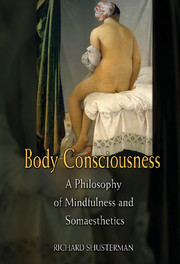
- Body ConsciousnessA Philosophy of Mindfulness and Somaesthetics, pp. 15 - 48Publisher: Cambridge University PressPrint publication year: 2008
Accessibility standard: Unknown
Why this information is here
This section outlines the accessibility features of this content - including support for screen readers, full keyboard navigation and high-contrast display options. This may not be relevant for you.Accessibility Information
Accessibility compliance for the PDF of this chapter is currently unknown
and may be updated in the future.