Book contents
- Frontmatter
- Contents
- List of figures
- List of tables
- Transcription conventions
- Preface and acknowledgments
- Chapter 1 Culture, communication and interaction
- Chapter 2 Direct and indirect messages: The role of social context identified by Grice and Searle
- Chapter 3 Politeness and face
- Chapter 4 Speech acts and politeness across cultures
- Chapter 5 The analysis of conversation
- Chapter 6 Power relations and stereotyping
- Chapter 7 Naming and addressing: Expressing deference, respect, and solidarity
- Chapter 8 Cultural differences in writing
- Chapter 9 Interpreting and translating
- Chapter 10 Intercultural communication issues in professional and workplace contexts
- Chapter 11 Towards successful intercultural communication
- References
- Index
- References
This chapter is part of a book that is no longer available to purchase from Cambridge Core
References

Book contents
- Frontmatter
- Contents
- List of figures
- List of tables
- Transcription conventions
- Preface and acknowledgments
- Chapter 1 Culture, communication and interaction
- Chapter 2 Direct and indirect messages: The role of social context identified by Grice and Searle
- Chapter 3 Politeness and face
- Chapter 4 Speech acts and politeness across cultures
- Chapter 5 The analysis of conversation
- Chapter 6 Power relations and stereotyping
- Chapter 7 Naming and addressing: Expressing deference, respect, and solidarity
- Chapter 8 Cultural differences in writing
- Chapter 9 Interpreting and translating
- Chapter 10 Intercultural communication issues in professional and workplace contexts
- Chapter 11 Towards successful intercultural communication
- References
- Index
- References
Summary
A summary is not available for this content so a preview has been provided. Please use the Get access link above for information on how to access this content.
Information
- Type
- Chapter
- Information
- Communication Across CulturesMutual Understanding in a Global World, pp. 181 - 192Publisher: Cambridge University PressPrint publication year: 2007
References
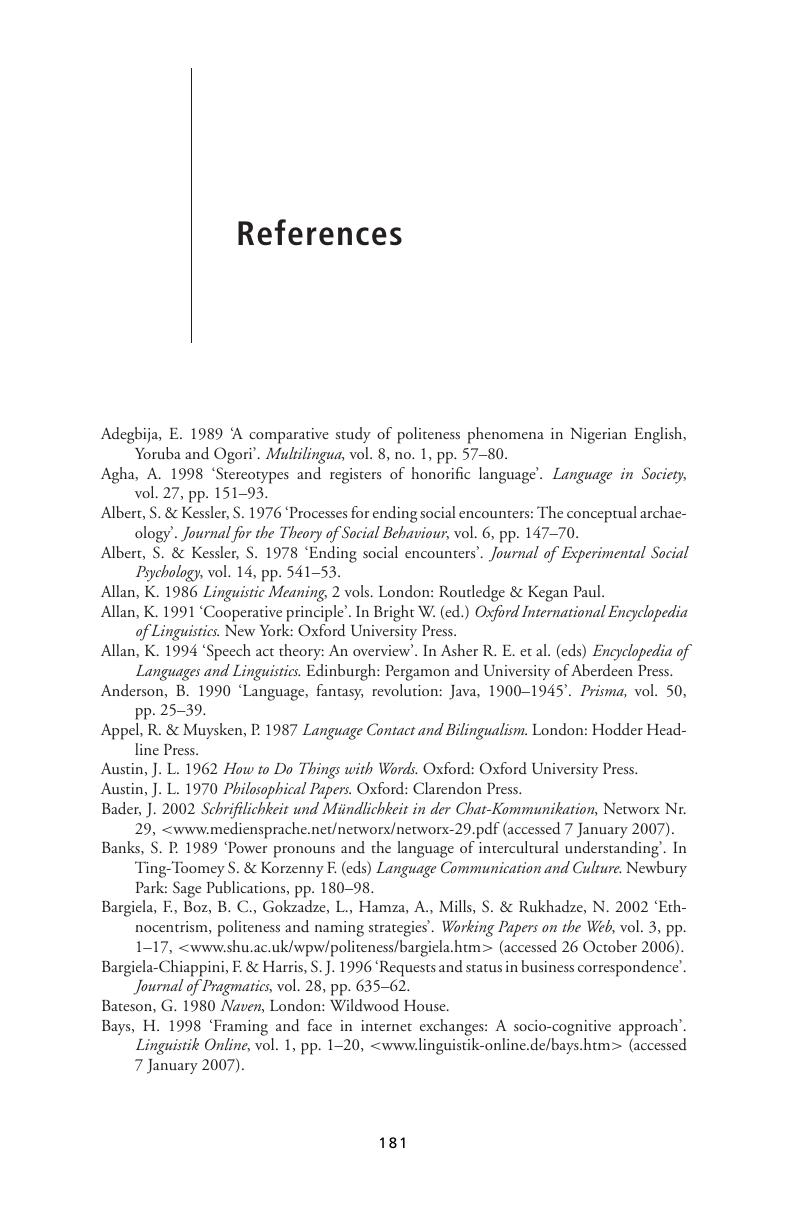
1989 ‘A comparative study of politeness phenomena in Nigerian English, Yoruba and Ogori’. Multilingua, vol. 8, no. 1, pp. 57–80.CrossRefGoogle Scholar
1998 ‘Stereotypes and registers of honorific language’. Language in Society, vol. 27, pp. 151–93.CrossRefGoogle Scholar
& 1976 ‘Processes for ending social encounters: The conceptual archaeology’. Journal for the Theory of Social Behaviour, vol. 6, pp. 147–70.CrossRefGoogle Scholar
& 1978 ‘Ending social encounters’. Journal of Experimental Social Psychology, vol. 14, pp. 541–53.CrossRefGoogle Scholar
Allan, K. 1991 ‘Cooperative principle’. In (ed.) Oxford International Encyclopedia of Linguistics. New York: Oxford University Press.Google Scholar
Allan, K. 1994 ‘Speech act theory: An overview’. In et al. (eds) Encyclopedia of Languages and Linguistics. Edinburgh: Pergamon and University of Aberdeen Press.Google Scholar
Bader, J. 2002 Schriftlichkeit und Mündlichkeit in der Chat-Kommunikation, Networx Nr. 29, <www.mediensprache.net/networx/networx-29.pdf (accessed 7 January 2007).
Banks, S. P. 1989 ‘Power pronouns and the language of intercultural understanding’. In & (eds) Language Communication and Culture. Newbury Park: Sage Publications, pp. 180–98.Google Scholar
, , , , & 2002 ‘Ethnocentrism, politeness and naming strategies’. Working Papers on the Web, vol. 3, pp. 1–17, <www.shu.ac.uk_wpw_politeness_bargiela.htm> (accessed 26 October 2006).Google Scholar
& 1996 ‘Requests and status in business correspondence’. Journal of Pragmatics, vol. 28, pp. 635–62.CrossRefGoogle Scholar
1998 ‘Framing and face in internet exchanges: A socio-cognitive approach’. Linguistik Online, vol. 1, pp. 1–20, <www.linguistik-online.de/bays.htm> (accessed 7 January 2007).Google Scholar
1990 ‘It's all in the asking: A perspective on problems of cross-cultural communication between native speakers of French and native speakers of Australian English in the workplace’. Australian Review of Applied Linguistics, Series S, vol. 7, pp. 16–32.CrossRefGoogle Scholar
1992 ‘Did you have a good weekend? Or why is there no such thing as a simple question in cross-cultural encounters?’ Australian Review of Applied Linguistics, vol. 15, no. 1, pp. 23–52.CrossRefGoogle Scholar
1990 ‘And so Nobby called to Smudger … nicknames associated with individual surnames’. Lore and Language, vol. 9, no. 1, pp. 3–18.Google Scholar
Bialystok, E. 1993 ‘Symbolic representation and attentional control in pragmatic competence’. In & (eds) Interlanguage Pragmatics. Oxford: Oxford University Press, pp. 43–63.Google Scholar
1987 ‘Indirectness and politeness in requests: Same or different?’ Journal of Pragmatics, vol. 11, pp. 131–46.CrossRefGoogle Scholar
Blum-Kulka, S. 1989 ‘Playing it safe: The role of conventionality in indirectness’. In , & (eds) Cross-cultural Pragmatics: Requests and Apologies. Norwood, New Jersey: Ablex, pp. 27–70.Google Scholar
1990 ‘You don't touch lettuce with your fingers: Parental politeness in family discourse’. Journal of Pragmatics, vol. 14, pp. 259–88.CrossRefGoogle Scholar
Blum-Kulka, S. 1992 ‘The metapragmatics of politeness in Israeli society’. In , & (eds) Politeness in Language: Studies in Its History, Theory and Practice. Berlin: Mouton de Gruyter, pp. 255–80.Google Scholar
Blum-Kulka, S. & House, J. 1989 ‘Cross-cultural and situational variation in requesting behavior’. In , & (eds) Cross-cultural Pragmatics: Requests and Apologies. Norwood, New Jersey: Ablex, pp. 123–54.Google Scholar
, & (eds) 1989 Cross-cultural Pragmatics: Requests and Apologies. Norwood, New Jersey: Ablex.Google Scholar
Blum-Kulka, S. & Katriel, T. 1991 ‘Nicknaming practices in families: A cross-cultural perspective’. In & (eds) Cross-Cultural Interpersonal Communication. Newbury Park: Sage Publications, pp. 58–78.
& 1984 ‘Requests and apologies: A cross-cultural study of speech act realisation patterns’. Applied Linguistics, vol. 5, no. 3.CrossRefGoogle Scholar
Bowe, H. 1994 ‘Developing successful communication with recently arrived migrants in industry’. Research Report submitted to DEET National Priority Reserve Fund.
Bowe, H. 1995 ‘The elaboration of repetition as a creative discourse strategy in the multilingual workforce’. Paper read at the Australian Linguistics Conference, Canberra.
Bowe, H. & Zhang, M. 2001 ‘Travel agency advertisements in Chinese newspapers’. Lecture notes provided as part of LIN3160 International Cultural Interaction, Monash University, Berwick.
Braun, F. 1988 Terms of address: Problems of Patterns and Usage in Various Languages and Cultures. Mouton de Gruyter, Berlin.
Brown, P. 1998 ‘How and why are women more polite: Some evidence from a Mayan community’. In (ed.) Language and Gender: A Reader. London: Blackwell Publishers.Google Scholar
& 1961 ‘Address in American English’. Journal of Abnormal and Social Psychology, vol. 67, pp. 375–85.CrossRefGoogle Scholar
Brown, R. & Gilman, A. 1960 ‘The pronouns of power and solidarity’. In (ed.) Style in Language. New York: Technology Press of MIT.Google Scholar
Brown, P. & Levinson, S. 1978 ‘Universals in language usage: Politeness phenomena’. In (ed.) Questions and Politeness. Cambridge: Cambridge University Press, pp. 56–289.Google Scholar
& 1987 Politeness: Some Universals in Language Usage. Cambridge: Cambridge University Press.CrossRefGoogle Scholar
Cameron, J. 1996 Titanic: A Screenplay. Twentieth Century Fox.
Clyne, M. 1983 ‘Communicative competences in contact’. In (ed.) Readings in English as an International Language. Oxford: Pergamon, pp. 147–63.Google Scholar
1987 ‘Cultural differences in the organisation of academic discourse’. Journal of Pragmatics, vol. 11, pp. 211–47.CrossRefGoogle Scholar
Clyne, M. 1991a ‘Trying to do things with letters: Letters of request and complaint in the university domain’. In Linguistics in the Service of Society: Essays in Honour of Susan Kaldor. Institute of Applied Language Studies, Perth: Edith Cowan University.
Clyne, M. 1991b ‘The sociocultural dimension: The dilemma of the German-speaking scholar’. In (ed.) Subject-oriented Texts,Berlin: Mouton de Gruyter, pp. 49–67.CrossRef
1994 Inter-cultural Communication at Work: Cultural Values in Discourse. Cambridge: Cambridge University Press.Google Scholar
, & 2003 ‘Communicative styles in a contact situation: Two German national varieties in a third country’. Journal of Germanic Linguistics, vol. 15, no. 2, pp. 95–154.CrossRefGoogle Scholar
Clyne, M. & Kreutz, H. 1987 ‘The nature and function of digression and other discourse structure phenomena in German academic writings’. Working Papers. In Migrant and Intercultural Studies 8.
Clyne, M. & Platt, J. 1990 ‘The role of language in cross-cultural communication’. In Proceedings of the Conference on Cross-Cultural Communication in the Health Profession. National Centre for Community Languages in the Professions, Melbourne: Monash University, pp. 38–55.
& 1981 ‘Developing a measure of sociocultural competence: The case of apology’. Language Learning, vol. 31, no. 1, pp. 113–34.CrossRefGoogle Scholar
Connor, U. 2003 ‘Changing currents in contrastive rhetoric: Implications for teaching and research’ In (ed.) Exploring Dynamics of Language Writing. New York: Cambridge University Press, pp. 218–41.Google Scholar
1990 ‘Spanish speakers apologizing in English: A cross-cultural pragmatic study’. Australian Review of Applied Linguistics, vol. 14, pp. 115–38.CrossRefGoogle Scholar
1991 ‘Apologizing in Chilean Spanish and Australian English: A cross-cultural perspective’. Australian Review of Applied Linguistics, Series S, vol. 7, pp. 66–92.CrossRefGoogle Scholar
Coupland, N., Coupland, J., Giles, H. & Henwood, K. 1988 ‘Accommodating the elderly: Invoking and extending a theory’. Language in Society, vol. 17.
Davidson, A. I. 1986 ‘Archaeology, genealogy and ethics’. In (ed.) Foucault: A Critical Reader. Oxford: Basil Blackwell, pp. 221–33.Google Scholar
2000 ‘The interpreter as institutional gatekeeper: The social-linguistic role of interpreters in Spanish–English medical discourse’. Journal of Sociolinguistics, vol. 4, no. 3, pp. 379–405.CrossRefGoogle Scholar
1988 Korean Etiquette and Ethics in Business. Lincolnwood, Illinois: NTC Business Books.Google Scholar
1989 Chinese Etiquette and Ethics in Business. Lincolnwood, Illinois: NTC Business Books.Google Scholar
Descartes, R. ‘La Recherche de la vérité’. In Oeuvres Complètes.
1973 ‘Towards a grammar for dyadic conversation’. Semiotica, vol. 9, pp. 29–46.CrossRefGoogle Scholar
1974 ‘On the structure of speaker interaction during speaking turns’. Language in Society, vol. 2, pp. 161–80.CrossRefGoogle Scholar
2000 ‘I don't think it's an answer to the question: Silencing Aboriginal witnesses in court’. Language in Society, vol. 29, pp. 161–95.CrossRefGoogle Scholar
Eggington, W. 1987 ‘Written academic discourse in Korean’. In & Writing Across Cultures. Reading, Massachusetts: Addison-Wesley, pp. 153–68.Google Scholar
Ehlich, K. 1992 ‘On the historicity of politeness’. In , & (eds) Politeness in Language. Berlin: Mouton de Gruyter, pp. 71–107.Google Scholar
& 2001 ‘Perceived in-group and out-group stereotypes among Brazilian foreign language students’. International Journal of Applied Linguistics, vol. 11, no. 2, pp. 224–37.CrossRefGoogle Scholar
1998 ‘The management of politeness in Japanese tour guiding discourse’. Japanese Studies, vol. 18, no. 3, pp. 295–310.CrossRefGoogle Scholar
1985 Language and Social Change in Java: Linguistic Reflexes of Modernisation in a Traditional Royal Polity. Ohio: Ohio University Press.Google Scholar
Ervin-Tripp, S. M. 1972 ‘Sociolinguistic rules of address’. In & (eds) Sociolinguistics. Harmondsworth: Penguin.Google Scholar
Fairclough, N. & Wodak, R. 1997 ‘Critical discourse analysis’. In (ed.) Discourse as Social Interaction. London: Sage Publications, pp. 258–84.Google Scholar
1976 ‘The structure and use of politeness formulas’. Language in Society, vol. 5, pp. 137–51.CrossRefGoogle Scholar
1992 ‘The interactive achievement of a sentence: Joint productions in therapeutic discourse’. Discourse Processes, vol. 15, pp. 207–28.CrossRefGoogle Scholar
1963 (1973) The Birth of the Clinic: An Archaeology of Medical Perception. New York: Vintage Books.CrossRefGoogle Scholar
1978 The History of Sexuality: Volume 1: An Introduction. Hurley R. (trans.), Harmondsworth: Penguin Books.Google Scholar
1980 Power/Knowledge: Selected Interviews and Other Writings, 1972–1977. New York: Pantheon.Google Scholar
Fraser, B. 1975 The concept of politeness. Paper presented at the NWAVE Meeting. Georgetown University.
1990 ‘Perspectives on politeness’. Journal of Pragmatics, vol. 14, pp. 219–36.CrossRefGoogle Scholar
& 1981 ‘The association of deference with linguistic form’. International Journal of the Sociology of Language, vol. 27, pp. 93–109.Google Scholar
Gallois, C., Franklyn-Stokes, A., Giles, H. & Coupland, N. 1988 ‘Communication accommodation in intercultural encounters’. In & Theories in Intercultural Communication. Newbury Park: Sage Publications, pp. 157–85.Google Scholar
1995 ‘Turn-initial versus turn-final laughter: Two techniques for initial remedy in English/Italian bookshop service encounters’. Discourse Processes, vol. 19, pp. 369–84.CrossRefGoogle Scholar
Geertz, C. 1976 ‘Linguistic etiquette’. In & (eds) Sociolinguistics. New Hampshire: Penguin Books, pp. 167–79.Google Scholar
Gentile, A. 1991 ‘Working with professional interpreters’. In (ed.) Cross-cultural Communication in Medical Encounters. Community Languages in the Professions Unit, Language and Society Centre NLIA, Melbourne: Monash University, pp. 26–48.Google Scholar
& 1990 (eds) Handbook of Language and Social Psychology. Chichester: John Wiley & Sons.Google Scholar
(ed.) 1983 Topic and Continuity in Discourse: A Quantitative Cross-language Study. Amsterdam: Benjamins.CrossRefGoogle Scholar
1989 ‘Issues in natural semantic metalanguage’. Quaderni di Semantica, vol. 10, no. 1, pp. 51–64 (Round table on Semantic Primitives, 1).Google Scholar
2005 ‘The lexical semantics of culture’. Language Sciences, no. 27, pp. 51–73.CrossRefGoogle Scholar
1977 ‘Same setting, different norms: Phone call beginnings in France and in the United States’. Language in Society, vol. 6, pp. 209–19.CrossRefGoogle Scholar
1955 ‘On facework: An analysis of ritual elements in social interaction’. Psychiatry, vol. 18, pp. 213–31.CrossRefGoogle Scholar
1998 ‘Discriminatory language in Japan: Burakumin, the disabled and women’. Asian Studies Review, vol. 22, no. 2, pp. 157–73.CrossRefGoogle Scholar
Gottlieb, N. 2006 Book review: Fushimi, N., Matsuzawa, K., Kurokawa, N., Yamanaka, T., Oikawa, K., Noguchi, K. 2002, ‘Okama’ wa sabetsu ka: ‘Shūkan Kinyōbi no Sabetsu Hyōgen Jiken [Does ‘okama’ have discriminatory connotations? The discriminating expression case in the weekly magazine Shūkan Kinyōbi] Intersections: Gender, History and Culture in the Asian Context, issue 12, January <http://wwwsshe.murdoch.edu.au/intersections/issue12/gotlieb_review.html>
Grice, H. P. 1975 ‘Logic and conversation’. In & (eds) Syntax and Semantics 3: Speech Acts. New York: Academic Press.Google Scholar
1990 ‘Politeness phenomena in modern Chinese’. Journal of Pragmatics, vol. 14, pp. 237–57.CrossRefGoogle Scholar
Gumperz, J. 1992 ‘Interviewing in intercultural situations’. In & (eds) Talk at Work. Cambridge: Cambridge University Press, pp. 302–27.Google Scholar
1992 ‘Translation is not enough: Interpreting in a medical setting in “Cross cultural medicine – a decade later”’. Special issue, Western Journal of Medicine, vol. 157, pp. 255–9.Google Scholar
1990 ‘Shame and shyness in the Aboriginal classroom: A case for practical semantics’. Australian Journal of Linguistics, vol. 10, pp. 293–306.CrossRefGoogle Scholar
1990 ‘Sex based differences in compliment behaviour’. Language in Society, vol. 19, pp. 201–24.CrossRefGoogle Scholar
1995 ‘The sociolinguistics of personal names: Two South African case studies’. South African Journal of African Languages, vol. 15, no. 1, pp. 1–8.Google Scholar
& 2003 ‘Der Chat als Textsorte und/oder als Dialogsorte?’ Linguistik online, vol. 13, no. 1, pp. 161–80 <www.linguistik-online.de/13_01/hessLuettichWilde.pdf> (accessed 26 October 2006).Google Scholar
2005 The Language of Police Interviewing : A Critical Analysis. New York: Palgrave Macmillan.CrossRefGoogle Scholar
, , , & 1986 ‘Universals of linguistic politeness’. Journal of Pragmatics, vol. 10, pp. 347–71.CrossRefGoogle Scholar
1980 ‘Japanese expository prose’. Papers in Linguistics: International Journal of Human Cognition, vol. 131, no. 1, pp. 117–58.CrossRefGoogle Scholar
1983b ‘Contrastive studies of English and Japanese’. Annual Review of Applied Linguistics, vol. 3, pp. 78–84.CrossRefGoogle Scholar
2003 ‘The medium is the message: Politeness strategies in men's and women's voice mail messages’. Journal of Pragmatics, vol. 35, pp. 243–62.CrossRefGoogle Scholar
1980 Culture's consequences: International differences in work-related values. Beverly Hills, California: Sage Publications.Google Scholar
Hofstede, G. 1983 ‘Dimensions of national cultures in fifty countries and three regions’. In & et al. (eds) Explications in Cross-cultural Psychology. Netherlands: Swets & Zeitlinger, pp. 335–55.Google Scholar
1998 ‘Think locally, act globally: Cultural constraints in personnel management’. Management International Review, Special issue, vol. 38, no. 2, pp. 7–26.Google Scholar
& 1984 ‘Hofstede's cultural dimensions’. Journal of Cross-Cultural Psychology, vol. 15, pp. 417–33.CrossRefGoogle Scholar
& 1988 Social Identifications: A Social Psychology of Intergroup Relations and Group Processes. London: Routledge.Google Scholar
1988 ‘Paying compliments: A sex-preferential politeness strategy’. Journal of Pragmatics, vol. 12, pp. 445–65.CrossRefGoogle Scholar
Holmes, J. 1998 ‘Women's talk: The question of sociolinguistic universals’. In (ed.) Language and Gender: A Reader. London: Blackwell Publishers.Google Scholar
House, J. & Kasper, G. 1981 ‘Politeness markers in English and German’. In (ed.) Conversational Routines. The Hague: Mouton, pp. 157–85.Google Scholar
2001 ‘The social use of personal names among the Kyrgyz’. Contemporary South Asia, vol. 20, no. 1, pp. 85–95.Google Scholar
1989 ‘Formal forms and discernment: Two neglected aspects of universals of linguistic politeness’. Multilingua, vol. 8, nos 2/3, pp. 223–38.CrossRefGoogle Scholar
Ide, S. 1990 ‘How and why do women speak more politely in Japanese?’ In & (eds) Aspects of Japanese Women's Language. Tokyo: Kuroshio Publishers, pp. 63–79.Google Scholar
Ide, S., Hill, B., Carnes, Y. M., Ogino, T. & Kawasaki, A. 1992 ‘The concept of politeness: An empirical study of American English and Japanese’. In , & (eds) Politeness in Language. Berlin: Mouton de Gruyter, pp. 281–93.Google Scholar
Janney, R. W. & Arndt, H. 1992 ‘Intracultural tact versus intercultural tact’. In , & (eds) Politeness in Language. Berlin: Mouton de Gruyter, pp. 21–41.Google Scholar
1998 ‘Relevance theory and the communication of politeness’. Journal of Pragmatics, vol. 30, no. 1, pp. 1–19.CrossRefGoogle Scholar
& 1992 ‘Complimenting and involvement in peer review: Gender variation’. Language in Society, vol. 21, pp. 27–57.CrossRefGoogle Scholar
Kachru, Y. 1988 ‘Writers in Hindi and English’. In (ed.) Writing Across Languages and Cultures. Newbury Park: Sage Publications, 109–37.Google Scholar
1998 ‘The concept of face and its applicability to the Zulu language’. Journal of Pragmatics, vol. 29, pp. 173–91.CrossRefGoogle Scholar
& 1976 ‘Japanese whimperatives’. Papers in Japanese Linguistics, vol. 4, pp. 13–53.CrossRefGoogle Scholar
Kaplan, R. B. 1972 ‘Cultural thought patterns in inter-cultural education’. In (ed.) Readings in English as a Second Language. Cambridge, Massachusetts: Winthrop, 246–62.Google Scholar
Kaplan, R. B. 1988 ‘Contrastive rhetoric and second language learning: Notes toward a theory of contrastive rhetoric’. In (ed.) Writing Across Languages and Cultures. Newbury Park: Sage Publications, pp. 275–304.Google Scholar
Kasher, A. 1986 ‘Politeness and rationality’. In & (eds) Pragmatics and Linguistics: Festchrift for Jacob Mey. Odense: Odense University Press, pp. 103–14.
1986 ‘Talking straight: Dugri speech in Israeli Sabra culture’. Cambridge: Cambridge University Press.Google Scholar
1991 ‘Information sequencing in Mandarin letters of request’. Anthropological Linguistics, vol. 33, no. 2, pp. 183–203.Google Scholar
1998 ‘The organization of discourse units in Mexican and Danish business negotiations’. Journal of Pragmatics, vol. 30, pp. 347–62.CrossRefGoogle Scholar
& 1997 ‘The sound patterns of English surnames’. Language Sciences, vol. 19, no. 4, pp. 289–301.CrossRefGoogle Scholar
, , & 1973 ‘The rhetoric of goodbye: Verbal and nonverbal correlates of human leave-taking’. Speech Monographs, vol. 40, pp. 182–98.CrossRefGoogle Scholar
1992 Japan: A Handbook in Intercultural Communication. Sydney: Macquarie University Press.Google Scholar
Kretzenbacher, H. L. 2005 ‘Hier im großen internetz, wo sich alle dududuzen’, Internet discourse politeness and German address. Paper given at the Third International Conference on Language Variation in Europe (IClaVE), Amsterdam, pp. 1–15.
Lakoff, R. 1973 ‘The logic of politeness: Or, p's and q's’. In Corum C. et al. (eds) Papers from the Ninth Regional Meeting of the Chicago Linguistic Society. Chicago Linguistic Society, pp. 292–305.
Lakoff, R. 1979 ‘Stylistic strategies within a grammar of style’. In Orasanu J. et al. (eds) Language Sex and Gender. Annals of the New York Academy of Sciences, pp. 53–80.
1989 ‘The limits of politeness: Therapeutic and courtroom discourse’. Multilingua, vol. 8, pp. 101–29.CrossRefGoogle Scholar
2001 Bilingual women and terms of address, Unpublished honours dissertation, Linguistics Department. Melbourne: Monash University.Google Scholar
1984 Meaning-based Translation: A Guide to Cross-Language Equivalence. Lanham, Maryland: University Press of America.Google Scholar
1976 Japanese Culture and Behaviour: Selected Readings, rev. edn. Honolulu: University Press of Hawaii.Google Scholar
1994a ‘Imperatives in requests: Direct or impolite, observations from Chinese’. Journal of Pragmatics, vol. 4, pp. 491–515.CrossRefGoogle Scholar
1994b ‘Qing/Please: A polite or requestive marker? Observations from Chinese’. Multilingua, vol. 13, no. 4, pp. 343–60.Google Scholar
Leibnitz, G. W. 1903 ‘De organo sive arte magna gogitanti’. In Opuscules et Fragments Inédits (ed.) L. Couturat, Paris.
1991 ‘On the syntax of sentences-in-progress’. Language in Society, vol. 20, pp. 441–58.CrossRefGoogle Scholar
Levinson, S. C. 1985 ‘What's special about conversational inference?’ Paper presented to the British Psychological Society Annual Meeting, Swansea, April 1985.
1994 ‘Beyond politeness theory: “Face” revisited and renewed’. Journal of Pragmatics, vol. 21, pp. 451–86.CrossRefGoogle Scholar
1990 ‘Intercultural business negotiations: The problem of norm discrepancy’. Australian Review of Applied Linguistics, Series S, vol. 7, pp. 33–65.CrossRefGoogle Scholar
1988 ‘Reexamination of the universality of face: Politeness phenomena in Japanese’. Journal of Pragmatics, vol. 12, pp. 403–26.CrossRefGoogle Scholar
1989 ‘Politeness and Conversational Universals: Observations from Japanese’. Multilingua, vol. 8, pp. 207–21.CrossRefGoogle Scholar
1995a ‘Defining politeness: Universality in appropriateness’. Language Sciences, vol. 17, no. 4, pp. 345–56.CrossRefGoogle Scholar
2002 ‘The address system in the Spanish of the Golden Age’. Journal of Pragmatics, vol. 34, no. 1, pp. 15–47.CrossRefGoogle Scholar
, & 1979 Nicknames: Their Origins and Social Consequences. London: Routledge & Kegan Paul.Google Scholar
1996 Linguistic Ecology: Language Change and Linguistic Imperialism in the Pacific Region. London: Routledge.CrossRefGoogle Scholar
2001 Introducing Translation Studies: Theories and Applications. London and New York: Routledge.Google Scholar
Murillo, A. 1989 ‘Do translated ads sell?’ Coming of Age, 30th Annual Conference ATA, Washington DC (eds) Hammond D. & Medford N. J. New Jersey: Learned Information.
NAATI (National Accreditation Authority for Translators and Interpreters) 2003 NAATI Information Booklet.
NAATI <www.naati.com.au> (accessed 26 October 2006)
Neil, D. 1996 Collaboration in Intercultural Discourse: Examples from a Multicultural Workplace. Frankfurt am Main: Peter Lang.
Neustypný, J. V. 1985 ‘Language norms in Australian–Japanese contact situations’. In (ed.) Australia, Meeting Place of Languages. Canberra: Pacific Linguistics, pp. 161–70.Google Scholar
1991 ‘Barriers to communication between Vietnamese and non-Vietnamese’. Journal of Vietnamese Studies, vol. 1, no. 4, pp. 40–5.Google Scholar
Nguyen, D. 1993 ‘Interpreting and translating in Australia’. Digest of Australian Language and Literacy, Issue no. 1, August, Canberra: National Languages and Literacy Institute of Australia.
2001 ‘Contrastive rhetoric in expository prose: Approaches and achievements’. Journal of Pragmatics, vol. 33, no. 2, pp. 255–69.CrossRefGoogle Scholar
Ochs, E. 1992 ‘Indexing gender’. In & (eds) Rethinking Context: Language as an Interactive Phenomenon. Cambridge: Cambridge University Press.Google Scholar
& 2002 Translation-Mediated Communication in a Digital World. Clevedon, UK: Multilingual Matters.Google Scholar
2003 ‘Breaking conversational norms on a Portuguese users network: Men as adjudicators of politeness?’ Journal of Computer-Mediated Communication, vol. 9, no. 1, p. 22 <http:((jcmc.indiana.edu/vol9/issue1/oliveira.html> (accessed 26 October 2006).Google Scholar
Olshtain, E. & Cohen, A. 1983 ‘Apology: A speech-act set’. In & (eds) Sociolinguistics and Language Acquisition. Rowley, Massachusetts: Newbury House, pp. 18–36.Google Scholar
Ostler, S. 1987 ‘English in parallels: A comparison of English and Arabic prose’. In & (eds) Writing Across Cultures. Reading, Massachusetts: Addison-Wesley, pp. 169–85.Google Scholar
1983 ‘Contrastive studies of English and Marathi’. Annual Review of Applied Linguistics, vol. 3, pp. 118–36.CrossRefGoogle Scholar
Pauwels, A., D'Argaville, M. & Eades, D. 1992 ‘Problems and issues of cross-cultural communication in legal settings’. In (ed.) Cross-cultural Communication in Legal Settings. Language and Society Centre, National Languages and Literacy Institute of Australia, Melbourne: Monash University, pp. 77–105.Google Scholar
Pavlidou, T. 1991 ‘Universality and relativity in cross-cultural politeness research’. Paper delivered at the International Conference on Contrastive Linguistics, Innsbruck, Austria, May 1991.
2001 Critical Applied Linguistics: A Critical Introduction. London: Lawrence Erlbaum Associates.Google Scholar
Pilkington, J. 1998 ‘Don't try and make out that I'm nice! The different strategies women and men use when gossiping’. In (ed.) Language and Gender: A Reader. London: Blackwell Publishers.Google Scholar
Poynton, C. 1989 ‘Terms of address in Australian English’. In & (eds) Autralian English. Australia: University of Queensland Press, pp. 53–69.Google Scholar
1998 ‘A cross-cultural comparison of letters of recommendation’. English for Specific Purposes, vol. 17, no. 3, pp. 241–65.CrossRefGoogle Scholar
2004 The Moving Text: Localization, Translation, and Distribution. Amsterdam: John Benjamins.CrossRefGoogle Scholar
2004 ‘Propositions on cross-cultural communication and translation’. Target: International Journal of Translation Studies, vol. 16, no. 1, pp. 1–28.CrossRefGoogle Scholar
& 1983 ‘Language transfer and conversational competence’. Applied Linguistics, vol. 4, pp. 113–25.CrossRefGoogle Scholar
1983 Big Business Blunders: Mistakes in Multinational Marketing. Homewood, Illinois: Dow-Jones Irwin.Google Scholar
Rumelhart, D. E., Smolensky, P., McClelland, J. L. & Hinton, G. E. 1986 ‘Schemata and sequential thought processes in PDP models’. In , & the PDP Research Group (eds) Parallel Distributed Processing: Explorations in the Microstructure of Cognition, Vol. 2, Psychological and Biological Models. Cambridge, Massachusetts: MIT Press, pp. 7–57.Google Scholar
1993 Mapping the Invisible Landscape: Folklore, Writing, and the Sense of Place. Iowa City: University of Iowa Press.CrossRefGoogle Scholar
1967–8 Lectures on Conversation, 2 vols (ed. G. Jefferson 1992). Cambridge, Massachusetts: Blackwell Publishers.Google Scholar
, & 1974 ‘A simplest systematic for the organization of turn-taking in conversations’. Language, vol. 59, pp. 941–2.Google Scholar
1996 ‘Conflation of institutional and cultural stereotyping in Asian migrants’ discourse'. Discourse & Society, vol. 7, pp. 359–87.CrossRefGoogle Scholar
& (eds) 1999 Talk, Work and Institutional Order: Discourse in Medical, Mediation and Management Settings. Berlin: Mouton de Gruyter.CrossRefGoogle Scholar
Schegloff, E. A. 1968 ‘Sequencing in conversational openings’. In & (eds) Directions in Sociolinguistics: The Ethnography of Communication. New York: Holt, Rinehart & Winston, pp. 346–80.Google Scholar
Schegloff, E. A. 1982 ‘Discourse as an interactional achievement: Some uses of “Uh huh” and other things that come between sentences’. In (ed.) Analyzing Discourse: Text and Talk. Georgetown University Round Table in Languages and Linguistics 1981, Washington DC: Georgetown University Press.Google Scholar
1997 ‘Convergent methodologies in cyber-psychology: A case study, Behavior Research Methods’. Instruments and Computers, vol. 29, no. 2, pp. 270–3.CrossRefGoogle Scholar
Schulze, M. 1999 ‘Substitution of paraverbal and nonverbal cues in the written medium of IRC’. In Naumann B. (ed.) Dialogue Analysis and the Mass Media. Proceedings of the International Conference in Erlangen, April 2–3, 1998, Niemeyer (Beiträge zur Dialogforschung 20), Tübingen, pp. 65–82.
Searle, J. R. 1975 ‘Indirect speech acts’. In & (eds) Syntax and Semantics 3 (Speech Acts). New York: Academic Press.Google Scholar
1979 Expression and Meaning: Studies in the Theory of Speech Acts. Cambridge: Cambridge University Press.Google Scholar
2003 ‘On cultural conceptualizations’. Journal of Cognition and Culture, vol. 3, no. 3, pp. 188–207.CrossRefGoogle Scholar
Sharifian, F. 2004 ‘Cultural schemas and intercultural communication: A study of Persian’. In & Outer Limits: A Reader in Communication Across Cultures. Melbourne: Language Australia, pp. 119–30.Google Scholar
2005 ‘The Persian cultural schema of shekasteh-nafsi: A study of complement responses in Persian and Anglo–Australian speakers’. Pragmatics and Cognition, vol. 13, no. 2, pp. 337–61.CrossRefGoogle Scholar
Sharifian, F. (forthcoming) ‘Distributed, emergent cultural cognition, conceptualisation and language’. In , , & (eds) Body, Language and Mind (Vol. 2): Sociocultural Situatedness. Berlin/New York: Mouton de Gruyter.
1989 ‘On the telephone again! Differences in telephone behaviour: England versus Greece’. Language in Society, vol. 18, pp. 527–44.CrossRefGoogle Scholar
1992 ‘Women in change: Politeness and directives in the speech of Japanese women’. Language in Society, vol. 21, pp. 59–82.CrossRefGoogle Scholar
1983 Japanese Society: Tradition, Self, and the Social Order. Cambridge: Cambridge University Press.Google Scholar
& 2003 ‘Managing rapport in intercultural business interactions: A comparison of two Chinese–British welcome meetings’. Journal of Intercultural Studies, vol. 24, no. 1, pp. 33–46.CrossRefGoogle Scholar
Sperber, D. & Hirschfeld, L. 1999 ‘Culture, cognition and evolution’. In & (eds) MIT Encyclopedia of the Cognitive Sciences. Cambridge, Massachusetts: MIT Press, pp. cxi–cxxxii.Google Scholar
& 1996 ‘Women's surnames and titles: Men's and women's views’. Communication Research Papers, vol. 13, no. 2, pp. 214–24.Google Scholar
1998 ‘Norms of apology depicted in U.S. American and Japanese literature on manners and etiquette’. International Journal of Intercultural Relations, vol. 22, no. 3, pp. 251–76.CrossRefGoogle Scholar
1999 ‘Apologizing in English, Polish and Hungarian: Different languages, different strategies’. Journal of Pragmatics, vol. 31, pp. 1053–65.CrossRefGoogle Scholar
1976 ‘Language and behavior in Japan: The conceptualization of personal relations’. Japan Quarterly, vol. 23, no. 3, pp. 255–66.Google Scholar
1982 ‘Social identity and intergroup relations’. Cambridge: Cambridge University Press.Google Scholar
Takahashi, T. & Beebe, L. M. 1993 ‘Cross-linguistic influence in the speech act of correction’. In & (eds) Interlanguage Pragmatics. Oxford: Oxford University Press, pp. 138–57.Google Scholar
1981 ‘Indirectness in discourse: Ethnicity as conversational style’. Discourse Processes, vol. 4, pp. 221–38.CrossRefGoogle Scholar
1994 Talking From 9 to 5: How Women's and Men's Conversational Styles Affect Who Gets Heard, Who Gets Credit, and What Gets Done at Work. New York: Avon Books.Google Scholar
2000 ‘Racism in the news: A critical discourse analysis of news reporting in two Australian newspapers’. Discourse & Society, vol. 11, no. 1, pp. 7–49.CrossRefGoogle Scholar
(ed.) 1994 Interlanguage Pragmatics: Requests, Complaints and Apologies (Studies in Anthropological Linguistics 7). Berlin/New York: Mouton de Gruyter.Google Scholar
1871 Primitive Culture: Researches into the Development of Mythology, Philosophy, Religion, Art, and Custom, Volume I. London: John Murray, Albemarle Street.Google Scholar
2002 Discourse Politeness in Japanese Conversation: Some Implications for a Universal Theory of Politeness. Tokyo: Hitsuji Shobo.Google Scholar
1987 Communicating Racism: Ethnic Prejudice in Thought and Talk. Newbury Park, California: Sage Publications.Google Scholar
Van Dijk, T. 1996 ‘Discourse, power and access’. In & (eds) Texts and Practices: Readings in Critical Discourse Analysis. London: Routledge, pp. 84–104.Google Scholar
1992 ‘Issues in language in international business communication’. In International Business Communication. New York: Harper Collins.Google Scholar
1991 The Politics of Medical Encounters: How Patients and Doctors Deal With Social Problems. New Haven/London: Yale University Press.Google Scholar
1989 ‘Relevance and relational work: Linguistic politeness as politic behavior’. Multilingua, vol. 8, pp. 131–66.CrossRefGoogle Scholar
, & 1992 Politeness in Language: Studies in its History, Theory and Practice. Berlin/New York: Mouton de Gruyter.Google Scholar
Weller, G. 1992 ‘Advertising: A true challenge for cross-cultural translation’. In & (eds) Translation East and West: A Cross-Cultural Approach: Selected Conference Papers. Honolulu: University of Hawaii.Google Scholar
1980 Lingua Mentalis: The Semantics of Natural Language. Sydney/New York: Academic Press.Google Scholar
1985 ‘Different cultures, different languages, different speech acts’. Journal of Pragmatics, vol. 9, pp. 145–78.CrossRefGoogle Scholar
1991 Cross-Cultural Pragmatics: The Semantics of Human Interaction. Berlin: Mouton de Gruyter.Google Scholar
Wierzbicka, A. 1994a ‘Cognitive domains and the structure of the lexicon: The case of emotions’. In & Mapping the Mind: Domain Specificity in Cognition and Culture. Cambridge: Cambridge University Press, pp. 771–97.Google Scholar
Wierzbicka, A. 1994b ‘Cultural scripts: A semantic approach to cultural analysis and cross-cultural communication’. In Pragmatics and Language Learning. & (eds) Urbana-Champaign: University of Illinois, pp. 1–24.Google Scholar
2003 Cross-cultural Pragmatics: The Semantics of Human Interaction, 2nd edn. Berlin: Mouton de Gruyter.CrossRefGoogle Scholar
& 2004 ‘Cultural scripts: What are they and what are they good for?’, Intercultural Pragmatics, vol. 1, no. 2, pp. 153–66.Google Scholar
1998 The Means of Naming: A Social and Cultural History of Personal Naming in Western Europe. London: OCL Press.CrossRefGoogle Scholar
Wittermans, E. p. 1990 ‘Indonesian terms of address in a situation of rapid social change’. Social Forces, pp. 48–51.
Young, L. W. 1983 ‘Inscrutability revisited’. In (ed), Discourse Strategies. Melbourne: Cambridge University Press, pp. 72–84.Google Scholar
1995 ‘Humorous face-threatening acts: Humour as strategy’. Journal of Pragmatics, vol. 23, pp. 325–39.Google Scholar
1981 ‘Sex and politeness: Factors in first- and second-language use’. International Journal of the Sociology of Language, vol. 27, pp. 35–58.Google Scholar
Zuengler, J. 1989 ‘Performance variation in native speaker–non native speaker interactions: Ethnolinguistic differences or discourse domain?’. In , , & (eds) Variation in Second Language Acquisition, Volume 1: Discourse and Pragmatics. Cleveland: Multilingual Matters.Google Scholar
1989 ‘A comparative study of politeness phenomena in Nigerian English, Yoruba and Ogori’. Multilingua, vol. 8, no. 1, pp. 57–80.CrossRefGoogle Scholar
1998 ‘Stereotypes and registers of honorific language’. Language in Society, vol. 27, pp. 151–93.CrossRefGoogle Scholar
& 1976 ‘Processes for ending social encounters: The conceptual archaeology’. Journal for the Theory of Social Behaviour, vol. 6, pp. 147–70.CrossRefGoogle Scholar
& 1978 ‘Ending social encounters’. Journal of Experimental Social Psychology, vol. 14, pp. 541–53.CrossRefGoogle Scholar
Allan, K. 1991 ‘Cooperative principle’. In (ed.) Oxford International Encyclopedia of Linguistics. New York: Oxford University Press.Google Scholar
Allan, K. 1994 ‘Speech act theory: An overview’. In et al. (eds) Encyclopedia of Languages and Linguistics. Edinburgh: Pergamon and University of Aberdeen Press.Google Scholar
Bader, J. 2002 Schriftlichkeit und Mündlichkeit in der Chat-Kommunikation, Networx Nr. 29, <www.mediensprache.net/networx/networx-29.pdf (accessed 7 January 2007).
Banks, S. P. 1989 ‘Power pronouns and the language of intercultural understanding’. In & (eds) Language Communication and Culture. Newbury Park: Sage Publications, pp. 180–98.Google Scholar
, , , , & 2002 ‘Ethnocentrism, politeness and naming strategies’. Working Papers on the Web, vol. 3, pp. 1–17, <www.shu.ac.uk_wpw_politeness_bargiela.htm> (accessed 26 October 2006).Google Scholar
& 1996 ‘Requests and status in business correspondence’. Journal of Pragmatics, vol. 28, pp. 635–62.CrossRefGoogle Scholar
1998 ‘Framing and face in internet exchanges: A socio-cognitive approach’. Linguistik Online, vol. 1, pp. 1–20, <www.linguistik-online.de/bays.htm> (accessed 7 January 2007).Google Scholar
1990 ‘It's all in the asking: A perspective on problems of cross-cultural communication between native speakers of French and native speakers of Australian English in the workplace’. Australian Review of Applied Linguistics, Series S, vol. 7, pp. 16–32.CrossRefGoogle Scholar
1992 ‘Did you have a good weekend? Or why is there no such thing as a simple question in cross-cultural encounters?’ Australian Review of Applied Linguistics, vol. 15, no. 1, pp. 23–52.CrossRefGoogle Scholar
1990 ‘And so Nobby called to Smudger … nicknames associated with individual surnames’. Lore and Language, vol. 9, no. 1, pp. 3–18.Google Scholar
Bialystok, E. 1993 ‘Symbolic representation and attentional control in pragmatic competence’. In & (eds) Interlanguage Pragmatics. Oxford: Oxford University Press, pp. 43–63.Google Scholar
1987 ‘Indirectness and politeness in requests: Same or different?’ Journal of Pragmatics, vol. 11, pp. 131–46.CrossRefGoogle Scholar
Blum-Kulka, S. 1989 ‘Playing it safe: The role of conventionality in indirectness’. In , & (eds) Cross-cultural Pragmatics: Requests and Apologies. Norwood, New Jersey: Ablex, pp. 27–70.Google Scholar
1990 ‘You don't touch lettuce with your fingers: Parental politeness in family discourse’. Journal of Pragmatics, vol. 14, pp. 259–88.CrossRefGoogle Scholar
Blum-Kulka, S. 1992 ‘The metapragmatics of politeness in Israeli society’. In , & (eds) Politeness in Language: Studies in Its History, Theory and Practice. Berlin: Mouton de Gruyter, pp. 255–80.Google Scholar
Blum-Kulka, S. & House, J. 1989 ‘Cross-cultural and situational variation in requesting behavior’. In , & (eds) Cross-cultural Pragmatics: Requests and Apologies. Norwood, New Jersey: Ablex, pp. 123–54.Google Scholar
, & (eds) 1989 Cross-cultural Pragmatics: Requests and Apologies. Norwood, New Jersey: Ablex.Google Scholar
Blum-Kulka, S. & Katriel, T. 1991 ‘Nicknaming practices in families: A cross-cultural perspective’. In & (eds) Cross-Cultural Interpersonal Communication. Newbury Park: Sage Publications, pp. 58–78.
& 1984 ‘Requests and apologies: A cross-cultural study of speech act realisation patterns’. Applied Linguistics, vol. 5, no. 3.CrossRefGoogle Scholar
Bowe, H. 1994 ‘Developing successful communication with recently arrived migrants in industry’. Research Report submitted to DEET National Priority Reserve Fund.
Bowe, H. 1995 ‘The elaboration of repetition as a creative discourse strategy in the multilingual workforce’. Paper read at the Australian Linguistics Conference, Canberra.
Bowe, H. & Zhang, M. 2001 ‘Travel agency advertisements in Chinese newspapers’. Lecture notes provided as part of LIN3160 International Cultural Interaction, Monash University, Berwick.
Braun, F. 1988 Terms of address: Problems of Patterns and Usage in Various Languages and Cultures. Mouton de Gruyter, Berlin.
Brown, P. 1998 ‘How and why are women more polite: Some evidence from a Mayan community’. In (ed.) Language and Gender: A Reader. London: Blackwell Publishers.Google Scholar
& 1961 ‘Address in American English’. Journal of Abnormal and Social Psychology, vol. 67, pp. 375–85.CrossRefGoogle Scholar
Brown, R. & Gilman, A. 1960 ‘The pronouns of power and solidarity’. In (ed.) Style in Language. New York: Technology Press of MIT.Google Scholar
Brown, P. & Levinson, S. 1978 ‘Universals in language usage: Politeness phenomena’. In (ed.) Questions and Politeness. Cambridge: Cambridge University Press, pp. 56–289.Google Scholar
& 1987 Politeness: Some Universals in Language Usage. Cambridge: Cambridge University Press.CrossRefGoogle Scholar
Cameron, J. 1996 Titanic: A Screenplay. Twentieth Century Fox.
Clyne, M. 1983 ‘Communicative competences in contact’. In (ed.) Readings in English as an International Language. Oxford: Pergamon, pp. 147–63.Google Scholar
1987 ‘Cultural differences in the organisation of academic discourse’. Journal of Pragmatics, vol. 11, pp. 211–47.CrossRefGoogle Scholar
Clyne, M. 1991a ‘Trying to do things with letters: Letters of request and complaint in the university domain’. In Linguistics in the Service of Society: Essays in Honour of Susan Kaldor. Institute of Applied Language Studies, Perth: Edith Cowan University.
Clyne, M. 1991b ‘The sociocultural dimension: The dilemma of the German-speaking scholar’. In (ed.) Subject-oriented Texts,Berlin: Mouton de Gruyter, pp. 49–67.CrossRef
1994 Inter-cultural Communication at Work: Cultural Values in Discourse. Cambridge: Cambridge University Press.Google Scholar
, & 2003 ‘Communicative styles in a contact situation: Two German national varieties in a third country’. Journal of Germanic Linguistics, vol. 15, no. 2, pp. 95–154.CrossRefGoogle Scholar
Clyne, M. & Kreutz, H. 1987 ‘The nature and function of digression and other discourse structure phenomena in German academic writings’. Working Papers. In Migrant and Intercultural Studies 8.
Clyne, M. & Platt, J. 1990 ‘The role of language in cross-cultural communication’. In Proceedings of the Conference on Cross-Cultural Communication in the Health Profession. National Centre for Community Languages in the Professions, Melbourne: Monash University, pp. 38–55.
& 1981 ‘Developing a measure of sociocultural competence: The case of apology’. Language Learning, vol. 31, no. 1, pp. 113–34.CrossRefGoogle Scholar
Connor, U. 2003 ‘Changing currents in contrastive rhetoric: Implications for teaching and research’ In (ed.) Exploring Dynamics of Language Writing. New York: Cambridge University Press, pp. 218–41.Google Scholar
1990 ‘Spanish speakers apologizing in English: A cross-cultural pragmatic study’. Australian Review of Applied Linguistics, vol. 14, pp. 115–38.CrossRefGoogle Scholar
1991 ‘Apologizing in Chilean Spanish and Australian English: A cross-cultural perspective’. Australian Review of Applied Linguistics, Series S, vol. 7, pp. 66–92.CrossRefGoogle Scholar
Coupland, N., Coupland, J., Giles, H. & Henwood, K. 1988 ‘Accommodating the elderly: Invoking and extending a theory’. Language in Society, vol. 17.
Davidson, A. I. 1986 ‘Archaeology, genealogy and ethics’. In (ed.) Foucault: A Critical Reader. Oxford: Basil Blackwell, pp. 221–33.Google Scholar
2000 ‘The interpreter as institutional gatekeeper: The social-linguistic role of interpreters in Spanish–English medical discourse’. Journal of Sociolinguistics, vol. 4, no. 3, pp. 379–405.CrossRefGoogle Scholar
1988 Korean Etiquette and Ethics in Business. Lincolnwood, Illinois: NTC Business Books.Google Scholar
1989 Chinese Etiquette and Ethics in Business. Lincolnwood, Illinois: NTC Business Books.Google Scholar
Descartes, R. ‘La Recherche de la vérité’. In Oeuvres Complètes.
1973 ‘Towards a grammar for dyadic conversation’. Semiotica, vol. 9, pp. 29–46.CrossRefGoogle Scholar
1974 ‘On the structure of speaker interaction during speaking turns’. Language in Society, vol. 2, pp. 161–80.CrossRefGoogle Scholar
2000 ‘I don't think it's an answer to the question: Silencing Aboriginal witnesses in court’. Language in Society, vol. 29, pp. 161–95.CrossRefGoogle Scholar
Eggington, W. 1987 ‘Written academic discourse in Korean’. In & Writing Across Cultures. Reading, Massachusetts: Addison-Wesley, pp. 153–68.Google Scholar
Ehlich, K. 1992 ‘On the historicity of politeness’. In , & (eds) Politeness in Language. Berlin: Mouton de Gruyter, pp. 71–107.Google Scholar
& 2001 ‘Perceived in-group and out-group stereotypes among Brazilian foreign language students’. International Journal of Applied Linguistics, vol. 11, no. 2, pp. 224–37.CrossRefGoogle Scholar
1998 ‘The management of politeness in Japanese tour guiding discourse’. Japanese Studies, vol. 18, no. 3, pp. 295–310.CrossRefGoogle Scholar
1985 Language and Social Change in Java: Linguistic Reflexes of Modernisation in a Traditional Royal Polity. Ohio: Ohio University Press.Google Scholar
Ervin-Tripp, S. M. 1972 ‘Sociolinguistic rules of address’. In & (eds) Sociolinguistics. Harmondsworth: Penguin.Google Scholar
Fairclough, N. & Wodak, R. 1997 ‘Critical discourse analysis’. In (ed.) Discourse as Social Interaction. London: Sage Publications, pp. 258–84.Google Scholar
1976 ‘The structure and use of politeness formulas’. Language in Society, vol. 5, pp. 137–51.CrossRefGoogle Scholar
1992 ‘The interactive achievement of a sentence: Joint productions in therapeutic discourse’. Discourse Processes, vol. 15, pp. 207–28.CrossRefGoogle Scholar
1963 (1973) The Birth of the Clinic: An Archaeology of Medical Perception. New York: Vintage Books.CrossRefGoogle Scholar
1978 The History of Sexuality: Volume 1: An Introduction. Hurley R. (trans.), Harmondsworth: Penguin Books.Google Scholar
1980 Power/Knowledge: Selected Interviews and Other Writings, 1972–1977. New York: Pantheon.Google Scholar
Fraser, B. 1975 The concept of politeness. Paper presented at the NWAVE Meeting. Georgetown University.
1990 ‘Perspectives on politeness’. Journal of Pragmatics, vol. 14, pp. 219–36.CrossRefGoogle Scholar
& 1981 ‘The association of deference with linguistic form’. International Journal of the Sociology of Language, vol. 27, pp. 93–109.Google Scholar
Gallois, C., Franklyn-Stokes, A., Giles, H. & Coupland, N. 1988 ‘Communication accommodation in intercultural encounters’. In & Theories in Intercultural Communication. Newbury Park: Sage Publications, pp. 157–85.Google Scholar
1995 ‘Turn-initial versus turn-final laughter: Two techniques for initial remedy in English/Italian bookshop service encounters’. Discourse Processes, vol. 19, pp. 369–84.CrossRefGoogle Scholar
Geertz, C. 1976 ‘Linguistic etiquette’. In & (eds) Sociolinguistics. New Hampshire: Penguin Books, pp. 167–79.Google Scholar
Gentile, A. 1991 ‘Working with professional interpreters’. In (ed.) Cross-cultural Communication in Medical Encounters. Community Languages in the Professions Unit, Language and Society Centre NLIA, Melbourne: Monash University, pp. 26–48.Google Scholar
& 1990 (eds) Handbook of Language and Social Psychology. Chichester: John Wiley & Sons.Google Scholar
(ed.) 1983 Topic and Continuity in Discourse: A Quantitative Cross-language Study. Amsterdam: Benjamins.CrossRefGoogle Scholar
1989 ‘Issues in natural semantic metalanguage’. Quaderni di Semantica, vol. 10, no. 1, pp. 51–64 (Round table on Semantic Primitives, 1).Google Scholar
2005 ‘The lexical semantics of culture’. Language Sciences, no. 27, pp. 51–73.CrossRefGoogle Scholar
1977 ‘Same setting, different norms: Phone call beginnings in France and in the United States’. Language in Society, vol. 6, pp. 209–19.CrossRefGoogle Scholar
1955 ‘On facework: An analysis of ritual elements in social interaction’. Psychiatry, vol. 18, pp. 213–31.CrossRefGoogle Scholar
1998 ‘Discriminatory language in Japan: Burakumin, the disabled and women’. Asian Studies Review, vol. 22, no. 2, pp. 157–73.CrossRefGoogle Scholar
Gottlieb, N. 2006 Book review: Fushimi, N., Matsuzawa, K., Kurokawa, N., Yamanaka, T., Oikawa, K., Noguchi, K. 2002, ‘Okama’ wa sabetsu ka: ‘Shūkan Kinyōbi no Sabetsu Hyōgen Jiken [Does ‘okama’ have discriminatory connotations? The discriminating expression case in the weekly magazine Shūkan Kinyōbi] Intersections: Gender, History and Culture in the Asian Context, issue 12, January <http://wwwsshe.murdoch.edu.au/intersections/issue12/gotlieb_review.html>
Grice, H. P. 1975 ‘Logic and conversation’. In & (eds) Syntax and Semantics 3: Speech Acts. New York: Academic Press.Google Scholar
1990 ‘Politeness phenomena in modern Chinese’. Journal of Pragmatics, vol. 14, pp. 237–57.CrossRefGoogle Scholar
Gumperz, J. 1992 ‘Interviewing in intercultural situations’. In & (eds) Talk at Work. Cambridge: Cambridge University Press, pp. 302–27.Google Scholar
1992 ‘Translation is not enough: Interpreting in a medical setting in “Cross cultural medicine – a decade later”’. Special issue, Western Journal of Medicine, vol. 157, pp. 255–9.Google Scholar
1990 ‘Shame and shyness in the Aboriginal classroom: A case for practical semantics’. Australian Journal of Linguistics, vol. 10, pp. 293–306.CrossRefGoogle Scholar
1990 ‘Sex based differences in compliment behaviour’. Language in Society, vol. 19, pp. 201–24.CrossRefGoogle Scholar
1995 ‘The sociolinguistics of personal names: Two South African case studies’. South African Journal of African Languages, vol. 15, no. 1, pp. 1–8.Google Scholar
& 2003 ‘Der Chat als Textsorte und/oder als Dialogsorte?’ Linguistik online, vol. 13, no. 1, pp. 161–80 <www.linguistik-online.de/13_01/hessLuettichWilde.pdf> (accessed 26 October 2006).Google Scholar
2005 The Language of Police Interviewing : A Critical Analysis. New York: Palgrave Macmillan.CrossRefGoogle Scholar
, , , & 1986 ‘Universals of linguistic politeness’. Journal of Pragmatics, vol. 10, pp. 347–71.CrossRefGoogle Scholar
1980 ‘Japanese expository prose’. Papers in Linguistics: International Journal of Human Cognition, vol. 131, no. 1, pp. 117–58.CrossRefGoogle Scholar
1983b ‘Contrastive studies of English and Japanese’. Annual Review of Applied Linguistics, vol. 3, pp. 78–84.CrossRefGoogle Scholar
2003 ‘The medium is the message: Politeness strategies in men's and women's voice mail messages’. Journal of Pragmatics, vol. 35, pp. 243–62.CrossRefGoogle Scholar
1980 Culture's consequences: International differences in work-related values. Beverly Hills, California: Sage Publications.Google Scholar
Hofstede, G. 1983 ‘Dimensions of national cultures in fifty countries and three regions’. In & et al. (eds) Explications in Cross-cultural Psychology. Netherlands: Swets & Zeitlinger, pp. 335–55.Google Scholar
1998 ‘Think locally, act globally: Cultural constraints in personnel management’. Management International Review, Special issue, vol. 38, no. 2, pp. 7–26.Google Scholar
& 1984 ‘Hofstede's cultural dimensions’. Journal of Cross-Cultural Psychology, vol. 15, pp. 417–33.CrossRefGoogle Scholar
& 1988 Social Identifications: A Social Psychology of Intergroup Relations and Group Processes. London: Routledge.Google Scholar
1988 ‘Paying compliments: A sex-preferential politeness strategy’. Journal of Pragmatics, vol. 12, pp. 445–65.CrossRefGoogle Scholar
Holmes, J. 1998 ‘Women's talk: The question of sociolinguistic universals’. In (ed.) Language and Gender: A Reader. London: Blackwell Publishers.Google Scholar
House, J. & Kasper, G. 1981 ‘Politeness markers in English and German’. In (ed.) Conversational Routines. The Hague: Mouton, pp. 157–85.Google Scholar
2001 ‘The social use of personal names among the Kyrgyz’. Contemporary South Asia, vol. 20, no. 1, pp. 85–95.Google Scholar
1989 ‘Formal forms and discernment: Two neglected aspects of universals of linguistic politeness’. Multilingua, vol. 8, nos 2/3, pp. 223–38.CrossRefGoogle Scholar
Ide, S. 1990 ‘How and why do women speak more politely in Japanese?’ In & (eds) Aspects of Japanese Women's Language. Tokyo: Kuroshio Publishers, pp. 63–79.Google Scholar
Ide, S., Hill, B., Carnes, Y. M., Ogino, T. & Kawasaki, A. 1992 ‘The concept of politeness: An empirical study of American English and Japanese’. In , & (eds) Politeness in Language. Berlin: Mouton de Gruyter, pp. 281–93.Google Scholar
Janney, R. W. & Arndt, H. 1992 ‘Intracultural tact versus intercultural tact’. In , & (eds) Politeness in Language. Berlin: Mouton de Gruyter, pp. 21–41.Google Scholar
1998 ‘Relevance theory and the communication of politeness’. Journal of Pragmatics, vol. 30, no. 1, pp. 1–19.CrossRefGoogle Scholar
& 1992 ‘Complimenting and involvement in peer review: Gender variation’. Language in Society, vol. 21, pp. 27–57.CrossRefGoogle Scholar
Kachru, Y. 1988 ‘Writers in Hindi and English’. In (ed.) Writing Across Languages and Cultures. Newbury Park: Sage Publications, 109–37.Google Scholar
1998 ‘The concept of face and its applicability to the Zulu language’. Journal of Pragmatics, vol. 29, pp. 173–91.CrossRefGoogle Scholar
& 1976 ‘Japanese whimperatives’. Papers in Japanese Linguistics, vol. 4, pp. 13–53.CrossRefGoogle Scholar
Kaplan, R. B. 1972 ‘Cultural thought patterns in inter-cultural education’. In (ed.) Readings in English as a Second Language. Cambridge, Massachusetts: Winthrop, 246–62.Google Scholar
Kaplan, R. B. 1988 ‘Contrastive rhetoric and second language learning: Notes toward a theory of contrastive rhetoric’. In (ed.) Writing Across Languages and Cultures. Newbury Park: Sage Publications, pp. 275–304.Google Scholar
Kasher, A. 1986 ‘Politeness and rationality’. In & (eds) Pragmatics and Linguistics: Festchrift for Jacob Mey. Odense: Odense University Press, pp. 103–14.
1986 ‘Talking straight: Dugri speech in Israeli Sabra culture’. Cambridge: Cambridge University Press.Google Scholar
1991 ‘Information sequencing in Mandarin letters of request’. Anthropological Linguistics, vol. 33, no. 2, pp. 183–203.Google Scholar
1998 ‘The organization of discourse units in Mexican and Danish business negotiations’. Journal of Pragmatics, vol. 30, pp. 347–62.CrossRefGoogle Scholar
& 1997 ‘The sound patterns of English surnames’. Language Sciences, vol. 19, no. 4, pp. 289–301.CrossRefGoogle Scholar
, , & 1973 ‘The rhetoric of goodbye: Verbal and nonverbal correlates of human leave-taking’. Speech Monographs, vol. 40, pp. 182–98.CrossRefGoogle Scholar
1992 Japan: A Handbook in Intercultural Communication. Sydney: Macquarie University Press.Google Scholar
Kretzenbacher, H. L. 2005 ‘Hier im großen internetz, wo sich alle dududuzen’, Internet discourse politeness and German address. Paper given at the Third International Conference on Language Variation in Europe (IClaVE), Amsterdam, pp. 1–15.
Lakoff, R. 1973 ‘The logic of politeness: Or, p's and q's’. In Corum C. et al. (eds) Papers from the Ninth Regional Meeting of the Chicago Linguistic Society. Chicago Linguistic Society, pp. 292–305.
Lakoff, R. 1979 ‘Stylistic strategies within a grammar of style’. In Orasanu J. et al. (eds) Language Sex and Gender. Annals of the New York Academy of Sciences, pp. 53–80.
1989 ‘The limits of politeness: Therapeutic and courtroom discourse’. Multilingua, vol. 8, pp. 101–29.CrossRefGoogle Scholar
2001 Bilingual women and terms of address, Unpublished honours dissertation, Linguistics Department. Melbourne: Monash University.Google Scholar
1984 Meaning-based Translation: A Guide to Cross-Language Equivalence. Lanham, Maryland: University Press of America.Google Scholar
1976 Japanese Culture and Behaviour: Selected Readings, rev. edn. Honolulu: University Press of Hawaii.Google Scholar
1994a ‘Imperatives in requests: Direct or impolite, observations from Chinese’. Journal of Pragmatics, vol. 4, pp. 491–515.CrossRefGoogle Scholar
1994b ‘Qing/Please: A polite or requestive marker? Observations from Chinese’. Multilingua, vol. 13, no. 4, pp. 343–60.Google Scholar
Leibnitz, G. W. 1903 ‘De organo sive arte magna gogitanti’. In Opuscules et Fragments Inédits (ed.) L. Couturat, Paris.
1991 ‘On the syntax of sentences-in-progress’. Language in Society, vol. 20, pp. 441–58.CrossRefGoogle Scholar
Levinson, S. C. 1985 ‘What's special about conversational inference?’ Paper presented to the British Psychological Society Annual Meeting, Swansea, April 1985.
1994 ‘Beyond politeness theory: “Face” revisited and renewed’. Journal of Pragmatics, vol. 21, pp. 451–86.CrossRefGoogle Scholar
1990 ‘Intercultural business negotiations: The problem of norm discrepancy’. Australian Review of Applied Linguistics, Series S, vol. 7, pp. 33–65.CrossRefGoogle Scholar
1988 ‘Reexamination of the universality of face: Politeness phenomena in Japanese’. Journal of Pragmatics, vol. 12, pp. 403–26.CrossRefGoogle Scholar
1989 ‘Politeness and Conversational Universals: Observations from Japanese’. Multilingua, vol. 8, pp. 207–21.CrossRefGoogle Scholar
1995a ‘Defining politeness: Universality in appropriateness’. Language Sciences, vol. 17, no. 4, pp. 345–56.CrossRefGoogle Scholar
2002 ‘The address system in the Spanish of the Golden Age’. Journal of Pragmatics, vol. 34, no. 1, pp. 15–47.CrossRefGoogle Scholar
, & 1979 Nicknames: Their Origins and Social Consequences. London: Routledge & Kegan Paul.Google Scholar
1996 Linguistic Ecology: Language Change and Linguistic Imperialism in the Pacific Region. London: Routledge.CrossRefGoogle Scholar
2001 Introducing Translation Studies: Theories and Applications. London and New York: Routledge.Google Scholar
Murillo, A. 1989 ‘Do translated ads sell?’ Coming of Age, 30th Annual Conference ATA, Washington DC (eds) Hammond D. & Medford N. J. New Jersey: Learned Information.
NAATI (National Accreditation Authority for Translators and Interpreters) 2003 NAATI Information Booklet.
NAATI <www.naati.com.au> (accessed 26 October 2006)
Neil, D. 1996 Collaboration in Intercultural Discourse: Examples from a Multicultural Workplace. Frankfurt am Main: Peter Lang.
Neustypný, J. V. 1985 ‘Language norms in Australian–Japanese contact situations’. In (ed.) Australia, Meeting Place of Languages. Canberra: Pacific Linguistics, pp. 161–70.Google Scholar
1991 ‘Barriers to communication between Vietnamese and non-Vietnamese’. Journal of Vietnamese Studies, vol. 1, no. 4, pp. 40–5.Google Scholar
Nguyen, D. 1993 ‘Interpreting and translating in Australia’. Digest of Australian Language and Literacy, Issue no. 1, August, Canberra: National Languages and Literacy Institute of Australia.
2001 ‘Contrastive rhetoric in expository prose: Approaches and achievements’. Journal of Pragmatics, vol. 33, no. 2, pp. 255–69.CrossRefGoogle Scholar
Ochs, E. 1992 ‘Indexing gender’. In & (eds) Rethinking Context: Language as an Interactive Phenomenon. Cambridge: Cambridge University Press.Google Scholar
& 2002 Translation-Mediated Communication in a Digital World. Clevedon, UK: Multilingual Matters.Google Scholar
2003 ‘Breaking conversational norms on a Portuguese users network: Men as adjudicators of politeness?’ Journal of Computer-Mediated Communication, vol. 9, no. 1, p. 22 <http:((jcmc.indiana.edu/vol9/issue1/oliveira.html> (accessed 26 October 2006).Google Scholar
Olshtain, E. & Cohen, A. 1983 ‘Apology: A speech-act set’. In & (eds) Sociolinguistics and Language Acquisition. Rowley, Massachusetts: Newbury House, pp. 18–36.Google Scholar
Ostler, S. 1987 ‘English in parallels: A comparison of English and Arabic prose’. In & (eds) Writing Across Cultures. Reading, Massachusetts: Addison-Wesley, pp. 169–85.Google Scholar
1983 ‘Contrastive studies of English and Marathi’. Annual Review of Applied Linguistics, vol. 3, pp. 118–36.CrossRefGoogle Scholar
Pauwels, A., D'Argaville, M. & Eades, D. 1992 ‘Problems and issues of cross-cultural communication in legal settings’. In (ed.) Cross-cultural Communication in Legal Settings. Language and Society Centre, National Languages and Literacy Institute of Australia, Melbourne: Monash University, pp. 77–105.Google Scholar
Pavlidou, T. 1991 ‘Universality and relativity in cross-cultural politeness research’. Paper delivered at the International Conference on Contrastive Linguistics, Innsbruck, Austria, May 1991.
2001 Critical Applied Linguistics: A Critical Introduction. London: Lawrence Erlbaum Associates.Google Scholar
Pilkington, J. 1998 ‘Don't try and make out that I'm nice! The different strategies women and men use when gossiping’. In (ed.) Language and Gender: A Reader. London: Blackwell Publishers.Google Scholar
Poynton, C. 1989 ‘Terms of address in Australian English’. In & (eds) Autralian English. Australia: University of Queensland Press, pp. 53–69.Google Scholar
1998 ‘A cross-cultural comparison of letters of recommendation’. English for Specific Purposes, vol. 17, no. 3, pp. 241–65.CrossRefGoogle Scholar
2004 The Moving Text: Localization, Translation, and Distribution. Amsterdam: John Benjamins.CrossRefGoogle Scholar
2004 ‘Propositions on cross-cultural communication and translation’. Target: International Journal of Translation Studies, vol. 16, no. 1, pp. 1–28.CrossRefGoogle Scholar
& 1983 ‘Language transfer and conversational competence’. Applied Linguistics, vol. 4, pp. 113–25.CrossRefGoogle Scholar
1983 Big Business Blunders: Mistakes in Multinational Marketing. Homewood, Illinois: Dow-Jones Irwin.Google Scholar
Rumelhart, D. E., Smolensky, P., McClelland, J. L. & Hinton, G. E. 1986 ‘Schemata and sequential thought processes in PDP models’. In , & the PDP Research Group (eds) Parallel Distributed Processing: Explorations in the Microstructure of Cognition, Vol. 2, Psychological and Biological Models. Cambridge, Massachusetts: MIT Press, pp. 7–57.Google Scholar
1993 Mapping the Invisible Landscape: Folklore, Writing, and the Sense of Place. Iowa City: University of Iowa Press.CrossRefGoogle Scholar
1967–8 Lectures on Conversation, 2 vols (ed. G. Jefferson 1992). Cambridge, Massachusetts: Blackwell Publishers.Google Scholar
, & 1974 ‘A simplest systematic for the organization of turn-taking in conversations’. Language, vol. 59, pp. 941–2.Google Scholar
1996 ‘Conflation of institutional and cultural stereotyping in Asian migrants’ discourse'. Discourse & Society, vol. 7, pp. 359–87.CrossRefGoogle Scholar
& (eds) 1999 Talk, Work and Institutional Order: Discourse in Medical, Mediation and Management Settings. Berlin: Mouton de Gruyter.CrossRefGoogle Scholar
Schegloff, E. A. 1968 ‘Sequencing in conversational openings’. In & (eds) Directions in Sociolinguistics: The Ethnography of Communication. New York: Holt, Rinehart & Winston, pp. 346–80.Google Scholar
Schegloff, E. A. 1982 ‘Discourse as an interactional achievement: Some uses of “Uh huh” and other things that come between sentences’. In (ed.) Analyzing Discourse: Text and Talk. Georgetown University Round Table in Languages and Linguistics 1981, Washington DC: Georgetown University Press.Google Scholar
1997 ‘Convergent methodologies in cyber-psychology: A case study, Behavior Research Methods’. Instruments and Computers, vol. 29, no. 2, pp. 270–3.CrossRefGoogle Scholar
Schulze, M. 1999 ‘Substitution of paraverbal and nonverbal cues in the written medium of IRC’. In Naumann B. (ed.) Dialogue Analysis and the Mass Media. Proceedings of the International Conference in Erlangen, April 2–3, 1998, Niemeyer (Beiträge zur Dialogforschung 20), Tübingen, pp. 65–82.
Searle, J. R. 1975 ‘Indirect speech acts’. In & (eds) Syntax and Semantics 3 (Speech Acts). New York: Academic Press.Google Scholar
1979 Expression and Meaning: Studies in the Theory of Speech Acts. Cambridge: Cambridge University Press.Google Scholar
2003 ‘On cultural conceptualizations’. Journal of Cognition and Culture, vol. 3, no. 3, pp. 188–207.CrossRefGoogle Scholar
Sharifian, F. 2004 ‘Cultural schemas and intercultural communication: A study of Persian’. In & Outer Limits: A Reader in Communication Across Cultures. Melbourne: Language Australia, pp. 119–30.Google Scholar
2005 ‘The Persian cultural schema of shekasteh-nafsi: A study of complement responses in Persian and Anglo–Australian speakers’. Pragmatics and Cognition, vol. 13, no. 2, pp. 337–61.CrossRefGoogle Scholar
Sharifian, F. (forthcoming) ‘Distributed, emergent cultural cognition, conceptualisation and language’. In , , & (eds) Body, Language and Mind (Vol. 2): Sociocultural Situatedness. Berlin/New York: Mouton de Gruyter.
1989 ‘On the telephone again! Differences in telephone behaviour: England versus Greece’. Language in Society, vol. 18, pp. 527–44.CrossRefGoogle Scholar
1992 ‘Women in change: Politeness and directives in the speech of Japanese women’. Language in Society, vol. 21, pp. 59–82.CrossRefGoogle Scholar
1983 Japanese Society: Tradition, Self, and the Social Order. Cambridge: Cambridge University Press.Google Scholar
& 2003 ‘Managing rapport in intercultural business interactions: A comparison of two Chinese–British welcome meetings’. Journal of Intercultural Studies, vol. 24, no. 1, pp. 33–46.CrossRefGoogle Scholar
Sperber, D. & Hirschfeld, L. 1999 ‘Culture, cognition and evolution’. In & (eds) MIT Encyclopedia of the Cognitive Sciences. Cambridge, Massachusetts: MIT Press, pp. cxi–cxxxii.Google Scholar
& 1996 ‘Women's surnames and titles: Men's and women's views’. Communication Research Papers, vol. 13, no. 2, pp. 214–24.Google Scholar
1998 ‘Norms of apology depicted in U.S. American and Japanese literature on manners and etiquette’. International Journal of Intercultural Relations, vol. 22, no. 3, pp. 251–76.CrossRefGoogle Scholar
1999 ‘Apologizing in English, Polish and Hungarian: Different languages, different strategies’. Journal of Pragmatics, vol. 31, pp. 1053–65.CrossRefGoogle Scholar
1976 ‘Language and behavior in Japan: The conceptualization of personal relations’. Japan Quarterly, vol. 23, no. 3, pp. 255–66.Google Scholar
1982 ‘Social identity and intergroup relations’. Cambridge: Cambridge University Press.Google Scholar
Takahashi, T. & Beebe, L. M. 1993 ‘Cross-linguistic influence in the speech act of correction’. In & (eds) Interlanguage Pragmatics. Oxford: Oxford University Press, pp. 138–57.Google Scholar
1981 ‘Indirectness in discourse: Ethnicity as conversational style’. Discourse Processes, vol. 4, pp. 221–38.CrossRefGoogle Scholar
1994 Talking From 9 to 5: How Women's and Men's Conversational Styles Affect Who Gets Heard, Who Gets Credit, and What Gets Done at Work. New York: Avon Books.Google Scholar
2000 ‘Racism in the news: A critical discourse analysis of news reporting in two Australian newspapers’. Discourse & Society, vol. 11, no. 1, pp. 7–49.CrossRefGoogle Scholar
(ed.) 1994 Interlanguage Pragmatics: Requests, Complaints and Apologies (Studies in Anthropological Linguistics 7). Berlin/New York: Mouton de Gruyter.Google Scholar
1871 Primitive Culture: Researches into the Development of Mythology, Philosophy, Religion, Art, and Custom, Volume I. London: John Murray, Albemarle Street.Google Scholar
2002 Discourse Politeness in Japanese Conversation: Some Implications for a Universal Theory of Politeness. Tokyo: Hitsuji Shobo.Google Scholar
1987 Communicating Racism: Ethnic Prejudice in Thought and Talk. Newbury Park, California: Sage Publications.Google Scholar
Van Dijk, T. 1996 ‘Discourse, power and access’. In & (eds) Texts and Practices: Readings in Critical Discourse Analysis. London: Routledge, pp. 84–104.Google Scholar
1992 ‘Issues in language in international business communication’. In International Business Communication. New York: Harper Collins.Google Scholar
1991 The Politics of Medical Encounters: How Patients and Doctors Deal With Social Problems. New Haven/London: Yale University Press.Google Scholar
1989 ‘Relevance and relational work: Linguistic politeness as politic behavior’. Multilingua, vol. 8, pp. 131–66.CrossRefGoogle Scholar
, & 1992 Politeness in Language: Studies in its History, Theory and Practice. Berlin/New York: Mouton de Gruyter.Google Scholar
Weller, G. 1992 ‘Advertising: A true challenge for cross-cultural translation’. In & (eds) Translation East and West: A Cross-Cultural Approach: Selected Conference Papers. Honolulu: University of Hawaii.Google Scholar
1980 Lingua Mentalis: The Semantics of Natural Language. Sydney/New York: Academic Press.Google Scholar
1985 ‘Different cultures, different languages, different speech acts’. Journal of Pragmatics, vol. 9, pp. 145–78.CrossRefGoogle Scholar
1991 Cross-Cultural Pragmatics: The Semantics of Human Interaction. Berlin: Mouton de Gruyter.Google Scholar
Wierzbicka, A. 1994a ‘Cognitive domains and the structure of the lexicon: The case of emotions’. In & Mapping the Mind: Domain Specificity in Cognition and Culture. Cambridge: Cambridge University Press, pp. 771–97.Google Scholar
Wierzbicka, A. 1994b ‘Cultural scripts: A semantic approach to cultural analysis and cross-cultural communication’. In Pragmatics and Language Learning. & (eds) Urbana-Champaign: University of Illinois, pp. 1–24.Google Scholar
2003 Cross-cultural Pragmatics: The Semantics of Human Interaction, 2nd edn. Berlin: Mouton de Gruyter.CrossRefGoogle Scholar
& 2004 ‘Cultural scripts: What are they and what are they good for?’, Intercultural Pragmatics, vol. 1, no. 2, pp. 153–66.Google Scholar
1998 The Means of Naming: A Social and Cultural History of Personal Naming in Western Europe. London: OCL Press.CrossRefGoogle Scholar
Wittermans, E. p. 1990 ‘Indonesian terms of address in a situation of rapid social change’. Social Forces, pp. 48–51.
Young, L. W. 1983 ‘Inscrutability revisited’. In (ed), Discourse Strategies. Melbourne: Cambridge University Press, pp. 72–84.Google Scholar
1995 ‘Humorous face-threatening acts: Humour as strategy’. Journal of Pragmatics, vol. 23, pp. 325–39.Google Scholar
1981 ‘Sex and politeness: Factors in first- and second-language use’. International Journal of the Sociology of Language, vol. 27, pp. 35–58.Google Scholar
Zuengler, J. 1989 ‘Performance variation in native speaker–non native speaker interactions: Ethnolinguistic differences or discourse domain?’. In , , & (eds) Variation in Second Language Acquisition, Volume 1: Discourse and Pragmatics. Cleveland: Multilingual Matters.Google Scholar
Accessibility standard: Unknown
Why this information is here
This section outlines the accessibility features of this content - including support for screen readers, full keyboard navigation and high-contrast display options. This may not be relevant for you.Accessibility Information
Accessibility compliance for the PDF of this chapter is currently unknown
and may be updated in the future.