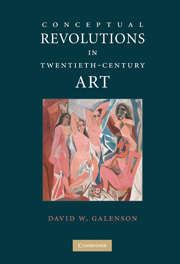
Book contents
- Frontmatter
- Contents
- List of Tables
- Preface
- Introduction: And Now for Something Completely Different
- 1 The Back Story of Twentieth-Century Art
- 2 The Greatest Artists of the Twentieth Century
- 3 The Most Important Works of Art of the Twentieth Century
- 4 The Greatest Artistic Breakthroughs of the Twentieth Century
- 5 The Greatest Women Artists of the Twentieth Century
- 6 Creating New Genres: Conceptual Artists at Work and Play in the Twentieth Century
- 7 And Now for Something Completely Different: The Versatility of Conceptual Innovators
- 8 You Cannot Be Serious: The Conceptual Innovator as Trickster
- 9 Painting by Proxy: The Conceptual Artist as Manufacturer
- 10 Co-Authoring Advanced Art
- 11 Language in Visual Art
- 12 Portraits of the Artist: Personal Visual Art in the Twentieth Century
- 13 The Rise and (Partial) Fall of Abstract Painting in the Twentieth Century
- 14 The Globalization of Advanced Art in the Twentieth Century
- 15 Artists and the Market: From Leonardo and Titian to Warhol and Hirst
- 16 The State of Advanced Art: The Late Twentieth Century and Beyond
- Notes
- Bibliography
- Index
3 - The Most Important Works of Art of the Twentieth Century
Published online by Cambridge University Press: 05 June 2012

Book contents
- Frontmatter
- Contents
- List of Tables
- Preface
- Introduction: And Now for Something Completely Different
- 1 The Back Story of Twentieth-Century Art
- 2 The Greatest Artists of the Twentieth Century
- 3 The Most Important Works of Art of the Twentieth Century
- 4 The Greatest Artistic Breakthroughs of the Twentieth Century
- 5 The Greatest Women Artists of the Twentieth Century
- 6 Creating New Genres: Conceptual Artists at Work and Play in the Twentieth Century
- 7 And Now for Something Completely Different: The Versatility of Conceptual Innovators
- 8 You Cannot Be Serious: The Conceptual Innovator as Trickster
- 9 Painting by Proxy: The Conceptual Artist as Manufacturer
- 10 Co-Authoring Advanced Art
- 11 Language in Visual Art
- 12 Portraits of the Artist: Personal Visual Art in the Twentieth Century
- 13 The Rise and (Partial) Fall of Abstract Painting in the Twentieth Century
- 14 The Globalization of Advanced Art in the Twentieth Century
- 15 Artists and the Market: From Leonardo and Titian to Warhol and Hirst
- 16 The State of Advanced Art: The Late Twentieth Century and Beyond
- Notes
- Bibliography
- Index
Summary
Introduction
Quality in art is not just a matter of private experience. There is a consensus of taste.
Clement GreenbergImportant works of art embody important innovations. The most important works of art are those that announce very important innovations.
There is considerable interest in identifying the most important artists, and their most important works, not only among those who study art professionally, but also among a wider public. The distinguished art historian Meyer Schapiro recognized that this is due in large part to the market value of works of art: “The great interest in painting and sculpture (versus poetry) arises precisely from its unique character as art that produces expensive, rare, and speculative commodities.” Schapiro's insight suggests one means of identifying the most important artists, through analysis of prices at public sales. This strategy is less useful in identifying the most important individual works of art, however, for these rarely, if ever, come to market.
An alternative is to survey the judgments of art experts. One way to do this is by analyzing textbooks. The illustrations an author chooses implicitly tell us which works of art he considers most valuable in providing a narrative of the successive innovations that make up the history of art. Surveying a large number of textbooks effectively allows us to poll art historians as to which works are generally considered the most essential to this narrative.
Information
- Type
- Chapter
- Information
- Conceptual Revolutions in Twentieth-Century Art , pp. 62 - 78Publisher: Cambridge University PressPrint publication year: 2009
Accessibility standard: Unknown
Why this information is here
This section outlines the accessibility features of this content - including support for screen readers, full keyboard navigation and high-contrast display options. This may not be relevant for you.Accessibility Information
Accessibility compliance for the PDF of this chapter is currently unknown
and may be updated in the future.