Book contents
- Frontmatter
- Contents
- List of illustrations
- Acknowledgments
- 1 Discovering nature
- 2 Night of the living dead fish
- 3 New natures
- 4 Stories of stone
- 5 Garbage wars and spiritual environments
- 6 On “policies from above and countermeasures from below”
- 7 Globals and locals
- List of Chinese characters
- Bibliography
- Index
7 - Globals and locals
Published online by Cambridge University Press: 05 June 2012

Book contents
- Frontmatter
- Contents
- List of illustrations
- Acknowledgments
- 1 Discovering nature
- 2 Night of the living dead fish
- 3 New natures
- 4 Stories of stone
- 5 Garbage wars and spiritual environments
- 6 On “policies from above and countermeasures from below”
- 7 Globals and locals
- List of Chinese characters
- Bibliography
- Index
Summary
Understandings of nature changed rapidly and radically over the twentieth century in China and Taiwan. Most of these changes added new layers of possibility to existing ideas, rather than substituting for them wholesale. Nevertheless, the new ways of thinking about the environment had a profound effect, above all on the educated elites who became so important in designing policy. We now have national parks and nature reserves, environmental protection bureaucracies and regulations, bird watching societies and environmentalist NGOs. Some of them resonate with earlier Chinese traditions, but all of them look outside that tradition for their direct inspiration. On the other hand, many older ideas remain vibrant, from gods protecting their neighborhood to the anthropocosmic qualities of food. We can also find new creations, for instance in the hands of local nature tourism sites, whose bricolages combine pieces of various traditions into something new.
The usual theoretical stories we tell about globalization seem inadequate for all this. Three such stories have dominated most of the discussion, and I have touched on all of them in earlier chapters. One is the avalanche from Hollywood (or Wall Street, for those who prefer a less entertaining sector), which sees globalization as an unstoppable homogenization that dooms local variation and that makes the nation-state increasingly irrelevant. The second highlights resistance to globalization, instead of the hegemony of the global leviathan. This has been the anthropologist's usual response of finding local agency in the power to negate or rework global pressures.
Information
- Type
- Chapter
- Information
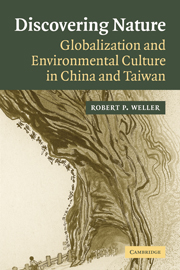
- Discovering NatureGlobalization and Environmental Culture in China and Taiwan, pp. 161 - 171Publisher: Cambridge University PressPrint publication year: 2006
Accessibility standard: Unknown
Why this information is here
This section outlines the accessibility features of this content - including support for screen readers, full keyboard navigation and high-contrast display options. This may not be relevant for you.Accessibility Information
Accessibility compliance for the PDF of this chapter is currently unknown
and may be updated in the future.