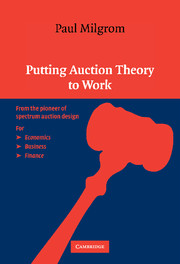
Book contents
- Frontmatter
- Contents
- Preface
- Foreword by Evan Kwerel
- PUTTING AUCTION THEORY TO WORK
- 1 Getting to Work
- PART I THE MECHANISM DESIGN APPROACH
- 2 Vickrey–Clarke–Groves Mechanisms
- 3 The Envelope Theorem and Payoff Equivalence
- 4 Bidding Equilibrium and Revenue Differences
- 5 Interdependence of Types and Values
- 6 Auctions in Context
- PART II MULTI-UNIT AUCTIONS
- Bibliography
- Author Index
- Subject Index
- References
5 - Interdependence of Types and Values
Published online by Cambridge University Press: 05 June 2012

Book contents
- Frontmatter
- Contents
- Preface
- Foreword by Evan Kwerel
- PUTTING AUCTION THEORY TO WORK
- 1 Getting to Work
- PART I THE MECHANISM DESIGN APPROACH
- 2 Vickrey–Clarke–Groves Mechanisms
- 3 The Envelope Theorem and Payoff Equivalence
- 4 Bidding Equilibrium and Revenue Differences
- 5 Interdependence of Types and Values
- 6 Auctions in Context
- PART II MULTI-UNIT AUCTIONS
- Bibliography
- Author Index
- Subject Index
- References
Summary
Most of the models in chapters 2–4 are independent private values models. Values are private if each player's value for any outcome depends only on his own type and independent if types are statistically independent. The only exceptions so far are the Jehiel–Moldovanu model of chapter 3, which discards the private values assumption, and the correlated-types example of chapter 4, which relaxes the independence assumption.
Relaxing the private values and independence assumptions raises a host of new issues. When bidders do not know their own values, the connection between bids and values is naturally weaker and the bidder with the highest value may win less often. Bidders' ignorance of their values leads us to study what information bidders are likely to acquire, whether they Will share this information or keep it secret, and whether the auctioneer can improve the outcome by gathering and disseminating information on its own. The independence assumption is an essential premise of the Myerson's lemma and the revenue equivalence theorems. Relaxing this assumption forces us to reevaluate the most basic results of auction theory.
In this chapter, we study issues raised by the two possible kinds of interdependence. Section 5.1 investigates the kinds of simplifying assumptions that are “reasonable” and “useful” in auction models. Section 5.2 explores the consequences of statistically interdependent types in an optimal auction model. Section 5.3 studies the empirically successful drainage tract model, which treats bidding for oil on tracts adjacent to a previously developed tract.
Information
- Type
- Chapter
- Information
- Putting Auction Theory to Work , pp. 157 - 207Publisher: Cambridge University PressPrint publication year: 2004
References
(2001). “Single Crossing Properties and the Existence of Pure Strategy Equilibria in Games of Incomplete Information.” Econometrica 69(4): 861–890CrossRefGoogle Scholar
(2002). “Monotone Comparative Statics Under Uncertainty.” Quarterly Journal of Economics 117(1): 187–223CrossRefGoogle Scholar
(1998). “Strategic Jump Bidding in English Auctions.” Review of Economic Studies 65(2, No. 223): 185–210CrossRefGoogle Scholar
, , and (2002). “Symmetric Separating Equilibria in English Auctions.” Games and Economic Behavior 38: 19–27CrossRefGoogle Scholar
, and (1999). “Toeholds and Takeovers.” Journal of Political Economy 107(3): 427–454CrossRefGoogle Scholar
, and (2002). “Prices and the Winner's Curse.” Rand Journal of Economics 33(1): 1–21CrossRefGoogle Scholar
and (1985). “Optimal Selling Strategies Under Uncertainty for a Discriminating Monopolist When Demands are Independent.” Econometrica 53(2): 345–361CrossRefGoogle Scholar
, and (1983). “Competitive Bidding with Proprietary Information.” Journal of Mathematical Economics 11: 161–169CrossRefGoogle Scholar
(1981). “The Informational Role of Warranties and Private Disclosure About Product Quality.” Journal of Law and Economics: 24(3:) 461–483CrossRefGoogle Scholar
, and (1994). “Auctions for Oil and Gas Leases with an Informed Bidder and a Random Reservation Price.” Econometrica 63(1): 1–27Google Scholar
Hernando-Veciana, Angel (2003). “Successful Uninformed Bidding.” Games and Economic Behavior (Forthcoming)
(1998). “Auctions with Almost Common Values: The Wallet Game and its Applications.” European Economic Review 42: 757–769CrossRefGoogle Scholar
Mas Colell, Andreu, Michael Whinston and Jerry Green (1995). Microeconomic Theory. New York: Oxford University Press
Maskin, Eric (1992). Auctions and Privatisation. Privatisation. H. Siebert: 115–136
and (1982). “Correlated Information and Mechanism Design.” Econometrica 60(2): 395–421CrossRefGoogle Scholar
(1981a). “Good News and Bad News: Representation Theorems and Applications.” Bell Journal of Economics 12: 380–391CrossRefGoogle Scholar
(1981b). “Rational Expectations, Information Acquisition, and Competitive Bidding.” Econometrica 49(4): 921–943CrossRefGoogle Scholar
and (1982a). “A Theory of Auctions and Competitive Bidding.” Econometrica 50: 463–483CrossRefGoogle Scholar
and (1982b). “The Value of Information in a Sealed-Bid Auction.” Journal of Mathematical Economics 10(1): 105–114CrossRefGoogle Scholar
Neeman, Zvika (2001). “The Relevance of Private Information in Mechanism Design.” Boston University Working paper
Ortega-Reichert, Armando (1968). Models for Competitive Bidding Under Uncertainty. Department of Operations Research. Stanford, CA, Stanford University
and (1997). “The Loser's Curse and Information Aggregation in Common Value Auctions.” Econometrica 65: 1247–1281CrossRefGoogle Scholar
Royden, H. L. (1968). Real Analysis. New York, NY: Macmillan
(1978). “Minimizing a Submodular Function on a Lattice.” Operations Research 26: 305–321CrossRefGoogle Scholar
Topkis, Donald (1998). Supermodularity and Complementarity: Princeton University Press
(1979). “Competitive Bidding With Asymmetric Information Reanalyzed.” Management Science 25: 291–94CrossRefGoogle Scholar
(1967). “Competitive Bidding with Asymmetric Information.” Management Science 13: 816–820CrossRefGoogle Scholar
(1969). “Competitive Bidding With Disparate Information.” Management Science 15(7): 446–448CrossRefGoogle Scholar
Wilson, Robert (1987). Bidding. The New Palgrave: A Dictionary of Economics. J. Eatwell, M. Milgate and P. Newman. London, MacMillan Press. 1: 238–242CrossRef
Accessibility standard: Unknown
Why this information is here
This section outlines the accessibility features of this content - including support for screen readers, full keyboard navigation and high-contrast display options. This may not be relevant for you.Accessibility Information
Accessibility compliance for the PDF of this chapter is currently unknown
and may be updated in the future.
- 4
- Cited by