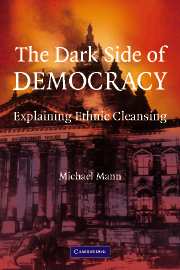
Book contents
- Frontmatter
- Contents
- Preface
- 1 The Argument
- 2 Ethnic Cleansing in Former Times
- 3 Two Versions of “We, the People”
- 4 Genocidal Democracies in the New World
- 5 Armenia, I: Into the Danger Zone
- 6 Armenia, II: Genocide
- 7 Nazis, I: Radicalization
- 8 Nazis, II: Fifteen Hundred Perpetrators
- 9 Nazis, III: Genocidal Careers
- 10 Germany's Allies and Auxiliaries
- 11 Communist Cleansing: Stalin, Mao, Pol Pot
- 12 Yugoslavia, I: Into the Danger Zone
- 13 Yugoslavia, II: Murderous Cleansing
- 14 Rwanda, I: Into the Danger Zone
- 15 Rwanda, II: Genocide
- 16 Counterfactual Cases: India and Indonesia
- 17 Combating Ethnic Cleansing in the World Today
- Works Cited
- Index
7 - Nazis, I: Radicalization
Published online by Cambridge University Press: 05 June 2012

Book contents
- Frontmatter
- Contents
- Preface
- 1 The Argument
- 2 Ethnic Cleansing in Former Times
- 3 Two Versions of “We, the People”
- 4 Genocidal Democracies in the New World
- 5 Armenia, I: Into the Danger Zone
- 6 Armenia, II: Genocide
- 7 Nazis, I: Radicalization
- 8 Nazis, II: Fifteen Hundred Perpetrators
- 9 Nazis, III: Genocidal Careers
- 10 Germany's Allies and Auxiliaries
- 11 Communist Cleansing: Stalin, Mao, Pol Pot
- 12 Yugoslavia, I: Into the Danger Zone
- 13 Yugoslavia, II: Murderous Cleansing
- 14 Rwanda, I: Into the Danger Zone
- 15 Rwanda, II: Genocide
- 16 Counterfactual Cases: India and Indonesia
- 17 Combating Ethnic Cleansing in the World Today
- Works Cited
- Index
Summary
THE GERMAN QUESTION
We approach the most notorious and best-evidenced case of genocide. My book Fascists shows that fascism was essentially a movement committed to extreme organic nationalism and statism, claiming to transcend social conflict, especially class conflict, by using paramilitary and state violence to “knock both their heads together.” But there were two additionally dangerous features of Nazism compared to other fascist movements: its conception of the nation was more racial than cultural, and it advocated an aggressive imperial revisionism to restore German's former power. I will argue that when both were turned into eastward expansion in Europe, they brought about Nazi genocide, though only after a series of radicalizations of leaders and militants. This chapter deals with the radicalizations, the following two with genocide.
Why did Germany nourish racial sentiments that the Nazis then took to extremes? This is the German Question. But perhaps it is slightly misplaced, for Germany was not alone. Northern Europe nourished racialism. As we saw in Chapter 4, Spaniards and Portuguese abroad were much readier to assimilate (and intermarry with) natives than were Northern European colonists. The late 19th and early 20th centuries also nourished racism. Social Darwinism now blended with biology, medicine, sociology, and psychology to generate racial-genetic notions of human progress. Many believed that the Germans or the British were genetically distinct from Slavs and Jews, that one race might be superior to another, and that social problems like crime or mental illness might be combated by eugenic, “race-purifying” policies.
Information
- Type
- Chapter
- Information
- The Dark Side of DemocracyExplaining Ethnic Cleansing, pp. 180 - 211Publisher: Cambridge University PressPrint publication year: 2004
Accessibility standard: Unknown
Why this information is here
This section outlines the accessibility features of this content - including support for screen readers, full keyboard navigation and high-contrast display options. This may not be relevant for you.Accessibility Information
Accessibility compliance for the PDF of this chapter is currently unknown
and may be updated in the future.