Book contents
- Frontmatter
- Contents
- Preface
- Contributors
- Political Sociology in the New Millenium
- PART I THEORIES OF POLITICAL SOCIOLOGY
- PART II CIVIL SOCIETY: THE ROOTS AND PROCESSES OF POLITICAL ACTION
- 10 Money, Participation, and Votes
- 11 Public Opinion, Political Attitudes, and Ideology
- 12 Nationalism in Comparative Perspective
- 13 Political Parties
- 14 Organized Interest Groups and Policy Networks
- 15 Corporate Control, Interfirm Relations, and Corporate Power
- 16 Social Movements and Social Change
- 17 Toward a Political Sociology of the News Media
- PART III THE STATE AND ITS MANIFESTATIONS
- PART IV STATE POLICY AND INNOVATIONS
- PART V GLOBALIZATION AND POLITICAL SOCIOLOGY
- References
- Name Index
- Subject Index
17 - Toward a Political Sociology of the News Media
Published online by Cambridge University Press: 05 June 2012

Book contents
- Frontmatter
- Contents
- Preface
- Contributors
- Political Sociology in the New Millenium
- PART I THEORIES OF POLITICAL SOCIOLOGY
- PART II CIVIL SOCIETY: THE ROOTS AND PROCESSES OF POLITICAL ACTION
- 10 Money, Participation, and Votes
- 11 Public Opinion, Political Attitudes, and Ideology
- 12 Nationalism in Comparative Perspective
- 13 Political Parties
- 14 Organized Interest Groups and Policy Networks
- 15 Corporate Control, Interfirm Relations, and Corporate Power
- 16 Social Movements and Social Change
- 17 Toward a Political Sociology of the News Media
- PART III THE STATE AND ITS MANIFESTATIONS
- PART IV STATE POLICY AND INNOVATIONS
- PART V GLOBALIZATION AND POLITICAL SOCIOLOGY
- References
- Name Index
- Subject Index
Summary
Sociologists have offered three different, if sometimes overlapping, responses to the question “how does journalism work?” Those who take a macroinstitutional approach argue that the structure of the state and the economic foundation of news organizations account for the process of news making and the content of news. Little can be understood about news, this position asserts, without addressing the political and economic conditions that underlie the workings of news organizations. A second approach stresses that microinstitutional practices and cultures shape how news is gathered, produced, and distributed. Understanding journalism requires an examination of occupational routines in the relations between reporters and their sources as well as a study of professional rules and values in the newsroom. Depending on the specific political and economic context, organizational and occupational demands may constrain journalists' daily job more than advertisers, securities analysts, corporate managers, or general political conditions. A third approach emphasizes the constraining force of broad cultural traditions and symbolic systems. In this view, news is storytelling, a form of cultural expression more than a market commodity or the product of an occupational practice. It is a structured set of genres of public meaning making that comes from and reaches out to enduring myths, narratives, values, and symbols. Journalism selectively taps into the cultural repertoire of societies as shown in journalists' penchant for drama, conflict, rituals of communion, and human interest events.
Macroinstitutional approaches typically, but not inevitably, minimize the role of human agency and imply that structural conditions alone account for most of the features of news content.
Information
- Type
- Chapter
- Information
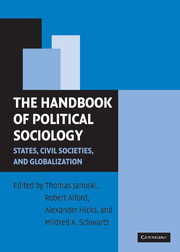
- The Handbook of Political SociologyStates, Civil Societies, and Globalization, pp. 350 - 364Publisher: Cambridge University PressPrint publication year: 2003
Accessibility standard: Unknown
Why this information is here
This section outlines the accessibility features of this content - including support for screen readers, full keyboard navigation and high-contrast display options. This may not be relevant for you.Accessibility Information
Accessibility compliance for the PDF of this chapter is currently unknown
and may be updated in the future.
- 2
- Cited by