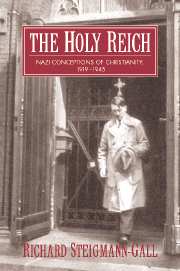
Book contents
- Frontmatter
- Contents
- List of Illustration
- Acknowledgments
- Abbreviations
- Note on Translation and Citations
- Introduction
- 1 Positive Christianity
- 2 Above the Confessions
- 3 Blood and Soil
- 4 National Renewal
- 5 Completing the Reformation
- 6 Public Need before Private Greed
- 7 Gottgläubig
- 8 The Holy Reich
- Primary Sources
- Secondary Sources
- Index
4 - National Renewal
Religion and the New Germany
Published online by Cambridge University Press: 05 June 2013

Book contents
- Frontmatter
- Contents
- List of Illustration
- Acknowledgments
- Abbreviations
- Note on Translation and Citations
- Introduction
- 1 Positive Christianity
- 2 Above the Confessions
- 3 Blood and Soil
- 4 National Renewal
- 5 Completing the Reformation
- 6 Public Need before Private Greed
- 7 Gottgläubig
- 8 The Holy Reich
- Primary Sources
- Secondary Sources
- Index
Summary
When I hear that a ‘Germanic wedding’ is to be celebrated, I have to ask: my God, what do you understand to be a Germanic wedding? What do you understand to be National Socialism?
Hermann Göring1933 was an important year in both secular and sacred terms. Ten years after the failed Beer Hall Putsch, the Nazis' legal path to power finally bore fruit. Without breaking a law, Hitler and his movement achieved their Third Reich. For some members in the movement, this was a time to “unite” the country; for others, the revolution was just beginning. 1933 was also a momentous year for Christian Germany. The years of Weimar had been marked by a growing loss of church membership, especially for the Protestant churches. In a movement known as Kirchenaustritt, approximately 200,000 people a year had formally rescinded their membership in their Protestant Church since the mid-1920s, whereas approximately 50,000 a year had joined. In 1933, however, the rate of church leaving plummeted to a little over 50,000 whereas the number joining the churches skyrocketed to almost 325,000. There could have been no clearer sign that national renewal and religious renewal were believed to be deeply connected. As Margaret Anderson has pointed out, for nineteenth-century German Catholics, religious revival could stimulate and facilitate political mobilization. In a similar process, millions of German Protestants, who were so overrepresented in the Nazi electorate, saw in the Seizure of Power a return to Christianity; for many of them, the Nazi Party served as a Protestant Center Party, achieving a longed-for rallying together of Protestants in a unitary Volkspartei.
Information
- Type
- Chapter
- Information
- The Holy ReichNazi Conceptions of Christianity, 1919–1945, pp. 114 - 154Publisher: Cambridge University PressPrint publication year: 2003
Accessibility standard: Unknown
Why this information is here
This section outlines the accessibility features of this content - including support for screen readers, full keyboard navigation and high-contrast display options. This may not be relevant for you.Accessibility Information
Accessibility compliance for the PDF of this chapter is currently unknown
and may be updated in the future.