Book contents
- Frontmatter
- Contents
- Preface
- Abbreviations and notes
- Editors' introduction
- THE 1897 DISSERTATION: THE METAPHYSICAL BASIS OF ETHICS
- EXAMINERS' REPORTS ON THE 1897 DISSERTATION
- THE 1898 DISSERTATION: THE METAPHYSICAL BASIS OF ETHICS
- Preface
- Table of contents
- Introduction
- Chapter I On the meaning of ‘Reason’ in Kant
- Chapter II Reason
- Chapter III The meaning of ‘Freedom’ in Kant
- Chapter IV Freedom
- Chapter V Ethical Conclusions
- Appendix on the chronology of Kant's ethical writings
- EXAMINER'S REPORT ON THE 1898 DISSERTATION
- Index
Chapter I - On the meaning of ‘Reason’ in Kant
Published online by Cambridge University Press: 05 June 2012

Book contents
- Frontmatter
- Contents
- Preface
- Abbreviations and notes
- Editors' introduction
- THE 1897 DISSERTATION: THE METAPHYSICAL BASIS OF ETHICS
- EXAMINERS' REPORTS ON THE 1897 DISSERTATION
- THE 1898 DISSERTATION: THE METAPHYSICAL BASIS OF ETHICS
- Preface
- Table of contents
- Introduction
- Chapter I On the meaning of ‘Reason’ in Kant
- Chapter II Reason
- Chapter III The meaning of ‘Freedom’ in Kant
- Chapter IV Freedom
- Chapter V Ethical Conclusions
- Appendix on the chronology of Kant's ethical writings
- EXAMINER'S REPORT ON THE 1898 DISSERTATION
- Index
Summary
In all that Kant says on the subject of Ethics in the Critique of Pure Reason and his subsequent writings, reference is constantly made to the notion of a ‘Practical Reason’. From the time when he had conceived his final system of philosophy, generally known as the ‘Critical’ or ‘Transcendental’, ‘Practical Reason’ always appeared to him one of the most fundamental conceptions of Ethical Philosophy. Hence it was in a ‘Critique of Practical Reason’ that he tried to establish those principles upon which he supposed the possibility of an ethical system to be founded; just as he had expressed his views upon the principles and limits of speculative philosophy in a ‘Critique of Pure Reason’. It seems never to have occurred to him that serious difficulty could be found in this conception of a practical faculty of Reason. He assumes its existence in the opening words of his Critique of it, telling us that the objection of his work is to prove, by a criticism of the whole extent of this practical faculty, that there is such a thing as pure practical Reason.
Now there can be no doubt that Kant thought there was something in common between Practical and Theoretical Reason. He declares that ‘after all it can be only one and the same reason, to be distinguished solely in its application’; and accordingly he often speaks of Reason in its theoretical and practical use, or of the theoretical and practical faculties of reason, as if Reason were one with two different applications, rather than as if there were two different kinds of Reason.
Information
- Type
- Chapter
- Information
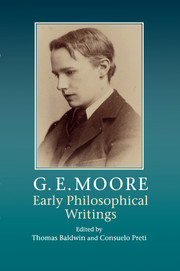
- G. E. Moore: Early Philosophical Writings , pp. 133 - 160Publisher: Cambridge University PressPrint publication year: 2011
Accessibility standard: Unknown
Why this information is here
This section outlines the accessibility features of this content - including support for screen readers, full keyboard navigation and high-contrast display options. This may not be relevant for you.Accessibility Information
Accessibility compliance for the PDF of this chapter is currently unknown
and may be updated in the future.