Book contents
- Frontmatter
- Contents
- List of contributors
- Acknowledgements
- Introduction
- 1 Swordsmen: W. B. Yeats and Hugh MacDiarmid
- 2 Tradition and the individual editor: Professor Grierson, modernism and national poetics
- 3 Louis MacNeice among the islands
- 4 Townland, desert, cave: Irish and Scottish Second World War poetry
- 5 Affinities in time and space: reading the Gaelic poetry of Ireland and Scotland
- 6 Contemporary affinities
- 7 The Classics in modern Scottish and Irish poetry
- 8 Translating Beowulf: Edwin Morgan and Seamus Heaney
- 9 Reading in the gutters
- 10 ‘What matters is the yeast’: ‘foreignising’ Gaelic poetry
- 11 Outside English: Irish and Scottish poets in the East
- 12 Names for nameless things: the poetics of place names
- 13 Desire lines: mapping the city in contemporary Belfast and Glasgow poetry
- 14 ‘The ugly burds without wings’?: reactions to tradition since the 1960s
- 15 ‘And cannot say / and cannot say’: Richard Price, Randolph Healy and the dialogue of the deaf
- 16 On ‘The Friendship of Young Poets’: Douglas Dunn, Michael Longley and Derek Mahon
- 17 ‘No misprints in this work’: the poetic ‘translations’ of Medbh McGuckian and Frank Kuppner
- 18 Phoenix or dead crow? Irish and Scottish poetry magazines, 1945–2000
- 19 Outwith the Pale: Irish–Scottish studies as an act of translation
- Guide to further reading
- Index
- References
9 - Reading in the gutters
Published online by Cambridge University Press: 18 April 2011
By

Book contents
- Frontmatter
- Contents
- List of contributors
- Acknowledgements
- Introduction
- 1 Swordsmen: W. B. Yeats and Hugh MacDiarmid
- 2 Tradition and the individual editor: Professor Grierson, modernism and national poetics
- 3 Louis MacNeice among the islands
- 4 Townland, desert, cave: Irish and Scottish Second World War poetry
- 5 Affinities in time and space: reading the Gaelic poetry of Ireland and Scotland
- 6 Contemporary affinities
- 7 The Classics in modern Scottish and Irish poetry
- 8 Translating Beowulf: Edwin Morgan and Seamus Heaney
- 9 Reading in the gutters
- 10 ‘What matters is the yeast’: ‘foreignising’ Gaelic poetry
- 11 Outside English: Irish and Scottish poets in the East
- 12 Names for nameless things: the poetics of place names
- 13 Desire lines: mapping the city in contemporary Belfast and Glasgow poetry
- 14 ‘The ugly burds without wings’?: reactions to tradition since the 1960s
- 15 ‘And cannot say / and cannot say’: Richard Price, Randolph Healy and the dialogue of the deaf
- 16 On ‘The Friendship of Young Poets’: Douglas Dunn, Michael Longley and Derek Mahon
- 17 ‘No misprints in this work’: the poetic ‘translations’ of Medbh McGuckian and Frank Kuppner
- 18 Phoenix or dead crow? Irish and Scottish poetry magazines, 1945–2000
- 19 Outwith the Pale: Irish–Scottish studies as an act of translation
- Guide to further reading
- Index
- References
Summary
Contemporary poetry in Irish and Scottish Gaelic emerges out of a tangle of material conditions. Closely related minority languages, Irish and Scottish Gaelic have continually outlived their supposed deaths, surviving traditionally in regions in northwest Scotland and the west and southwest of the island of Ireland. Severely weakened in the eighteenth and nineteenth centuries, both have undergone periods of revitalisation since the late nineteenth century, and though the number of native speakers of both languages continues to decline, the second half of the twentieth century featured renewed efforts to incorporate Gaelic more substantially into educational programmes and bolster institutional support for Gaelic cultural activities within and without the Gaeltacht and Gàidhealtachd. While neither has yet achieved Welsh's sustained renaissance, both are healthier than the many languages around the world in immediate danger of extinction. Additionally, Irish and Scottish cultural activities and products have thrived in the Anglo-American marketplace, and Ireland and Scotland are cultural and genealogical touchstones for large numbers of people globally. Gaelic has long been imagined to be the repository of origins in Irish cultural debates, and while the situation is surely different in Scotland, where English, Scots and Scottish Gaelic exist in a nuanced tension, both languages carry notions of authenticity even as their actual day-to-day use has declined over the past two centuries. The relevance and portability of Irishness and Scottishness in a postmodern and hyper-capitalist global fabric has both furthered and forestalled their obsolescence.
Information
- Type
- Chapter
- Information
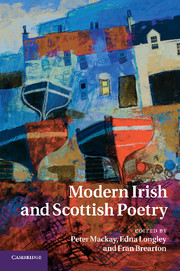
- Modern Irish and Scottish Poetry , pp. 161 - 175Publisher: Cambridge University PressPrint publication year: 2011
References
Translation in a Postcolonial Context: Irish Literature in English Translation (Manchester: St Jerome Publishing, 1999)
The Translator's Invisibility: A History of Translation, 2nd edn (New York: Routledge, 2008)Google Scholar
An Tuil: Anthology of 20th Century Scottish Gaelic Verse (Edinburgh: Polygon, 1999), lxiv–lxvi
Dàin do Eimhir agus Dàin Eile (Glasgow: William MacLellan, 1943)
Dàin do Eimhir (Poems to Eimhir) (Edinburgh: Polygon, 2008), 1–41
, ‘The Task of the Translator’, in Illuminations, trans. and ed. (New York: Schocken, 1969), 69–82, 71Google Scholar
Selected Essays (Dublin: New Island, 2005)
, Pharaoh's Daughter (Winston-Salem, NC: Wake Forest University Press, 1993 [1990]), 48–9Google Scholar
Accessibility standard: Unknown
Why this information is here
This section outlines the accessibility features of this content - including support for screen readers, full keyboard navigation and high-contrast display options. This may not be relevant for you.Accessibility Information
Accessibility compliance for the PDF of this chapter is currently unknown
and may be updated in the future.