3 - Time as Consent
Common Law Thought after the American Revolution
Published online by Cambridge University Press: 03 May 2011

Summary
The Loneliness of Consent
Over the past several decades, scholars have been made aware of many of the intellectual sources of the American revolutionary struggle, the period of constitution making, and its aftermath. These include republican thought, Lockean natural rights, Scottish ideas about the shift from the feudal to the commercial, common law thought, and Protestant millennial thought. These various intellectual sources were often mixed in ways that are difficult to separate out. The writings of Bolingbroke, Kames, Blackstone, and others were fully part of this complex universe of ideas.
It is important to emphasize, however, that none of the British writers discussed in the preceding chapter had mapped out the truly innovative political structure that emerged out of the 1787 Philadelphia convention. While eighteenth-century British legal thinkers had imagined government to be constrained by the logic of history, and had sought to subject law to criticism in the name of the logic of history, few had imagined a government in which all three of the traditional orders of government would be subjected to the electoral principle. Accustomed to monarchy and aristocracy, to a world in which birth determined status, eighteenth-century Europeans deemed the constraint of history just one among many.
Information
- Type
- Chapter
- Information
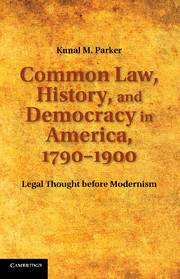
- Common Law, History, and Democracy in America, 1790–1900Legal Thought before Modernism, pp. 67 - 116Publisher: Cambridge University PressPrint publication year: 2011
References
, The Ideological Origins of the American Revolution (enlarged ed.) (Cambridge, Mass.: Belknap Press, 1992)
, The Enlightenment in America (New York: Oxford University Press, 1976)
, The Creation of the American Republic, 1776–1787 (Chapel Hill: University of North Carolina Press, 1969)
, Redeemer Nation: The Idea of America's Millennial Role (Chicago: University of Chicago Press, 1968)
, The Development of American Citizenship, 1608–1870 (Chapel Hill: University of North Carolina Press, 1978)
, By Birth or Consent: Children, Law and the Anglo-American Revolution in Authority (Chapel Hill: University of North Carolina Press, 2005)
, “An Introductory Lecture to a Course of Law Lectures: Delivered November 17, 1794,” Columbia Law Review 3 (1903): 330–343, at 331Google Scholar
, James Kent: A Study in Conservatism, 1763–1847 (New York: Da Capo Press, 1969)
and , Reports of the Proceedings and Debates of the Convention of 1821 Assembled for the Purpose of Amending the Constitution of the State of New York; Containing All the Official Documents Relating to the Subject, and Other Valuable Matter (Albany: E. & E. Hosford, 1821), p. 221
, Constituting Empire: New York and the Transformation of Constitutionalism in the Atlantic World, 1664–1830 (Chapel Hill: University of North Carolina Press, 2005), Chap. 8
and , eds., The Key of Liberty: The Life and Democratic Writings of William Manning, “A Laborer,” 1747–1814 (Cambridge, Mass.: Harvard University Press, 1993)
, Law, Labor, and Ideology in the Early American Republic (Cambridge: Cambridge University Press, 1993)
, Elements of Jurisprudence: Treated of in the Preliminary Part of a Course of Lectures on the Laws of England (Dublin: H. Fitzpatrick, 1792), p. 35
, Common Sense, in Basic Writings of Thomas Paine (New York: Willey Book Company, 1942), p. 52
, “Introduction,” in Report of Cases Adjudged in the Superior Court and Supreme Court of Errors: From July, A.D. 1789 to June, AD 1793 (Hartford, Conn.: Hudson and Goodwin, 1798–1802), p. xii
, The Federal and State Constitutions, Colonial Charters, and Other Organic Laws of the United States (2 vols.) (Washington, D.C.: Government Printing Office, 1877)
, “The Common Law: An Account of Its Reception in the United States,” Vanderbilt Law Review 4 (1951): 791–825Google Scholar
, Federalist 14, in The Federalist (New York: C. Scribner, 1863), pp. 88–89
, “Burke and the Ancient Constitution: A Problem in the History of Ideas,” in Politics, Language & Time: Essays on Political Thought and History (New York: Atheneum, 1971)
, The Jeffersonian Persuasion (Ithaca, N.Y.: Cornell University Press, 1978), p. 155
, Dissertations: Being the Preliminary Part of a Course of Law Lectures (New York: George Forman, 1795) (1991), p. 6
, Sketches of the Principles of Government (Rutland, Vt.: From the Press of J. Lyon, 1793), pp. 33–40
, The Political and Legal Philosophy of James Wilson, 1742–1798 (Columbia: University of Missouri Press, 1997), p. 1
, Patriots and Cosmopolitans: Hidden Histories of American Law (Cambridge, Mass.: Harvard University Press, 2007)
, Considerations on the Jurisprudence of the State of Pennsylvania (Philadelphia, 1808), p. 8
, Federalists in Dissent: Imagery and Ideology in Jeffersonian America (Ithaca, N.Y.: Cornell University Press, 1970), p. 154
, Law, Labor, and Ideology in the Early American Republic (Cambridge: Cambridge University Press, 1993), esp
, The Trial of the Boot and Shoemakers of Philadelphia, on an Indictment for a Combination to Raise their Wages (Philadelphia: B. Graves, 1806), p. 146
, Trial of the Journeymen Cordwainers of the City of New-York; for a Conspiracy to Raise their Wages; with the Arguments of Counsel at Full Length, on a Motion to Quash the Indictment, the Verdict of the Jury, and the Sentence of the Court (New York: I. Riley, 1810), p. 31
, Historical Sketches of the Principles and Maxims of American Jurisprudence, in Contrast with the Doctrines of English Common Law on the Subject of Crimes and Punishments (Steubenville, Ohio: James Wilson, 1819) (1821) (Buffalo: William S. Hein & Co., 1975)
Accessibility standard: Unknown
Why this information is here
This section outlines the accessibility features of this content - including support for screen readers, full keyboard navigation and high-contrast display options. This may not be relevant for you.Accessibility Information
Accessibility compliance for the PDF of this chapter is currently unknown
and may be updated in the future.