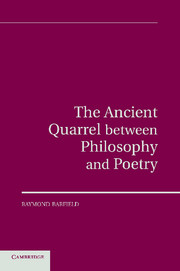
Book contents
- Frontmatter
- Contents
- Acknowledgments
- Introduction
- 1 Socrates, Plato, and the Invention of the Ancient Quarrel
- 2 Aristotle, Poetry, and Ethics
- 3 Plotinus, Augustine, and Strange Sweetness
- 4 Boethius, Dionysius, and the Forms
- 5 Thomas and Some Thomists
- 6 Vico's New Science
- 7 Kant and His Students on the Genius of Nature
- 8 Hegel and the Owl of Minerva
- 9 Kierkegaard: A Poet, Alas
- 10 Dilthey: Poetry and the Escape from Metaphysics
- 11 Nietzsche, Heidegger, and the Saving Power of Poetry
- 12 Mikhail Bakhtin and Novelistic Consciousness
- Index
- References
4 - Boethius, Dionysius, and the Forms
Published online by Cambridge University Press: 03 May 2011

Book contents
- Frontmatter
- Contents
- Acknowledgments
- Introduction
- 1 Socrates, Plato, and the Invention of the Ancient Quarrel
- 2 Aristotle, Poetry, and Ethics
- 3 Plotinus, Augustine, and Strange Sweetness
- 4 Boethius, Dionysius, and the Forms
- 5 Thomas and Some Thomists
- 6 Vico's New Science
- 7 Kant and His Students on the Genius of Nature
- 8 Hegel and the Owl of Minerva
- 9 Kierkegaard: A Poet, Alas
- 10 Dilthey: Poetry and the Escape from Metaphysics
- 11 Nietzsche, Heidegger, and the Saving Power of Poetry
- 12 Mikhail Bakhtin and Novelistic Consciousness
- Index
- References
Summary
Anicius Manlius Severinus Boethius sat in prison at the age of roughly forty-four, condemned by Theodoric, king of the Ostrogoths. He awaited execution, which came around the year a.d. 525 – he was tortured and bludgeoned to death in Pavia. In the time between his imprisonment and his death, he was able to write The Consolation of Philosophy, one of the central texts bridging the classical and medieval worlds. When Lady Philosophy visits Boethius in prison, the urgency of Boethius's struggle is rooted in his strange circumstance. Facing death by bludgeon in the not-too-distant future hones his ear as he listens to Philosophy's counsel and to her carefully crafted cure. The book follows in the tradition of Menippean satire. The poetry is not where consolation is found, though often the poems are used to refresh Boethius after a difficult course of treatment by Philosophy in her attempt to cure him. He goes through the curative rigors and is then allowed a draft at the fountain of poetry for relief. Other times poems do carry forward an idea presented in the prose argument or else sum up what she has said. No longer does poetry find itself struggling against philosophy. Poetry is very nearly subsumed by Philosophy, who speaks in poems at various junctures in the work of helping Boethius make the ascent from the earthbound grief he starts with in the first poem to contemplation of the mind of God, even approaching in the final chapter (which is all prose with no poem) the very ideas of the nature of God's knowledge, time, and eternity – a fitting place to end before exiting this life at the hands of a tyrant.
Information
- Type
- Chapter
- Information
- The Ancient Quarrel Between Philosophy and Poetry , pp. 86 - 105Publisher: Cambridge University PressPrint publication year: 2011
References
Accessibility standard: Unknown
Why this information is here
This section outlines the accessibility features of this content - including support for screen readers, full keyboard navigation and high-contrast display options. This may not be relevant for you.Accessibility Information
Accessibility compliance for the PDF of this chapter is currently unknown
and may be updated in the future.