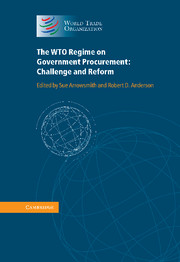
Book contents
- Frontmatter
- Contents
- List of contributors
- Foreword by Pascal Lamy
- Perspective of the Chairman of the WTO Committee on Government Procurement, Nicholas Niggli (Switzerland)
- Preface
- Disclaimer
- PART I The WTO regime on government procurement
- PART II Expanding the scope of the Agreement on Government Procurement: accession and coverage
- PART III Revision of the procedural rules and other transparency provisions of the Agreement on Government Procurement
- PART IV Developing countries in the WTO procurement regime
- PART V Economic and social development (horizontal policies) in government procurement
- 14 The national treatment and exceptions provisions of the Agreement on Government Procurement and the pursuit of horizontal policies
- 15 The limited case for permitting SME procurement preferences in the Agreement on Government Procurement
- 16 Social policies in procurement and the Agreement on Government Procurement: a perspective from South Africa
- PART VI Enforcement and remedies
- PART VII Multilateralism and regionalism
- PART VIII Challenges and new directions
- Index
- References
16 - Social policies in procurement and the Agreement on Government Procurement: a perspective from South Africa
from PART V - Economic and social development (horizontal policies) in government procurement
Published online by Cambridge University Press: 07 September 2011

Book contents
- Frontmatter
- Contents
- List of contributors
- Foreword by Pascal Lamy
- Perspective of the Chairman of the WTO Committee on Government Procurement, Nicholas Niggli (Switzerland)
- Preface
- Disclaimer
- PART I The WTO regime on government procurement
- PART II Expanding the scope of the Agreement on Government Procurement: accession and coverage
- PART III Revision of the procedural rules and other transparency provisions of the Agreement on Government Procurement
- PART IV Developing countries in the WTO procurement regime
- PART V Economic and social development (horizontal policies) in government procurement
- 14 The national treatment and exceptions provisions of the Agreement on Government Procurement and the pursuit of horizontal policies
- 15 The limited case for permitting SME procurement preferences in the Agreement on Government Procurement
- 16 Social policies in procurement and the Agreement on Government Procurement: a perspective from South Africa
- PART VI Enforcement and remedies
- PART VII Multilateralism and regionalism
- PART VIII Challenges and new directions
- Index
- References
Summary
Introduction
Public procurement is extensively used in South Africa as a tool to achieve horizontal policies – that is, policies that are not necessarily directly connected with the functional purposes of the goods, works or services acquired in the procurement. The most pervasive of these policies are the social-policy-underlying mechanisms to redress inequalities in the South African economy created by colonization and apartheid. This policy of economic redress in favour of previously disadvantaged groups, generally known as black economic empowerment (‘BEE’), forms part of the larger project of constitutional transformation in South Africa, which informs the entire government agenda. In public procurement specifically, the primacy of this policy is reflected in the constitutional mandate for BEE mechanisms in procurement. The policy of BEE is so pervasive that it has also found its way into private procurement in South Africa through the Broad-Based Black Economic Empowerment Act (‘BBBEEA’). The South African system thus provides an interesting example to test the ‘fit’ of the WTO's Agreement on Government Procurement (GPA) in a context where social policy plays a major role in shaping procurement practices.
In this chapter we assess the South African approach to social policy in public procurement against the approach to public procurement put forward by the GPA. We argue that while there are options within the general GPA approach for a system such as South Africa's to advance social policies, like BEE through public procurement, the pervasive nature of this policy and the national commitments it represents raise questions about the suitability of the GPA's approach within the South African system.
Information
- Type
- Chapter
- Information
- The WTO Regime on Government ProcurementChallenge and Reform, pp. 459 - 480Publisher: Cambridge University PressPrint publication year: 2011
References
and , ‘Public Procurement and Corruption: The South African Response’, South African Law Journal, 124 (2007), 339Google Scholar
, ‘Incorporating Environmental Considerations into Government Procurement in South Africa’, Journal of South African Law, (2008), 31Google Scholar
, The Law of Government Procurement in South Africa (Durban: LexisNexis Butterworths, 2007)Google Scholar
, Buying Social Justice: Equality, Government Procurement and Legal Change (Oxford University Press, 2007), p. 245CrossRefGoogle Scholar
, ‘Public Procurement’, Juta's Quarterly Review of South African Law, 4 (2008), para. 2.1Google Scholar
, ‘Public Procurement’, Juta's Quarterly Review of South African Law, 2 (2008), para. 2.2Google Scholar
Accessibility standard: Unknown
Why this information is here
This section outlines the accessibility features of this content - including support for screen readers, full keyboard navigation and high-contrast display options. This may not be relevant for you.Accessibility Information
Accessibility compliance for the PDF of this chapter is currently unknown
and may be updated in the future.
- 2
- Cited by