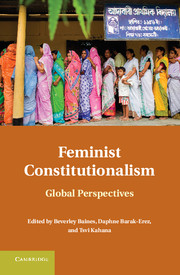
Book contents
- Frontmatter
- Contents
- Foreword
- Contributors
- Introduction
- Part I Feminism as a Challenge to Constitutional Theory
- Part II Feminism and Judging
- Part III Feminism, Democracy, and Political Participation
- Part IV The Constitutionalism of Reproductive Rights
- Part V Women's Rights, Multiculturalism, and Diversity
- Part VI Women between Secularism and Religion
- Index
- References
Introduction
The Idea and Practice of Feminist Constitutionalism
Published online by Cambridge University Press: 05 June 2012

Book contents
- Frontmatter
- Contents
- Foreword
- Contributors
- Introduction
- Part I Feminism as a Challenge to Constitutional Theory
- Part II Feminism and Judging
- Part III Feminism, Democracy, and Political Participation
- Part IV The Constitutionalism of Reproductive Rights
- Part V Women's Rights, Multiculturalism, and Diversity
- Part VI Women between Secularism and Religion
- Index
- References
Summary
What is feminist constitutionalism? Basically, it is the project of rethinking constitutional law in a manner that addresses and reflects feminist thought and experience. We use this term in contrast with the “constitutional law and” approach – constitutional law and gender or constitutional law and feminist theory – because we aspire to explore the relationship between constitutional law and feminism by examining, challenging, and redefining the very idea of constitutionalism from a feminist perspective. Feminist constitutionalism demands that we not only revisit classical topics from new perspectives but, more importantly, pose new questions, introduce new topics, and take responsibility for changing the focus of constitutional discussion and debate. We embrace the questions raised by studies of gender or feminism “and” constitutional law even as we urge scholars to move beyond them.
We acknowledge the importance of constitutional law for feminist analysis. Constitutional law is foundational to most of the world's legal systems. It shapes fundamental assumptions regarding citizenship, rights, and responsibilities. Feminists who critique law must understand that legal systems cannot really be transformed without addressing their constitutional foundations. Historically, the second-class status of women in law derived from constitutional structures and assumptions. For instance, in the Anglo-American countries – Great Britain, the United States of America, and Canada – women were denied the right to vote in the nineteenth and early twentieth centuries in part because constitutional norms were phrased in masculine terminology (e.g., “men,” “he”) or given a gendered interpretation (e.g., “persons” as referring to “men”).
Information
- Type
- Chapter
- Information
- Feminist ConstitutionalismGlobal Perspectives, pp. 1 - 12Publisher: Cambridge University PressPrint publication year: 2012
References
Constitutive and Entrenchment Functions of Constitutions: A Research Agenda 10 2007
Rethinking Sex and the Constitution 132 1984
Foreword: The Supreme Court, 1986 Term – Justice Engendered 110 10 1987
The Family and the Market 96 1983
Feminism and the Public/Private Distinction 45 1992
1987
1993
2003
Accessibility standard: Unknown
Why this information is here
This section outlines the accessibility features of this content - including support for screen readers, full keyboard navigation and high-contrast display options. This may not be relevant for you.Accessibility Information
Accessibility compliance for the PDF of this chapter is currently unknown
and may be updated in the future.
- 1
- Cited by