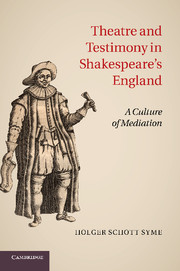
Book contents
- Frontmatter
- Contents
- Illustrations
- Acknowledgments
- Textual note
- Abbreviations
- Introduction: The authenticity of mediation
- Chapter 1 Trial representations
- Chapter 2 Judicial digest
- Chapter 3 Performance anxiety
- Chapter 4 Royal depositions
- Chapter 5 The reporter’s presence
- Epilogue: The theatre of the twice-told tale
- Select bibliography
- Index
- References
Chapter 1 - Trial representations
live and scripted testimony in criminal prosecutions
Published online by Cambridge University Press: 05 March 2012

Book contents
- Frontmatter
- Contents
- Illustrations
- Acknowledgments
- Textual note
- Abbreviations
- Introduction: The authenticity of mediation
- Chapter 1 Trial representations
- Chapter 2 Judicial digest
- Chapter 3 Performance anxiety
- Chapter 4 Royal depositions
- Chapter 5 The reporter’s presence
- Epilogue: The theatre of the twice-told tale
- Select bibliography
- Index
- References
Summary
This chapter offers a detailed account of how testimony acquired authority in early modern criminal trials. As I will argue, the recording and reproduction of depositions can be seen as a microcosmic instance of what I call the culture of mediation in Shakespeare’s time. As witness statements were written down, authority passed, to some extent, from speaker to recorder, from examinee to examiner, but not wholesale; instead, the authenticity of a deposition depended on a host of authorizing devices, agents, and manoeuvres, from signatures to oaths, and from narrative cohesion to the inherent credit of state-appointed officials. But although the process of recording testimony involved a remarkable dispersal of witnessing power and created an ever-growing number of second-level witnesses, ultimately, the documents generated in that process could only be used in court if reproduced orally, through the agency of a single mediating figure: the court clerk, whose speech returned the voices submerged under all those layers of authority to life. In all these transactions, moments of presence are displaced onto various representational acts, but not, crucially, in order to weaken their impact. On the contrary, the legal process relied on a dizzying array of gestures of mediation designed to produce a richly enhanced kind of presence-effect; at every turn, the process was underwritten by a logic that implies that authenticity is not an inherent quality of statements, but the result of a carefully constructed, multiply mediated representation. Trials and pretrial procedures thus not only staged a complex interplay of writing and speech that has been largely overlooked by legal historians, they also relied broadly on a strategy of dispersing authority among multiple agents, documents, and sources.
The reconstruction of these efforts at generating presence through deferral is complicated by the fact that, ideologically, the common law trial was meant to be dominated by a sort of procedural presentism. In the small number of early modern doctrinal treatments of criminal trials, they are imagined as a largely unmediated confrontation between accuser and accused, observed by an attentive jury. As I will show in my first section, however, this ideological imaginary only captures the presence-effects produced via the system of representation I have begun to outline above. The reassembly of that system from scattered and often fragmentary archival remains will occupy the bulk of this chapter and the next, but we can get a preliminary glimpse of its workings through a seventeenth-century manual for court clerks. Accordingly, I will begin my discussion by juxtaposing that practical guidebook with a close reading of the best-known theoretical account of the criminal trial, authored by the same Sir Thomas Smith E. K. cited in the Shepheardes Calender.
Information
- Type
- Chapter
- Information
- Theatre and Testimony in Shakespeare's EnglandA Culture of Mediation, pp. 26 - 71Publisher: Cambridge University PressPrint publication year: 2011
References
‘Beyond Reasonable Doubt’ and ‘Probable Cause’: Historical Perspectives on the Anglo-American Law of EvidenceBerkeleyUniversity of California Press 1991 189Google Scholar
: Ramism, Rhetoric, and the Genealogy of English JurisprudenceLegal Hermeneutics: History, Theory, and PracticeBerkeleyUniversity of California Press 1992 43Google Scholar
Rethinking the “Spectacle of the Scaffold”: Juridical Epistemologies and English Revenge TragedyRepresentations 89 2005 30CrossRefGoogle Scholar
Classical Rhetoric and the English Law of EvidenceRhetoric and the Law in Early Modern EuropeNew HavenYale University Press 2001 54Google Scholar
The Commoning of the Common Law: The Renaissance Debate over Printing English Law, 1520–1640University of Pennsylvania Law Review 146 1998 323CrossRefGoogle Scholar
Forms of Nationhood: The Elizabethan Writing of EnglandUniversity of Chicago Press 1992 63Google Scholar
Trial by the Book? Fact and Theory in the Criminal Process, 1558–1625Legal Records and the HistorianLondonRoyal Historical Society 1978 60Google Scholar
The Privilege and Common Law Criminal Procedure: The Sixteenth to the Eighteenth CenturiesThe Privilege against Self-Incrimination: Its Origins and DevelopmentUniversity of Chicago Press 1997 82Google Scholar
The State and Social Change in Early Modern England, c.1550–1640BasingstokeMacmillan 2000Google Scholar
The Criminal Trial in Later Medieval England: Felony before the Courts from Edward I to the Sixteenth CenturyUniversity of Toronto Press 1998 106
The Common Peace: Participation and the Criminal Law in Seventeenth-Century EnglandCambridge University Press 1987 84CrossRefGoogle Scholar
Noises Off: Participatory Justice in The Law in ShakespeareBasingstokePalgrave 2007 143CrossRefGoogle Scholar
Was the Jury ever Self Informing?Judicial Tribunals in England and Europe, 1200–1700Manchester University Press 2003 58Google Scholar
Verdict According to Conscience: Perspectives on the English Criminal Trial Jury, 1200–1800University of Chicago Press 1985 105CrossRefGoogle Scholar
From Tongue to Text: The Transmission of the Salem Witchcraft Examination RecordsAmerican Speech 82 2007 119CrossRefGoogle Scholar
Treason’s Reward: The Punishment of Conspirators in the Bye Plot of 1603The Historical Journal 38 1995 821CrossRefGoogle Scholar
“Ridiculous Fictions”: Making Distinctions in the Discourse of Witchcraftdifferences 7 1995 82Google Scholar
Languages of Law: From Logics of Memory to Nomadic MasksLondonWeidenfeld and Nicolson 1990 117Google Scholar
A Direction or Preparatiue to the Study of the LaweLondonThomas Wight 1600
Interpretation and Meaning in the Renaissance: The Case of Lawambridge University Press 1992 181Google Scholar
Speech – Manuscript – PrintMaking Meaning: ‘Printers of the Mind’ and Other EssaysAmherstUniversity of Massachusetts Press 2002 237Google Scholar
The Court of Star Chamber and its Records to the Reign of Elizabeth ILondonHMSO 1985 43Google Scholar
The Wonderfull Discoverie of Witches in the Countie of LancasterEarly Modern Witches: Witchcraft Cases in Contemporary WritingLondonRoutledge 2000 179Google Scholar
A House in Gross Disorder: Sex, Law, and the 2nd Earl of CastlehavenOxford University Press 1999 60Google Scholar
Criminal Courts and Procedure at Common Law, 1550–1800The Legal Profession and the Common LawLondonHambledon 1986 259Google Scholar
No Link: The Jury and the Origins of the Confrontation Right and the Hearsay Rule‘The Dearest Birth Right of the People of England’: The Jury in the History of Common LawOxfordHart 2002 93Google Scholar
The Invention of the Eyewitness: Witnessing and Testimony in Early Modern FranceChapel HillNorth Carolina Studies in the Romance Languages and Literatures 2004 124Google Scholar
Erinnerungsräume: Formen und Wandlungen des kulturellen GedächtnissesMunichBeck 2003 190Google Scholar
The Acoustic World of Early Modern England: Attending to the O-FactorUniversity of Chicago Press 1999Google Scholar
Communication, Knowledge, and Memory in Early Modern SpainPhiladelphiaUniversity of Pennsylvania Press 2004Google Scholar
The Uses of Script and Print, 1300–1700Cambridge University Press 2004
“These fewe scribbled rules”: Representing Scribal Intimacy in Early Modern PrintHLQ 67 2004 295Google Scholar
Custom and the Social Organization of Writing in Early Modern EnglandTransactions of the Royal Historical Society 9 1999 257CrossRefGoogle Scholar
Der Schein der Person: Steckbrief, Ausweis und Kontrolle im MittelalterMunichBeck 2004Google Scholar
Writing Matter: From the Hands of the English RenaissanceStanford University Press 1990 245Google Scholar
The Origin of Holographic Wills in English LawJournal of Legal History 15 1994 97CrossRefGoogle Scholar
Accessibility standard: Unknown
Why this information is here
This section outlines the accessibility features of this content - including support for screen readers, full keyboard navigation and high-contrast display options. This may not be relevant for you.Accessibility Information
Accessibility compliance for the PDF of this chapter is currently unknown
and may be updated in the future.