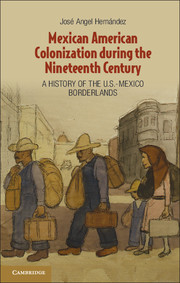
 Mexican American Colonization during the Nineteenth Century
 A History of the U.S.-Mexico Borderlands
Book contents
- Frontmatter
- Contents
- Figures
- Acknowledgments
- Introduction
- Part I Migration to Mexico in an Age of Global Immigrations
- Chapter One From Conquest to Colonization
- Chapter Two Postwar Expulsions and Early Repatriation Policy
- Part II México Perdido and the Making of Postwar Repatriation Programs Along the Borderlands
- Chapter Three Postwar Repatriation and Settling the Frontiers of New Mexico
- Chapter Four Repatriations Along the International Boundary
- Part III The Local Mixing, Unmixing, and Remixing of a Repatriate Colony in Chihuahua
- Chapter Five The 1871 Riot of La Mesilla, New Mexico
- Chapter Six Colonizing La Ascensión, Chihuahua
- Chapter Seven Anatomy of The 1892 Revolt of La Ascensión, or the Public Lynching of Rafael Ancheta
- Conclusion Repatriating Modernity?
- Bibliography
- Index
- References
Chapter One - From Conquest to Colonization
The Making of Mexican Colonization Policy After Independence
Published online by Cambridge University Press: 05 June 2012

Book contents
- Frontmatter
- Contents
- Figures
- Acknowledgments
- Introduction
- Part I Migration to Mexico in an Age of Global Immigrations
- Chapter One From Conquest to Colonization
- Chapter Two Postwar Expulsions and Early Repatriation Policy
- Part II México Perdido and the Making of Postwar Repatriation Programs Along the Borderlands
- Chapter Three Postwar Repatriation and Settling the Frontiers of New Mexico
- Chapter Four Repatriations Along the International Boundary
- Part III The Local Mixing, Unmixing, and Remixing of a Repatriate Colony in Chihuahua
- Chapter Five The 1871 Riot of La Mesilla, New Mexico
- Chapter Six Colonizing La Ascensión, Chihuahua
- Chapter Seven Anatomy of The 1892 Revolt of La Ascensión, or the Public Lynching of Rafael Ancheta
- Conclusion Repatriating Modernity?
- Bibliography
- Index
- References
Summary
This first chapter examines how the demographic and strategic position of Indios Bárbaros, immigrants, migrant Indians, and Mexicans north of the Rio Grande influenced the direction and ultimate implementation of immigration-cum-colonization policies after Mexican independence. Many intellectuals of the era argued that one of the primary reasons for dramatic U.S. economic growth and aggressive westward expansion was the arrival of European immigrants – a global phenomenon on which Mexico also sought to capitalize. But, unlike its neighbors, Mexico received few of these immigrants because of restrictive policies influenced by botched colonization schemes, lower wages, three Spanish expulsions, and religious intolerance against non-Catholics. Mexican colonization policy fluctuated between inclusion and exclusion, but ultimately these early trials and tribulations became the basis for a series of laws that would ultimately give preferential treatment to Mexicans willing to settle and colonize the frontiers of the Republic.
These conclusions contradict a view in the immigration and colonization historiography that suggests these policies were implemented solely to “whiten” the populations like those in the United States, Argentina, or Brazil. Aside from emerging in a period that witnessed the movement of millions of people across the globe, Mexico’s immigration policies emerged in large part as a way to incorporate the majority of the indigenous populace into the larger “Mexican family,” but also as a way to “Mexicanize” communities outside of state control like those residing on the frontiers of Tejas, Alta California, and Nuevo Mexico. The botched colonization project of Stephen F. Austin in Texas in the early 1820s – a project that set in motion the confrontation between Mexico and the United States in 1846 – forever altered not only the politics of colonization in Mexico, but the very way in which Mexican national identity was imagined. Populations along the newly independent nation’s frontiers, many of whom had been neglected for generations under the Spanish Empire, were now being courted to thwart European and Euro American immigrants making their way toward Texas and the frontiers of the two republics.
Information
- Type
- Chapter
- Information
- Mexican American Colonization during the Nineteenth CenturyA History of the U.S.-Mexico Borderlands, pp. 25 - 66Publisher: Cambridge University PressPrint publication year: 2012
References
2002
The Uses of Failure in Mexican Literature and IdentityAustinUniversity of Texas Press 2004Google Scholar
Logics of History: Social Theory and Social TransformationChicagoThe University of Chicago Press 2005CrossRefGoogle Scholar
Colonización e inmigración extranjera durante las primeras décadas del siglo xixBoletín bibliográfico de la Secretaria de Hacienda y Crédito 412 1973 4Google Scholar
Proyectos liberales de colonización en el siglo XIXLa palabra y el hombre 52, 1984 129Google Scholar
Small Numbers, Great Impact: Mexico and Its Immigrants, 1821–1973Journal of American Ethnic History 2001 23Google Scholar
Reform Before Liberals, Conservatives and the Debate Over Immigration, 1846–1855Mexican Studies/Estudios Mexicanos 23;2, 2007 283CrossRefGoogle Scholar
1980
A Continent of Immigrants: Postcolonial Shifts in the Western HemisphereHispanic American Historical Review 86:1, 2006 1CrossRefGoogle Scholar
Adventurers and Proletarians: The Story of Migrants in Latin AmericaPittsburghUniversity of Pittsburgh Press & UNESCO 1985Google Scholar
Exits from the Labyrinth: Culture and Ideology in the Mexican National SpaceBerkeleyUniversity of California Press 1992Google Scholar
Indigenism and Racism in Mexican Thought: 1857–1911Journal of Inter-American Studies 1, 1959 405CrossRefGoogle Scholar
Mexican Intellectuals and the Indian Question, 1876–1911The Hispanic American Historical Review 48, 1968 19CrossRefGoogle Scholar
1912
The Mexican Frontier, 1821–1846: The American Southwest Under MexicoAlbuquerqueUniversity of New Mexico Press 1982Google Scholar
Las ideas de un día; el pueblo mexicano ante la consumación de su independenciaMéxicoColegio de México 1969Google Scholar
The Economic History of Latin America Since IndependenceCambridgeCambridge University Press 2003CrossRefGoogle Scholar
2005
Forging of the Cosmic Race: A Reinterpretation of Colonial México, Expanded EditionLos AngelesUniversity of California Press 1990Google Scholar
The Other Rebellion: Popular Violence, Ideology, and the Mexican Struggle for Independence, 1810–1821StanfordStanford University Press 2001Google Scholar
Drinking, Homicide and Rebellion in Colonial Mexican VillagesStanfordStanford University Press 1976Google Scholar
Vanishing Indians: The Social Construction of Race in Colonial Sao PauloThe Americas 57, 2001 497CrossRefGoogle Scholar
Adventurers and Proletarians: The Story of Migrants in Latin AmericaPittsburghUniversity of Pittsburgh Press 1985Google Scholar
Immigration and Nationalism, Argentina and Chile, 1890–1914AustinUniversity of Texas Press 1970Google Scholar
Cousins and Strangers: Spanish Immigrants in Buenos Aires, 1850–1930BerkeleyUniversity of California Press 1998Google Scholar
Migration during 1820–1920, the First Global CenturyWorld Economic and Social Survey 2004 10Google Scholar
Juan Bautista Alberdi and his Influence on Immigration Policy in the Argentine Constitution of 1853The Americas 5 1948 3CrossRefGoogle Scholar
La expulsion de los españoles de México y su destino incierto, 1821–1836SevillaConsejo Superior de Investigaciones Científicas; Escuela de Estudios Hispano Americanos 2006Google Scholar
By the Sweat of Their Brow: Mexican Immigrant Labor in the United States, 1900–1940Westport, CTGreenwood Press 1976Google Scholar
The Sonoran Migration to California, 1848–1856: A Study in PrejudiceSouthern California Quarterly LVIII, 1976 333CrossRefGoogle Scholar
La sucesión presidencial en 1910. El partido nacional democráticoSan Pedro, Coahuila 1908Google Scholar
1968
War of a Thousand Deserts: Indian Raids and the US-Mexican WarNew HavenYale University Press 2008Google Scholar
Tadeo Ortiz, Mexican Emissary ExtraordinaryThe Hispanic American Historical Review 51 1971 463CrossRefGoogle Scholar
2002
Anglo American Migrants to the West: Men of Broken Fortunes? The Case of Texas, 1821–1846The Western Historical Quarterly 5 1974 441CrossRefGoogle Scholar
Descolonización en Mexico: El conflicto entre mexicanos y españoles (1821–1831)MéxicoFondo de la Cultura Económica 1982Google Scholar
The Expulsion of Mexico’s Spaniards, 1821–1836,PittsburghUniversity of Pittsburgh Press 1990Google Scholar
La expulsión de los españoles de México y su destino incierto, 1821–1836SevillaDiputación de Sevilla 2006Google Scholar
1994
Accessibility standard: Unknown
Why this information is here
This section outlines the accessibility features of this content - including support for screen readers, full keyboard navigation and high-contrast display options. This may not be relevant for you.Accessibility Information
Accessibility compliance for the PDF of this chapter is currently unknown
and may be updated in the future.
- 1
- Cited by