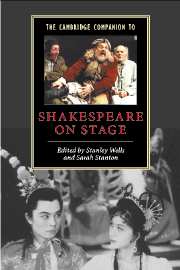
Book contents
- Frontmatter
- 1 Shakespeare plays on Renaissance stages
- 2 Improving Shakespeare: from the Restoration to Garrick
- 3 Romantic Shakespeare
- 4 Pictorial Shakespeare
- 5 Reconstructive Shakespeare: reproducing Elizabethan and Jacobean stages
- 6 Twentieth-century performance: the Stratford and London companies
- 7 The tragic actor and Shakespeare
- 8 The comic actor and Shakespeare
- 9 Women and Shakespearean performance
- 10 International Shakespeare
- 11 Touring Shakespeare
- 12 Shakespeare on the political stage in the twentieth century
- 13 Shakespeare in North America
- 14 Shakespeare on the stages of Asia
- 15 Shakespeare and Africa
- Further reading
- Index
9 - Women and Shakespearean performance
Published online by Cambridge University Press: 28 May 2006
By

Book contents
- Frontmatter
- 1 Shakespeare plays on Renaissance stages
- 2 Improving Shakespeare: from the Restoration to Garrick
- 3 Romantic Shakespeare
- 4 Pictorial Shakespeare
- 5 Reconstructive Shakespeare: reproducing Elizabethan and Jacobean stages
- 6 Twentieth-century performance: the Stratford and London companies
- 7 The tragic actor and Shakespeare
- 8 The comic actor and Shakespeare
- 9 Women and Shakespearean performance
- 10 International Shakespeare
- 11 Touring Shakespeare
- 12 Shakespeare on the political stage in the twentieth century
- 13 Shakespeare in North America
- 14 Shakespeare on the stages of Asia
- 15 Shakespeare and Africa
- Further reading
- Index
Summary
The Elizabethan and Jacobean stage
I shall see
Some squeaking Cleopatra boy my greatness
I’th’posture of a whore.
(Antony, 5.2.218–20)Cleopatra, Juliet, Lady Macbeth, Rosalind, Viola and Olivia, and all the rest of the approximately 140 named female roles in Shakespeare, were written as roles for boys or young men. We do not know what the considerable number of women in the audience felt about their exclusion from the stage, either as actors or as writers. On the one hand, they were 'represented' by a male writer's concept and a male performer's body; on the other hand, the many speeches throughout Shakespeare's plays that refer to this fact create a unique bond of sophisticated complicity between actor and audience. It would, after all, have been a 'squeaking boy' who first uttered these words on the stage of the Globe, as his performance moved towards the climax of Cleopatra's great threnody. Shakespeare seems to have written in the confidence that the young actor would perform the role with far greater expertise than his character's derogatory comment suggests.
The age of puberty for males in the early seventeenth century was probablylater than it is today; and the adolescent boy can often seem androgynous,his voice not fully broken, his body slim and childish.
Information
- Type
- Chapter
- Information
- The Cambridge Companion to Shakespeare on Stage , pp. 155 - 173Publisher: Cambridge University PressPrint publication year: 2002
Accessibility standard: Unknown
Why this information is here
This section outlines the accessibility features of this content - including support for screen readers, full keyboard navigation and high-contrast display options. This may not be relevant for you.Accessibility Information
Accessibility compliance for the PDF of this chapter is currently unknown
and may be updated in the future.