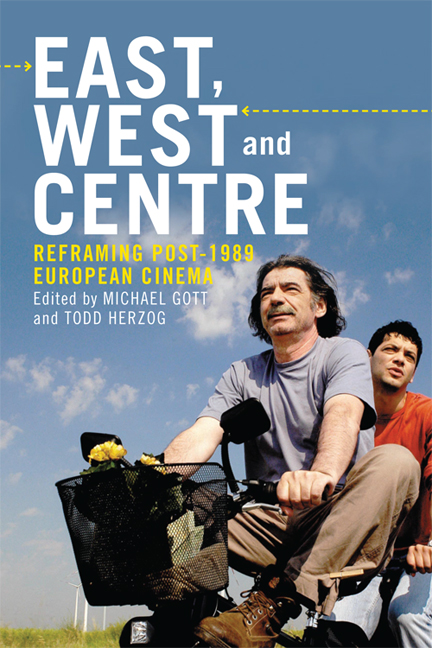
Book contents
- Frontmatter
- Contents
- List of Figures
- Notes on Contributors
- Acknowledgements
- Introduction: East, West and Centre: ‘Mapping Post-1989 European Cinema’
- Part I Redrawing the Lines: De/Recentring Europe
- Part II Border Spaces, Eastern Margins and Eastern Markets: Belonging and the Road to/from Europe
- 8 Contemporary Bulgarian Cinema: From Allegorical Expressionism to Declined National Cinema
- 9 The Point of No Return: From Great Expectations to Great Desperation in New Romanian Cinema
- 10 ‘Weirdness’, Modernity and the Other Europe in Attenberg (2010, Athina Rachel Tsangari)
- 11 Lithuania Redirected: New Connections, Businesses and Lifestyles in Cinema since 2000
- 12 Lessons of Neo-liberalism: Co-productions and the Changing Image of Estonian Cinema
- 13 Decentring Europe from the Fringe: Reimagining Balkan Identities in the Films of the 1990s
- Part III Spectres of the East
- Notes
- Bibliography
- Index
9 - The Point of No Return: From Great Expectations to Great Desperation in New Romanian Cinema
from Part II - Border Spaces, Eastern Margins and Eastern Markets: Belonging and the Road to/from Europe
Published online by Cambridge University Press: 05 September 2016

Book contents
- Frontmatter
- Contents
- List of Figures
- Notes on Contributors
- Acknowledgements
- Introduction: East, West and Centre: ‘Mapping Post-1989 European Cinema’
- Part I Redrawing the Lines: De/Recentring Europe
- Part II Border Spaces, Eastern Margins and Eastern Markets: Belonging and the Road to/from Europe
- 8 Contemporary Bulgarian Cinema: From Allegorical Expressionism to Declined National Cinema
- 9 The Point of No Return: From Great Expectations to Great Desperation in New Romanian Cinema
- 10 ‘Weirdness’, Modernity and the Other Europe in Attenberg (2010, Athina Rachel Tsangari)
- 11 Lithuania Redirected: New Connections, Businesses and Lifestyles in Cinema since 2000
- 12 Lessons of Neo-liberalism: Co-productions and the Changing Image of Estonian Cinema
- 13 Decentring Europe from the Fringe: Reimagining Balkan Identities in the Films of the 1990s
- Part III Spectres of the East
- Notes
- Bibliography
- Index
Summary
Preamble
April 2011: a Romanian in his twenties, a poor worker residing in the small Spanish town of Torrejon de Ardez, kills his pregnant, nineteen-year-old Romanian fiancee. The last minutes of the ordeal and the corpse are filmed with a webcam and shown ‘live’ via the Internet to the family of the girl in their country of origin. The criminal is arrested within minutes as the parents reel from the traumatic shock.
This is neither a snuff movie nor the latest minimalist production of the New Romanian Wave which rose to worldwide fame in the first decade of the twenty-first century for its dark, sombre and depressive hyper-realist dramas. It is the depiction of only one of the many stories revealing some of the sombre results of the exodus of a population coming from a ‘marginal space’ of Europe, a nation that woke up from the communist nightmare confused about its identity, living a permanent ‘frontier situation’ and ‘still in the search of the way ahead’ (Boia 2001: 12–13, 27).
Twenty-five years after the fall of the communism, Romanian villages are depopulated. The locals, once not even allowed to hold a passport, are now leaving the country at an alarming and increasing rate. The often tragic results of this exodus are nevertheless profound, with dramatic long-term consequences. Thousands of children are left without proper supervision or education. The family, once at the centre of patriarchal society, has been destroyed in the desperate rush of parents towards the West. A good number of their children will later become criminals, closing a vicious circle. This is the dramatic resort of Eu cand vreau să fluier, fluier When I want to whistle, I whistle (Florin ‘erban, 2010, Romania/Sweden/Germany) and the philosophy behind Periferic Outbound (Bogdan George Apetri, 2011, Romania), the film that closes stylistically the first decade of New Romanian Cinema. The young criminal from Torrejon de Ardez, Spain might easily have been Paul, the protagonist from Outbound.
Information
- Type
- Chapter
- Information
- East, West and CentreReframing post-1989 European Cinema, pp. 147 - 158Publisher: Edinburgh University PressPrint publication year: 2014
Accessibility standard: Unknown
Why this information is here
This section outlines the accessibility features of this content - including support for screen readers, full keyboard navigation and high-contrast display options. This may not be relevant for you.Accessibility Information
Accessibility compliance for the PDF of this chapter is currently unknown
and may be updated in the future.