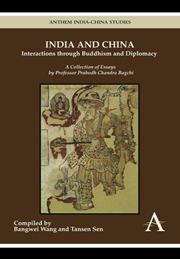
 India and China: Interactions through Buddhism and Diplomacy
 A Collection of Essays by Professor Prabodh Chandra Bagchi
Book contents
- Frontmatter
- Contents
- Compilers' Note
- Introduction (English and Chinese)
- Part One
- 1 Ancient Chinese Names of India
- 2 The Beginnings of Buddhism in China
- 3 Indian Influence on Chinese Thought
- 4 A Note on the Avadānaśataka and its Chinese Translation
- 5 Bodhisattva-śīla of Śubhākarasiṁha
- 6 A Fragment of the Kāśyapa Saṁhitā in Chinese
- 7 The Chinese Mysticism
- 8 Some Early Buddhist Missionaries of Persia in China
- 9 Some Letters of Hiuan-Tsang and his Indian Friends
- 10 New Lights on the Chinese Inscriptions of Bodhgayā
- 11 A Buddhist Monk of Nālandā amongst the Western Turks
- 12 Political Relations between Bengal and China in the Pathan Period
- 13 Chinese Coins from Tanjore
- 14 Report on a New Hoard of Chinese Coins
- 15 Ki-pin and Kashmir
- 16 Sino-Indian Relations – The Period of the United Empires (618–1100 A.D.)
- Part Two Short Articles
- Part Three Articles in Bengali
- Appendix
- Index
12 - Political Relations between Bengal and China in the Pathan Period
from Part One
Published online by Cambridge University Press: 05 March 2012
Book contents
- Frontmatter
- Contents
- Compilers' Note
- Introduction (English and Chinese)
- Part One
- 1 Ancient Chinese Names of India
- 2 The Beginnings of Buddhism in China
- 3 Indian Influence on Chinese Thought
- 4 A Note on the Avadānaśataka and its Chinese Translation
- 5 Bodhisattva-śīla of Śubhākarasiṁha
- 6 A Fragment of the Kāśyapa Saṁhitā in Chinese
- 7 The Chinese Mysticism
- 8 Some Early Buddhist Missionaries of Persia in China
- 9 Some Letters of Hiuan-Tsang and his Indian Friends
- 10 New Lights on the Chinese Inscriptions of Bodhgayā
- 11 A Buddhist Monk of Nālandā amongst the Western Turks
- 12 Political Relations between Bengal and China in the Pathan Period
- 13 Chinese Coins from Tanjore
- 14 Report on a New Hoard of Chinese Coins
- 15 Ki-pin and Kashmir
- 16 Sino-Indian Relations – The Period of the United Empires (618–1100 A.D.)
- Part Two Short Articles
- Part Three Articles in Bengali
- Appendix
- Index
Summary
Sources of Information
Political relations between India and China practically come to a close with the end of the Buddhist period. There is no reference in the Chinese records to any exchange of ambassadors after the T'ang period. There is neither any mention of Indian missionaries going to China after the middle of the 11th century. There was however an attempt to resume political relations between the two countries in the Ming period but it succeeded only temporarily. The Chinese official records of this period reveal a complete ignorance of the former relations between the two countries. The records sometimes show that the Chinese writers had even forgotten the geography of India and considered parts of it as countries outside India.
There are a number of records on the exchange of embassies between Bengal and China during the first half of the 15th century. These records have a special interest in so far as they throw light from an unexpected quarter on the political, social and economic condition of Bengal in the 15th century. Two of these records had been formerly translated by Rockhill in T'oung Pao, 1915, pp. 436–444. There are however a few more which are more complete and precise than the former in certain respects. They have now been, translated with the help of my friend and colleague in the Visva-Bharati, Mr. Hsiaoling Wu. I have thought it fit to publish these records here along with those previously translated by Rockhill which also have been partly revised.
Information
- Type
- Chapter
- Information
- India and China: Interactions through Buddhism and DiplomacyA Collection of Essays by Professor Prabodh Chandra Bagchi, pp. 109 - 136Publisher: Anthem PressPrint publication year: 2011
Accessibility standard: Unknown
Why this information is here
This section outlines the accessibility features of this content - including support for screen readers, full keyboard navigation and high-contrast display options. This may not be relevant for you.Accessibility Information
Accessibility compliance for the PDF of this chapter is currently unknown
and may be updated in the future.