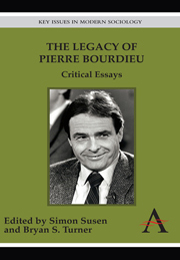
Book contents
- Frontmatter
- Contents
- List of Contributors
- Introduction: Preliminary Reflections on the Legacy of Pierre Bourdieu
- 1 Between Structuralism and Theory of Practice: The Cultural Sociology of Pierre Bourdieu
- 2 Pierre Bourdieu: Unorthodox Marxist?
- 3 From Marx to Bourdieu: The Limits of the Structuralism of Practice
- 4 Durkheim and Bourdieu: The Common Plinth and its Cracks
- 5 With Weber Against Weber: In Conversation With Pierre Bourdieu
- 6 Bourdieu and Nietzsche: Taste as a Struggle
- 7 Elias and Bourdieu
- 8 Bourdieu and Adorno on the Transformation of Culture in Modern Society: Towards a Critical Theory of Cultural Production
- 9 The Grammar of an Ambivalence: On the Legacy of Pierre Bourdieu in the Critical Theory of Axel Honneth
- 10 Pierre Bourdieu and the Sociology of Religion
- 11 Bourdieu's Sociological Fiction: A Phenomenological Reading of Habitus
- 12 Overcoming Semiotic Structuralism: Language and Habitus in Bourdieu
- 13 Social Theory and Politics: Aron, Bourdieu and Passeron, and the Events of May 1968
- 14 Intellectual Critique and the Public Sphere: Between the Corporatism of the Universal and the Realpolitik of Reason
- 15 Practice as Temporalisation: Bourdieu and Economic Crisis
- Afterword: Concluding Reflections on the Legacy of Pierre Bourdieu
- Index of Names
- Index of Subjects
- Plate section
10 - Pierre Bourdieu and the Sociology of Religion
Published online by Cambridge University Press: 05 March 2012

Book contents
- Frontmatter
- Contents
- List of Contributors
- Introduction: Preliminary Reflections on the Legacy of Pierre Bourdieu
- 1 Between Structuralism and Theory of Practice: The Cultural Sociology of Pierre Bourdieu
- 2 Pierre Bourdieu: Unorthodox Marxist?
- 3 From Marx to Bourdieu: The Limits of the Structuralism of Practice
- 4 Durkheim and Bourdieu: The Common Plinth and its Cracks
- 5 With Weber Against Weber: In Conversation With Pierre Bourdieu
- 6 Bourdieu and Nietzsche: Taste as a Struggle
- 7 Elias and Bourdieu
- 8 Bourdieu and Adorno on the Transformation of Culture in Modern Society: Towards a Critical Theory of Cultural Production
- 9 The Grammar of an Ambivalence: On the Legacy of Pierre Bourdieu in the Critical Theory of Axel Honneth
- 10 Pierre Bourdieu and the Sociology of Religion
- 11 Bourdieu's Sociological Fiction: A Phenomenological Reading of Habitus
- 12 Overcoming Semiotic Structuralism: Language and Habitus in Bourdieu
- 13 Social Theory and Politics: Aron, Bourdieu and Passeron, and the Events of May 1968
- 14 Intellectual Critique and the Public Sphere: Between the Corporatism of the Universal and the Realpolitik of Reason
- 15 Practice as Temporalisation: Bourdieu and Economic Crisis
- Afterword: Concluding Reflections on the Legacy of Pierre Bourdieu
- Index of Names
- Index of Subjects
- Plate section
Summary
Introduction: The Secularisation Thesis
Whereas in recent years many of sociologists and philosophers have come to the conclusion that religion has to be taken seriously in debates about modern politics and the public sphere, such was not the case with many post-war social theorists. Louis Althusser, Luc Boltanski, Ralf Dahrendorf, Norbert Elias, Anthony Giddens, David Harvey, Edward Said and Göran Therborn either ignored religion or paid little attention to it, rather than treating it as a central aspect of modern society. Michel Foucault was probably alone in his consistent interest in religion – for example, in his essays on medieval Christian teaching on chastity and in his view of the Iranian Revolution as a form of spiritual politics. On a more personal note, he spoke about ‘spirituality’, that is, the ‘search, practice and experience through which the subject carries out the necessary transformations on himself in order to have access to the truth’ (Foucault, 2005 [2001]: 15). The majority of public intellectuals on the Left in the post-war period ignored religion as a spent force in modernity. What has changed? The obvious answer is that there are various transformations of social and political life that have placed religion as an institution at the centre of modern society. Religion now appears to be closely related to identity politics and has been the ideological driving force behind social movements such as Solidarity, ‘engaged Buddhism’ and Hindu nationalism.
Information
- Type
- Chapter
- Information
- The Legacy of Pierre BourdieuCritical Essays, pp. 223 - 246Publisher: Anthem PressPrint publication year: 2011
Accessibility standard: Unknown
Why this information is here
This section outlines the accessibility features of this content - including support for screen readers, full keyboard navigation and high-contrast display options. This may not be relevant for you.Accessibility Information
Accessibility compliance for the PDF of this chapter is currently unknown
and may be updated in the future.
- 10
- Cited by