Book contents
- Frontmatter
- Contents
- List of tables, figures and boxes
- FIGURES
- Acronyms
- Preface
- List of contributors
- 1 Introduction
- 2 Effects of growth, its interruption, and the Uruguay Round on Indonesian agriculture
- 3 Effects of AFTA and APEC trade policy reforms on Indonesian agriculture
- 4 Trade liberalisation and soil degradation in Indonesia
- 5 Will the Uruguay Round and APEC reforms harm air and water quality in Indonesia?
- 6 Impacts of agricultural protection growth at home and the WTO's Doha Round on Indonesian agriculture
- 7 Effects of agricultural policy reform on household and regional income distribution in Indonesia
- 8 Effects of farm policy reform on Indonesia's secondary food crops
- 9 Effects of agricultural policy reform in Indonesia on its food security and environment
- 10 Impacts of trade policy reform on income distribution and poverty in Indonesia
- APPENDIX 1 The WAYANG Model of the Indonesian economy
- APPENDIX 2 The GTAP Model and database
Preface
Published online by Cambridge University Press: 05 June 2012

Book contents
- Frontmatter
- Contents
- List of tables, figures and boxes
- FIGURES
- Acronyms
- Preface
- List of contributors
- 1 Introduction
- 2 Effects of growth, its interruption, and the Uruguay Round on Indonesian agriculture
- 3 Effects of AFTA and APEC trade policy reforms on Indonesian agriculture
- 4 Trade liberalisation and soil degradation in Indonesia
- 5 Will the Uruguay Round and APEC reforms harm air and water quality in Indonesia?
- 6 Impacts of agricultural protection growth at home and the WTO's Doha Round on Indonesian agriculture
- 7 Effects of agricultural policy reform on household and regional income distribution in Indonesia
- 8 Effects of farm policy reform on Indonesia's secondary food crops
- 9 Effects of agricultural policy reform in Indonesia on its food security and environment
- 10 Impacts of trade policy reform on income distribution and poverty in Indonesia
- APPENDIX 1 The WAYANG Model of the Indonesian economy
- APPENDIX 2 The GTAP Model and database
Summary
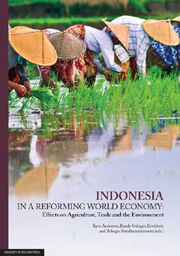
In the mid-1990s a joint research project was established between CASER (Bogor), CIES (Adelaide), CSIS (Jakarta) and RSPAS (at ANU, Canberra) to examine interactions between agriculture, trade and the environment in Indonesia. Funded by the Australian Centre for International Agricultural Research (ACIAR Project No. 9449), the specific objective of the project was to assess the production, consumption, trade, income distributional, regional, environmental, and welfare effects in Indonesia of structural and policy changes at home and abroad. Particular attention was to be paid to those structural and policy changes that could affect Indonesia's agricultural sector over the next 5-10 years. The implications of national and global economic growth, of regional and multilateral trade liberalisation initiatives, and of Indonesia's ongoing unilateral policy reforms were the initial focus of the study. However, with the onslaught of the financial crisis that began in the latter part of 1997, the project leaders added that issue to the research agenda.
The analysis draws on and adapts the global GTAP Model, which is a computable general equilibrium (CGE) model for the world economy within which there are sub-models for numerous individual economies including for Indonesia. The project began by also using a national CGE model for Indonesia, called INDOGEM, which was constructed in a previous ACIAR project by Ray Trewin and colleagues at the Australian National University (which in turn drew on a forestry-focused model developed by Philippa Dee of the Productivity Commission in Canberra).
Information
- Type
- Chapter
- Information
- Indonesia in a Reforming World EconomyEffects on Agriculture, Trade and the Environment, pp. xiv - xvPublisher: The University of Adelaide PressPrint publication year: 2009
Accessibility standard: Unknown
Why this information is here
This section outlines the accessibility features of this content - including support for screen readers, full keyboard navigation and high-contrast display options. This may not be relevant for you.Accessibility Information
Accessibility compliance for the PDF of this chapter is currently unknown
and may be updated in the future.