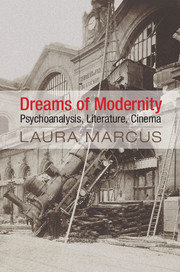
Book contents
- Frontmatter
- Dedication
- Contents
- Acknowledgements
- Introduction
- Chapter 1 The Lodger
- Chapter 2 Oedipus Express
- Chapter 3 Railway Reading
- Chapter 4 ‘From Autumn to Spring, Aesthetics Change’
- Chapter 5 ‘A Hymn to Movement’
- Chapter 6 Staging the ‘Private Theatre’
- Chapter 7 The Newness of the ‘New Biography’
- Chapter 8 European Witness
- Chapter 9 Dreaming and Cinematographic Consciousness
- Chapter 10 Directed Dreaming
- Chapter 11 ‘In the Circle of the Lens’
- Chapter 12 Virginia Woolf and the Art of the Novel
- Index
- References
Chapter 12 - Virginia Woolf and the Art of the Novel
Published online by Cambridge University Press: 05 November 2014

Book contents
- Frontmatter
- Dedication
- Contents
- Acknowledgements
- Introduction
- Chapter 1 The Lodger
- Chapter 2 Oedipus Express
- Chapter 3 Railway Reading
- Chapter 4 ‘From Autumn to Spring, Aesthetics Change’
- Chapter 5 ‘A Hymn to Movement’
- Chapter 6 Staging the ‘Private Theatre’
- Chapter 7 The Newness of the ‘New Biography’
- Chapter 8 European Witness
- Chapter 9 Dreaming and Cinematographic Consciousness
- Chapter 10 Directed Dreaming
- Chapter 11 ‘In the Circle of the Lens’
- Chapter 12 Virginia Woolf and the Art of the Novel
- Index
- References
Summary
In the last months of her life, Virginia Woolf was working on a writing project to which she gave the title ‘Reading at Random’. The first of her notes for this work is dated 18 September 1940. The book was to have an historical orientation – as Woolf wrote in the first entry, ‘Keep to time sequence’. But, she added, there should be ‘No “periods”: No text book’.
In a later note she wrote:
The 19th Cent. to consist of outlines of people.
Skip present day.
A Chapter on the future.
‘Reading at Random’ bears similarities to Woolf’s work, nearly two decades earlier, on the essays which became the two volumes of The Common Reader, Woolf’s working title for which was ‘Reading’. In the first reference to what would become The Common Reader, first series, Woolf wrote in her diary (23 May 1921): ‘I’m wondering how to shape my Reading book.’ Two years later (11 May 1923), she described ‘edg[ing] in a little time every now & then at Reading. I am at the Greek chapter (in reading). Shall I read a little Greek? … Or shall I plunge into early Elizabethans, of whom I am appallingly ignorant? What happened between Chaucer & Shakespeare. I think that attracts me as a basis’. The entry is interesting in part because it suggests a more linear model of literary history than The Common Reader in fact offers, in anticipation of ‘Reading at Random’.
Information
- Type
- Chapter
- Information
- Dreams of ModernityPsychoanalysis, Literature, Cinema, pp. 238 - 256Publisher: Cambridge University PressPrint publication year: 2014
References
, ‘“Anon” and “The Reader”: Virginia Woolf’s Last Essays’, edited by , Twentieth Century Literature 25 (1979): 356–441, 375Google Scholar
, The Diary of Virginia Woolf: Volume 2 1920–24, edited by (London: Hogarth Press, 1978), p. 120Google Scholar
, ‘Mr Conrad: a Conversation’, in The Essays of Virginia Woolf: Volume 3, 1919–1924, edited by (London: Hogarth Press, 1988), p. 376Google Scholar
, ‘The Common Reader’, The Essays of Virginia Woolf: Volume 4, 1925–1928, edited by (London: Hogarth Press, 1994), p. 19Google Scholar
, ‘What is the Contemporary?’, in What Is an Apparatus? and Other Essays, translated by and (Stanford: Stanford University Press, 2009), pp. 39–54Google Scholar
, ‘Theses on the Philosophy of History’, in Illuminations, translated by (New York: Harcourt, Brace and World, 1968), pp. 253–264Google Scholar
, ‘Lady Hester Stanhope’, in The Essays of Virginia Woolf: Volume 1, 1904–1912, edited by (London: Hogarth Press, 1986), p. 327Google Scholar
, ‘Art as Technique’, in Russian Formalist Criticism: Four Essays, edited by and (Lincoln: University of Nebraska Press, 1965), pp. 3–24, 17Google Scholar
, Transition: Essays on Contemporary Literature (London: Hogarth Press, 1926), pp. 4–5Google Scholar
, The Use and Abuse of History for Life, translated by (New York: Macmillan, 1985), p. 8Google Scholar
, ‘Phases of Fiction’, in The Essays of Virginia Woolf: Volume 5, 1929–1932, edited by (London: Hogarth Press, 2009), p. 83Google Scholar
, ‘Hours in a Library’, in The Essays of Virginia Woolf: Volume 2, 1912–1918, edited by (London: Hogarth Press, 1987), p. 58Google Scholar
, The Diary of Virginia Woolf: Volume 3 1925–30, edited by (London: Hogarth Press, 1980), pp. 50–51Google Scholar
, letter to (9 October 1927), in A Change of Perspective: The Letters of Virginia Woolf 1923–1928, edited by (London: Chatto and Windus, 1977), pp. 428–429Google Scholar
Accessibility standard: Unknown
Why this information is here
This section outlines the accessibility features of this content - including support for screen readers, full keyboard navigation and high-contrast display options. This may not be relevant for you.Accessibility Information
Accessibility compliance for the PDF of this chapter is currently unknown
and may be updated in the future.