Book contents
- Frontmatter
- Contents
- Acknowledgements
- Introduction
- 1 Personal Law and Citizenship in India's Transition to Independence
- 2 From Subjects to Citizens? Rationing, Refugees and the Publicity of Corruption over Independece in UP
- 3 Performing Peace: Gandhi's Assassination as a Critical Moment in the Consolidation of the Nehruvian State
- 4 Migration, Citizenship and Belonging in Hyderabad (Deccan), 1946–1956
- 5 Punjabi Refugees' Rehabilitation and the Indian State: Discourses, Denials and Dissonances
- 6 Sovereignty, Governmentality and Development in Ayub's Pakistan: The Case of Korangi Township
- 7 Everyday Expectations of the State during Pakistan's Early Years: Letters to the Editor, Dawn (Karachi), 1950–1953
- 8 Concrete ‘Progress’: Irrigation, Development and Modernity in Mid-Twentieth Century Sind
- 9 Partition Narratives: Displaced Trauma and Culpability among British Civil Servants in 1940s Punjab
- Contributors
- Index
9 - Partition Narratives: Displaced Trauma and Culpability among British Civil Servants in 1940s Punjab
Published online by Cambridge University Press: 05 February 2014

Book contents
- Frontmatter
- Contents
- Acknowledgements
- Introduction
- 1 Personal Law and Citizenship in India's Transition to Independence
- 2 From Subjects to Citizens? Rationing, Refugees and the Publicity of Corruption over Independece in UP
- 3 Performing Peace: Gandhi's Assassination as a Critical Moment in the Consolidation of the Nehruvian State
- 4 Migration, Citizenship and Belonging in Hyderabad (Deccan), 1946–1956
- 5 Punjabi Refugees' Rehabilitation and the Indian State: Discourses, Denials and Dissonances
- 6 Sovereignty, Governmentality and Development in Ayub's Pakistan: The Case of Korangi Township
- 7 Everyday Expectations of the State during Pakistan's Early Years: Letters to the Editor, Dawn (Karachi), 1950–1953
- 8 Concrete ‘Progress’: Irrigation, Development and Modernity in Mid-Twentieth Century Sind
- 9 Partition Narratives: Displaced Trauma and Culpability among British Civil Servants in 1940s Punjab
- Contributors
- Index
Summary
Introduction
Partition narratives recorded in the wake of the transition of power in 1947 envelop the period in terms of personal experience. Men and women who bore witness to the state change, and its accompanying violence, recorded their experiences in memoirs, often processing this information in such a way as to attempt to come to terms with the shock of what had happened, as well as potentially releasing their lingering feelings of guilt for their involvement. Recent scholarship has extended understanding of the change from being ‘subjects’ to ‘citizens’, and offers a more universal picture of what ‘transfer of power’ really meant for individuals. Although the emerging narratives are fragmented by the trauma of partition experiences, they nonetheless offer the historian an insight into the memorialisation used within communities to come to terms with the grim events of the partition period. For one group, however, the historian's image remains relatively faceless. Although the Indian Civil Service (ICS) warrants substantial coverage as a bureaucratic organization, and as a site for the examination of late colonial imperial mentalities, the personal face of individual administrators at district level has been surprisingly neglected around the specific period of independence and partition. Scholarship covering the early twentieth century puts a face to district administration, in terms of the male civil servants' backgrounds and approaches on arrival in the subcontinent. As for the subjects of the colonial regime, however, the transfer of power in 1947 had more than a professional impact on its administrative officers.
Information
- Type
- Chapter
- Information
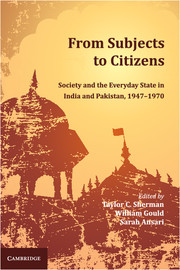
- From Subjects to CitizensSociety and the Everyday State in India and Pakistan, 1947–1970, pp. 216 - 240Publisher: Cambridge University PressPrint publication year: 2014
Accessibility standard: Unknown
Why this information is here
This section outlines the accessibility features of this content - including support for screen readers, full keyboard navigation and high-contrast display options. This may not be relevant for you.Accessibility Information
Accessibility compliance for the PDF of this chapter is currently unknown
and may be updated in the future.