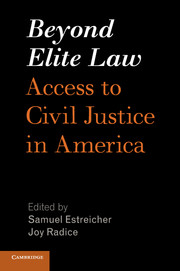
Book contents
- Frontmatter
- Contents
- Beyond Elite Law
- Foreword
- List of Contributors
- Overview
- Overview
- PART I CURRENT STATE OF ACCESS TO LEGAL SERVICES
- PART II SOURCES OF LEGAL SERVICES ASSISTANCE FOR WORKING AMERICANS
- 10 Evolution of Legal Services in the United States: From the War on Poverty to Civil Gideon and Beyond
- 11 The Effect of Contingent Fees and Statutory Fee-Shifting
- 12 The Market for Recent Law Graduates
- 13 Clinical Legal Education and Access to Justice: Conflicts, Interests, and Evolution
- 14 Loan Repayment Assistance and Access to Justice
- 15 Federally Funded Civil Legal Services
- 16 New York's Lawyer Referral Services
- 17 Growth of Large Law Firm Pro Bono Programs
- 18 Institutionalizing Pro Bono
- 19 Pro Bono as a Second Career
- 20 Employer-Provided Legal Services for Employment Claims
- 21 Company-Provided Legal Services
- 22 Individualized Justice in Class and Collective Actions
- PART III FASHIONING A REFORM AGENDA
- PART IV CREATING A CULTURE OF SERVICE
- Index
11 - The Effect of Contingent Fees and Statutory Fee-Shifting
from PART II - SOURCES OF LEGAL SERVICES ASSISTANCE FOR WORKING AMERICANS
Published online by Cambridge University Press: 05 May 2016

Book contents
- Frontmatter
- Contents
- Beyond Elite Law
- Foreword
- List of Contributors
- Overview
- Overview
- PART I CURRENT STATE OF ACCESS TO LEGAL SERVICES
- PART II SOURCES OF LEGAL SERVICES ASSISTANCE FOR WORKING AMERICANS
- 10 Evolution of Legal Services in the United States: From the War on Poverty to Civil Gideon and Beyond
- 11 The Effect of Contingent Fees and Statutory Fee-Shifting
- 12 The Market for Recent Law Graduates
- 13 Clinical Legal Education and Access to Justice: Conflicts, Interests, and Evolution
- 14 Loan Repayment Assistance and Access to Justice
- 15 Federally Funded Civil Legal Services
- 16 New York's Lawyer Referral Services
- 17 Growth of Large Law Firm Pro Bono Programs
- 18 Institutionalizing Pro Bono
- 19 Pro Bono as a Second Career
- 20 Employer-Provided Legal Services for Employment Claims
- 21 Company-Provided Legal Services
- 22 Individualized Justice in Class and Collective Actions
- PART III FASHIONING A REFORM AGENDA
- PART IV CREATING A CULTURE OF SERVICE
- Index
Summary
Contingent-fee and statutory fee-shifting provisions shift costs away from the client and to the back end of the litigation. David Noll's analysis suggests that even with these arrangements, only a limited number of attorneys are willing and able to finance plaintiff-side litigation. The result is that the demand for legal assistance in cases with fee-shifting devices exceeds the supply of lawyers who handle these cases. Noll concludes that alternative payment arrangements that place the burden of costs on the lawyer will not solve the affordability problem.
Litigation is time-consuming, and the complexity of American law and importance of understanding court procedure place pro se litigants at a demonstrable disadvantage to counseled parties. But, for the victim of a legal injury, the cost of representation may be so high that the only viable way to assert a claim is to proceed pro se. The high cost of legal services therefore can lead to a denial of justice in a very practical sense. Though an individual is formally entitled to a remedy, the cost of claiming makes obtaining one impossible.
Such access-preclusive costs result in part from two norms governing attorney fees in the United States: the “American” rule of attorney fees, whereby litigants are responsible for their own attorney fees, and the practice of charging for legal services on an hourly basis. It is therefore unsurprising that legal policymakers have attempted to expand court access by authorizing departures from those norms. “No win no fee” contingent-fee agreements and statutory fee-shifting provisions both modify the timing of payment for legal services; instead of being paid as services are rendered, an attorney is paid upon obtaining a recovery. In the case of fee-shifting provisions, ultimate responsibility for the cost of legal services is also transferred to the losing defendant.
But what effect do these ameliorative mechanisms have on the basic problem of access-preclusive costs? Do they ensure that individuals with meritorious claims are able to make use of the civil justice system?
In one sense the answer is easy. Domestic relations disputes, for instance, make up a significant proportion of Americans’ legal problems, but the coverage of fee-shifting statutes in this context is sporadic, and ethical rules generally prohibit contingency fees paid to outcomes such as a divorce.
Information
- Type
- Chapter
- Information
- Beyond Elite LawAccess to Civil Justice in America, pp. 170 - 183Publisher: Cambridge University PressPrint publication year: 2016
Accessibility standard: Unknown
Why this information is here
This section outlines the accessibility features of this content - including support for screen readers, full keyboard navigation and high-contrast display options. This may not be relevant for you.Accessibility Information
Accessibility compliance for the PDF of this chapter is currently unknown
and may be updated in the future.