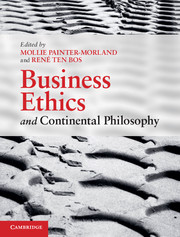
Book contents
- Frontmatter
- Contents
- Figures
- Boxes
- Contributors
- Foreword
- Acknowledgements
- Introduction: critical crossings
- 1 Agency in corporations
- 2 Stakeholder theory
- 3 Organizational culture
- 4 Enron narrative
- 5 Moral decision-making
- 6 Organizational justice
- 7 Reward, incentive, and compensation
- 8 Leadership
- 9 Whistle-blowing
- 10 Marketing, bad faith, and responsibility
- 11 Corporate social responsibility
- 12 Corporate responsibility standards
- 13 Sustainability
- 14 Globalization
- Glossary
- Name index
- Subject index
- References
6 - Organizational justice
Published online by Cambridge University Press: 05 June 2012
By

Book contents
- Frontmatter
- Contents
- Figures
- Boxes
- Contributors
- Foreword
- Acknowledgements
- Introduction: critical crossings
- 1 Agency in corporations
- 2 Stakeholder theory
- 3 Organizational culture
- 4 Enron narrative
- 5 Moral decision-making
- 6 Organizational justice
- 7 Reward, incentive, and compensation
- 8 Leadership
- 9 Whistle-blowing
- 10 Marketing, bad faith, and responsibility
- 11 Corporate social responsibility
- 12 Corporate responsibility standards
- 13 Sustainability
- 14 Globalization
- Glossary
- Name index
- Subject index
- References
Summary
Goals of this chapter
After studying this chapter you will be able to:
articulate the ways in which management and business ethics researchers have approached and developed the idea of organizational justice;
distinguish between the three most commonly defined dimensions of organizational justice: distributive justice, procedural justice, and interactional justice;
explain how management and business ethics researchers have understood the relationship between justice and ethics;
explain how the concept of justice is understood in the philosophy of Emmanuel Levinas and contrast this with the concept of justice used in the literature on organizational justice;
consider the radical implications of Levinas's understanding of justice for organizational justice;
understand the meaning of the term pleonexia and its relationship with justice in organizations.
Introduction
The idea of justice is philosophically sophisticated, culturally embedded, and practically enacted. Justice has had massive uptake in Western society and culture over some thousands of years. With this longevity ‘justice’ is part of our normal lexicon and is an idea that forms the basis of some of the main national and international institutions that serve to govern our everyday lives. The breadth of juridico-political structures that regulates interactions between people in both national and global settings rests in one way or the other on the idea of justice. Business organizations are also sites where the idea of justice is meaningful, and it has therefore not escaped the attention of those who study, theorize, and practice management and ethics – especially in terms of the just treatment of employees.
Information
- Type
- Chapter
- Information
- Business Ethics and Continental Philosophy , pp. 141 - 161Publisher: Cambridge University PressPrint publication year: 2011
References
Nicomachean EthicsCambridgeCambridge University Press 1987
The Blackwell Guide to Aristotle's Nicomachean EthicsOxfordBlackwell 2006
Justice: a ReaderOxfordOxford University Press 2007
A Theory of JusticeCambridge, MAHarvard University Press 2005
Business Ethics Quarterly 15 2005 455
Business Ethics Quarterly 9 1999 619
The Handbook of Organizational JusticeMahwah, NJLawrence Erlbaum 2005
Business Ethics Quarterly 19 2009 193
The Handbook of Organizational JusticeMahwah, NJLawrence Erlbaum 2007
International Journal of Management Reviews 10 2008 93
Journal of Business Ethics 85 2009 147
Journal of Abnormal and Social Psychology 67 1963 422
Journal of Management 16 1990 399
Procedural Justice. A Psychological AnalysisHillsdale, NJLawrence Erlbaum 1975
Justice and Social InteractionNew YorkSpringer 1980
Research on Negotiation in OrganizationsGreenwichJAI Press 1986
Justice in the Workplace: from Theory to PracticeMahwah, NJLawrence Erlbaum 2001
Journal of Management 32 2006 951
The Cambridge Companion to LevinasCambridgeCambridge University Press 2002
Business Ethics: a European Review 16 2007 239
Ethics and InfinityPittsburgh, PADuquesne University Press 1985
Outside the SubjectLondonContinuum 1993
Totality and InfinityPittsburgh, PADuquesne University Press 1969
Journal of Management Studies 38 2001 769
Surveillance and Society 1 2003 210
Phenomenology, Organisation and TechnologyLissabonUniversidade Catolica Editora 2008
International Journal of Management Concepts and Philosophy 3 2008 176
Otherwise Than Being or Beyond EssencePittsburgh, PADuquesne University Press 1998
Entre NousLondonContinuum 2006
Deconstruction and the Possibility of JusticeNew YorkRoutledge 1992
Management Decision 46 2008 1,175
Organization 10 2003 223
Business Ethics: a European Review 16 2007 264
Beyond: the Philosophy of Emmanuel LevinasEvanston, ILNorthwestern University Press 1997
Accessibility standard: Unknown
Why this information is here
This section outlines the accessibility features of this content - including support for screen readers, full keyboard navigation and high-contrast display options. This may not be relevant for you.Accessibility Information
Accessibility compliance for the PDF of this chapter is currently unknown
and may be updated in the future.
- 1
- Cited by