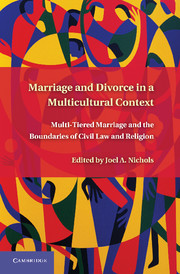
 Marriage and Divorce in a Multi-Cultural Context
 Multi-Tiered Marriage and the Boundaries of Civil Law and Religion
Book contents
- Frontmatter
- Contents
- Detail Contents
- About the Editor
- List of Contributors
- Preface
- Permissions
- Introduction
- 1 Multi-Tiered Marriage
- 2 Pluralism and Decentralization in Marriage Regulation
- 3 Marriage and the Law
- 4 Unofficial Family Law
- 5 Covenant Marriage Laws
- 6 New York’s Regulation of Jewish Marriage
- 7 Political Liberalism, Islamic Family Law, and Family Law Pluralism
- 8 Multi-Tiered Marriages in South Africa
- 9 Ancient and Modern Boundary Crossings Between Personal Laws and Civil Law in Composite India
- 10 The Perils of Privatized Marriage
- 11 Canadian Conjugal Mosaic
- 12 Marriage Pluralism in the United States
- 13 Faith in Law? Diffusing Tensions Between Diversity and Equality
- 14 The Frontiers of Marital Pluralism
- Index
- References
6 - New York’s Regulation of Jewish Marriage
Covenant, Contract, or Statute?
Published online by Cambridge University Press: 05 November 2011
Edited by

Book contents
- Frontmatter
- Contents
- Detail Contents
- About the Editor
- List of Contributors
- Preface
- Permissions
- Introduction
- 1 Multi-Tiered Marriage
- 2 Pluralism and Decentralization in Marriage Regulation
- 3 Marriage and the Law
- 4 Unofficial Family Law
- 5 Covenant Marriage Laws
- 6 New York’s Regulation of Jewish Marriage
- 7 Political Liberalism, Islamic Family Law, and Family Law Pluralism
- 8 Multi-Tiered Marriages in South Africa
- 9 Ancient and Modern Boundary Crossings Between Personal Laws and Civil Law in Composite India
- 10 The Perils of Privatized Marriage
- 11 Canadian Conjugal Mosaic
- 12 Marriage Pluralism in the United States
- 13 Faith in Law? Diffusing Tensions Between Diversity and Equality
- 14 The Frontiers of Marital Pluralism
- Index
- References
Summary
Introduction
Is Jewish marriage and divorce law essentially covenantal or contractual? The answer to this ancient question – and the extent to which the answer is an amalgamation of the two choices – has changed over time. Different authorities have disagreed about this question in profound ways, and the answer is still in flux today.
On the one hand, Jewish tradition is replete with references to the sacred nature of the marital relationship. The Talmud recounts that a person is not complete until he or she marries, and he or she is not even called a person until two are united. Further, the classical sources recount the profound Divine hand in the creation of marriage. One Talmudic source goes so far as to state, “Forty days prior to birth, the Holy One, Blessed be He, announces that so-and-so should marry so-and-so.” Marriages appear to be holy relationships that embrace and are embraced by the Divine. For example, the earliest commentaries on the Bible posit that God performed the wedding ceremony between Adam and Eve. Indeed, the blessings recited at Jewish weddings recount that it is God who “commanded us with regard to forbidden relationships, forbade [merely] betrothed women to us, and permitted wives [to husbands] through the Jewish wedding ceremony.”
Information
- Type
- Chapter
- Information
- Marriage and Divorce in a Multi-Cultural ContextMulti-Tiered Marriage and the Boundaries of Civil Law and Religion, pp. 138 - 163Publisher: Cambridge University PressPrint publication year: 2011
References
The Complete Artscroll Siddur, Rabbinical Council of America EditionNew YorkMesorah Publications 1995Google Scholar
Jewish Divorce: Judicial Misconceptions and Possible Means of Civil Enforcement,Connecticut Law Review 16 1984 201Google Scholar
The Ketubah in America: Its Value in Dollars, its Significance in and its Enforceability in American Law,Journal of Halacha and Contemporary Society 47 2004 101Google Scholar
Between Civil and Religious Law: The Plight of the Agunah in American SocietyWestport, CTGreenwood Press 1993Google Scholar
Marriage, Divorce and the Abandoned Wife in Jewish Law: A Conceptual Approach to the Agunah Problems in AmericaHoboken, NJKtav 2001Google Scholar
1980
Making and Unmaking the Jewish Family: Marriage and Divorce in Imperial Russia, 1850–1914Brandeis University 1997Google Scholar
Informing on Others for Violating American Law: A Jewish Law View,Journal of Halacha and Contemporary Society 41 2002 5Google Scholar
Jewish Divorce and Secular Court: The Promise of Avitzur,Georgetown Law Journal 73 1984 193Google Scholar
The New York Approach to Enforcing Religious Marriage Contracts,Brooklyn Law Review 50 1984 229Google Scholar
Transnational non-Judicial Divorces: A Comparative Analysis of Recognition under English and R.S. Jurisprudence,Loyola International and Comparative Law Review 18 1996 311Google Scholar
New York’s Get Laws: A Constitutional Analysis,Columbia Journal of Law and Social Problems 27 1998 55Google Scholar
New York Divorce Law and the Religion Clauses: An Unconstitutional Exorcism of The Jewish Get Laws,Seton Hall Constitutional Law Journal 6 1996 1117Google Scholar
Civil Enforceability of Religious Prenuptial Agreements,Columbia Journal of Law and Social Problems 32 1999 359Google Scholar
Religious Law and Civil Law: Using Secular Law to Assure Observance of Practices With Religious Significance,Southern California Law Review 71 1998 781Google Scholar
Beyond The Constitution: Is The New York Get Legislation Good Law?Pace Law Review 15 1995 703Google Scholar
A Bad Marriage: Jewish Divorce and the First Amendment,Cardozo Women’s Law Journal 2 1995 131Google Scholar
New York’s Get Laws: A Constitutional Analysis,Columbia Journal of Law & Social Problems 27 1993 55Google Scholar
: The Constitutional Implications of Judicially Enforcing Religious Agreements,Catholic University Law Review 33 1983 219Google Scholar
The New York State [Jewish Divorce] Law,Tradition: A Journal of Jewish Thought 29:4 1995 3Google Scholar
Religious Marriage Contracts: Judicial Enforcement of Mahr Agreements in American Courts,Journal of Law & Religion 15 2000 67CrossRefGoogle Scholar
Human Rights in Judaism: Cultural, Religious, and Political PerspectivesNorthvale, NJJason Aronson 1998Google Scholar
Accessibility standard: Unknown
Why this information is here
This section outlines the accessibility features of this content - including support for screen readers, full keyboard navigation and high-contrast display options. This may not be relevant for you.Accessibility Information
Accessibility compliance for the PDF of this chapter is currently unknown
and may be updated in the future.
- 1
- Cited by