Book contents
4 - The Picturesque
Published online by Cambridge University Press: 05 February 2013

Summary
Picturesque – literally, “like a picture” – entered English from Italian (pitteresco) through French (pittoresque) and the term was common coin by the middle of the eighteenth century, well before it became part of the tradition of philosophical aesthetics. Stewart suggests that its oldest and most general meaning was “that graphical power by which Poetry and Eloquence produce effects on the mind analogous to those of a picture,” and cites for support its use by Joseph Warton (1722–1800) (Essay on the Genius and Writings of Pope, vol. 1 [1756]), and Johnson who writes of “a picturesque description of love” in his Dictionary of the English Language, although he does not deem it singular enough to warrant an entry for the term in its own right. The term was adopted in England, Stewart observes, with the more familiar meaning of “what is done in the style, and with the sprit of a painter,” and was then attached as an “innovation” of meaning to the genre of landscape painting, which came increasingly into vogue as the century progressed (see PE, 230–ff.). Thus by the time picturesque became an aesthetic term of art, poetry had already found its “picturesque school” in James Thompson (1700–48) and Thomas Gray (1716–71) – The Seasons in particular was a literary and aesthetic landmark – and in fine arts the Baroque landscape artists of France and Italy, Niccolo Poussin (1594–1665), Gaspar Dughet (1613–75), Salvator Rosa (1615–73), and Claude Lorrain (c. 1600–82), provided well-established models for describing scenes witnessed by those on the Grand Tour; the works of Claude in particular were lauded as something akin to the Platonic Form of the picturesque style.
Information
- Type
- Chapter
- Information
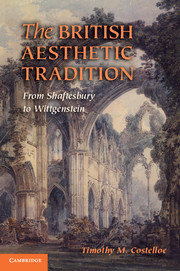
- The British Aesthetic TraditionFrom Shaftesbury to Wittgenstein, pp. 135 - 166Publisher: Cambridge University PressPrint publication year: 2013
References
The Letters of William and Dorothy Wordsworth: The Later Years Part I 1821–1828, 2nd ed., arr. and ed. Ernest de Selincourt; rev., arr., and ed. Alan G. Hill (Oxford: Clarendon Press, 1978), 175 and 290–1, respectively
Accessibility standard: Unknown
Why this information is here
This section outlines the accessibility features of this content - including support for screen readers, full keyboard navigation and high-contrast display options. This may not be relevant for you.Accessibility Information
Accessibility compliance for the PDF of this chapter is currently unknown
and may be updated in the future.