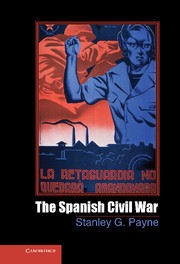
Book contents
- Frontmatter
- Contents
- Chronology of Major Events
- Glossary
- Preface
- Introduction Civil War in Twentieth-Century Europe
- 1 Modernization and Conflict in Spain
- 2 From Revolutionary Insurrection to Popular Front
- 3 The Breakdown of Democracy
- 4 The Military Insurrection of the Eighteenth of July
- 5 The Battle of Madrid – the First Turning Point
- 6 Revolution
- 7 Terror
- 8 A War of Religion
- 9 Franco's Counterrevolution
- 10 Foreign Intervention and Nonintervention
- 11 Soviet Policy in Spain, 1936–1939
- 12 The Propaganda and Culture War
- 13 A Second Counterrevolution? The Power Struggle in the Republican Zone
- 14 The Decisive Northern Campaigns of 1937–1938
- 15 The War at Sea and in the Air
- 16 Civil Wars within a Civil War
- 17 The War in Perspective
- Conclusion Costs and Consequences
- Select Bibliography
- Index
- References
1 - Modernization and Conflict in Spain
Published online by Cambridge University Press: 05 September 2012

Book contents
- Frontmatter
- Contents
- Chronology of Major Events
- Glossary
- Preface
- Introduction Civil War in Twentieth-Century Europe
- 1 Modernization and Conflict in Spain
- 2 From Revolutionary Insurrection to Popular Front
- 3 The Breakdown of Democracy
- 4 The Military Insurrection of the Eighteenth of July
- 5 The Battle of Madrid – the First Turning Point
- 6 Revolution
- 7 Terror
- 8 A War of Religion
- 9 Franco's Counterrevolution
- 10 Foreign Intervention and Nonintervention
- 11 Soviet Policy in Spain, 1936–1939
- 12 The Propaganda and Culture War
- 13 A Second Counterrevolution? The Power Struggle in the Republican Zone
- 14 The Decisive Northern Campaigns of 1937–1938
- 15 The War at Sea and in the Air
- 16 Civil Wars within a Civil War
- 17 The War in Perspective
- Conclusion Costs and Consequences
- Select Bibliography
- Index
- References
Summary
From the sixteenth to the eighteenth century, Spain experienced less internalconflict than other large Western countries such as France, England, or Germany.This changed drastically, however, with the transition to modern politics in thenineteenth century, when Spain became the most conflict-prone country in WesternEurope.
The long history of Spain has been marked by extreme heights and depths. It tookthe Romans much longer to conquer the peninsula – nearly two centuries– than any other part of their empire, but the land they called“Hispania” then became an important and integral part of the Romanworld. It is from Rome that it would derive its name, languages, laws, culture,religion, and initial social development. After the breakup of Rome, the newkingdom of the Visigoths in what was then called “Spania” createdthe first of the historic nations of Europe, with a written legal code and thebeginning of a new identity and institutional structure. Yet the Visigoths werenever able to achieve political unity, and internal division contributed greatlyto their sudden overthrow.
The course of Spanish history was drastically altered in 711, when a Musliminvasion overthrew the Visigothic monarchy and soon occupied most of thepeninsula. During the next three centuries, most of the country becamereligiously and culturally Islamic, part of the Middle Eastern world centered onMecca and Bagdad. Small, isolated Christian communities survived only with thegreatest difficulty in the northern mountains, but they slowly became strongeruntil they eventually reconquered the entire peninsula. This was the onlysignificant case in world history in which a major territory was not merelyconquered militarily by Muslims, but also religiously and culturallyIslamicized, and then was completely reconquered by a portion of its nativepopulation, who not merely expelled the intruders, but also restored their ownreligion and culture. Had the Spanish never achieved anything else in all theirhistory, this alone would have made them unique in human annals.
Information
- Type
- Chapter
- Information
- The Spanish Civil War , pp. 5 - 23Publisher: Cambridge University PressPrint publication year: 2012
References
Accessibility standard: Unknown
Why this information is here
This section outlines the accessibility features of this content - including support for screen readers, full keyboard navigation and high-contrast display options. This may not be relevant for you.Accessibility Information
Accessibility compliance for the PDF of this chapter is currently unknown
and may be updated in the future.