Book contents
- Frontmatter
- Dedication
- Contents
- List of figures
- Preface
- List of abbreviations
- Introduction
- 1 Reformation, custom and the end of medieval England
- 2 Custom and popular memory
- 3 Rights, resources and social alignments
- 4 Topographies of remembrance
- 5 Textual and verbal ways of remembering
- 6 The politics of popular memory
- Epilogue.
- Bibliography
- Index

Book contents
- Frontmatter
- Dedication
- Contents
- List of figures
- Preface
- List of abbreviations
- Introduction
- 1 Reformation, custom and the end of medieval England
- 2 Custom and popular memory
- 3 Rights, resources and social alignments
- 4 Topographies of remembrance
- 5 Textual and verbal ways of remembering
- 6 The politics of popular memory
- Epilogue.
- Bibliography
- Index
Summary
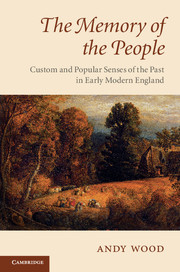
This book describes some of the cultural resources that the poorer and middling people of Tudor, Stuart and early Georgian England brought to their world. For sure, the book is sensitive to the difficulties under which those people lived. For many of them, this was a grim, dark time. But for others, it was a time of happiness, opportunity and material advancement. Both for richer and poorer common people, it was a time in which lives were lived, landscapes felt, neighbours known and loved ones held to the heart. Alongside the many cruelties that underwrote early modern English society, ordinary people made for themselves a world that had meaning, one built upon solidarities, kindnesses and mutual respect. These resources of hope were organized by customary law and constructed within social memory. The Memory of the People describes how poorer and middling people developed ways of preserving and distributing local resources. It shows how those distributive systems were organized around senses of the past; how neighbours struggled over the meaning of custom with one another and with their rulers; and how custom and memory were shaped within power, resistance, landscape, literacy, tradition and place.
The Memory of the People advances a set of overlapping arguments. It suggests that customary law was central to early modern popular memory. As lex loci, custom defined identities, senses of belonging and entitlement, all of which operated within intensely felt local relationships. While it draws wider conclusions concerning popular memory and customary law, all the time The Memory of the People is sensitive to geographical and social diversity. Popular memory could generate, when needed, a kind of usable past, a sense of the past that legitimated claims to rights, space and resources in the present. Popular memory, and custom in particular, therefore, had the potential to be very political.
Information
- Type
- Chapter
- Information
- The Memory of the PeopleCustom and Popular Senses of the Past in Early Modern England, pp. ix - xiiPublisher: Cambridge University PressPrint publication year: 2013
Accessibility standard: Unknown
Why this information is here
This section outlines the accessibility features of this content - including support for screen readers, full keyboard navigation and high-contrast display options. This may not be relevant for you.Accessibility Information
Accessibility compliance for the PDF of this chapter is currently unknown
and may be updated in the future.