Book contents
- Frontmatter
- Contents
- List of Figures and Tables
- Acknowledgments
- Note on Transliteration
- List of Abbreviations
- Glossary
- Map
- Introduction
- 1 The Rise of the Baʿth Party
- 2 Party Structure and Organization
- 3 The Baʿth Party Branches
- 4 Security Organizations during the Baʿth Era
- 5 The Baʿth Party and the Army
- 6 The Personality Cult of Saddam Hussein
- 7 Control and Resistance
- 8 Bureaucracy and Civil Life under the Baʿth
- Conclusion
- Appendix I Chart of the Structure of the Baʿth Party Secretariat (maktab amanat sir al-qutr)
- Appendix II Baʿth Party Statistics as of September 2002
- Notes on Sources
- Bibliography
- Index
- References
7 - Control and Resistance
Published online by Cambridge University Press: 05 June 2012

Book contents
- Frontmatter
- Contents
- List of Figures and Tables
- Acknowledgments
- Note on Transliteration
- List of Abbreviations
- Glossary
- Map
- Introduction
- 1 The Rise of the Baʿth Party
- 2 Party Structure and Organization
- 3 The Baʿth Party Branches
- 4 Security Organizations during the Baʿth Era
- 5 The Baʿth Party and the Army
- 6 The Personality Cult of Saddam Hussein
- 7 Control and Resistance
- 8 Bureaucracy and Civil Life under the Baʿth
- Conclusion
- Appendix I Chart of the Structure of the Baʿth Party Secretariat (maktab amanat sir al-qutr)
- Appendix II Baʿth Party Statistics as of September 2002
- Notes on Sources
- Bibliography
- Index
- References
Summary
Fear played a major role in sustaining the Baʿth regime for more than three decades, but the party's control of the population was not based only on fear. An elaborate system of rewards and punishments provided a robust framework for the Baʿth Party's domination. Nevertheless, although society as a whole accepted the regime and its relentless demands, a significant number of people did not. Examining the different forms of resistance helps us to understand what “made one person a dissident or resistance fighter and another a collaborator.”
Fear and Violence
In Chapter 4, we saw that the Baʿth regime created many security agencies and an extensive security network. In so doing, it was strikingly similar to other tyrannies. Like Stalin, Saddam Hussein was always acutely aware that the people closest to him had the greatest ability to inflict harm: “Near the Tsar, near to death.” In his semiautobiographical book, rijal wa madina, Saddam Hussein wrote that “he who is not alert, even with a long stick, the dogs will covet him and bite him.” Both dictators knew that treachery could arise from within their inner circles, and they understood the need for special guards and organizations that they personally controlled, who would be more loyal than their closest associates but would remain carefully segregated from their inner circles. Both leaders were closely involved with their security organizations, received direct information from them, and intervened in their affairs. Based on remarks from close associates of Saddam Hussein, Aburish quotes him as saying that “when we take over the government I’ll turn this country into a Stalinist state.” Both leaders kept changing the organizational structure of the security organs to meet their needs and used fear and violence to keep a firm grip on power.
Information
- Type
- Chapter
- Information
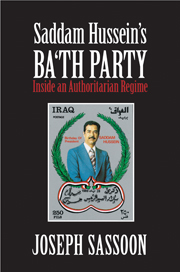
- Saddam Hussein's Ba'th PartyInside an Authoritarian Regime, pp. 193 - 226Publisher: Cambridge University PressPrint publication year: 2011
References
Totalitarian Dictatorship and AutocracyNew YorkPraeger 1961
From the Gulag to the Killing Fields: Personal Accounts of Political Violence and Repression in Communist StatesWilmington, DEISI 2006
Laylat al-harir fi qasr al-nihayaLondonDar al-Barraq 1999
2006
Fi jahim Saddam Hussein: Thalathma'a wa khamsa wa sittun yawman fi qasr al-nihayaJerusalemAssociation for Jewish Academics from Iraq 1999
Cruelty and Silence: War, Tyranny, Uprising and the Arab WorldNew YorkW. W. Norton 1994
Tortured Confessions: Prisons and Public Recantations in Modern IranBerkeleyUniversity of California Press 1999
Policing and Prisons in the Middle East: Formations of CoercionLondonHurst 2010
An Insight into the Mindset of Iraq's Security ApparatusIntelligence and National Security 18 2003 1Google Scholar
Sanawat al-jamr: Masirat al-haraka al-Islamiyya fi al-ʿIraq, 1957–1986LondonDar al-Masirah 1993 181
Basic WritingsNew YorkColumbia University Press 1964 18
Ascribing Class: The Construction of Social Identity in Soviet RussiaJournal of Modern History 65 1993Google Scholar
1990
1989
Domination and the Arts of Resistance: Hidden TranscriptsNew Haven, CTYale University Press 1990
Civil Resistance and Power Politics: The Experience of Non-Violent Action from Gandhi to the PresentOxford University Press 2009
1997
Iraq since the Gulf War: Prospects for DemocracyLondonZed 1994 13
Accessibility standard: Unknown
Why this information is here
This section outlines the accessibility features of this content - including support for screen readers, full keyboard navigation and high-contrast display options. This may not be relevant for you.Accessibility Information
Accessibility compliance for the PDF of this chapter is currently unknown
and may be updated in the future.