Introduction
Published online by Cambridge University Press: 28 March 2008

Summary
For readers over the age of fifty, modernism and the New Criticism are not just terms that refer to a remote and distant past, not just names that stretch across a map of venerable but vanished empires in the history of literary criticism. They evoke places where we have conversed with colleagues, or hours spent with books that still rest upon the shelves, only slightly discoloured with age. New Criticism has perhaps slipped more irretrievably into the past of professional literary studies than modernism, which continues to play a pivotal role in contemporary cultural debate as the governing term in discussions about the notion of ‘the postmodern’. But for a history of literary criticism that is devoted to modernism and the New Criticism, the personal associations of both terms can easily undermine a dispassionate account. The subject extends into the present and lacks the corrective of a tranquil and healing hindsight. Moreover, situated at that troublesome crossroad where professional literary studies (New Criticism) meet with the broader cultural and social transformations of the twentieth century (modernism), it is a subject that engages some of our most passionate views about art and society, intellectuals and public culture.
The ongoing contemporaneity of these subjects inevitably affects the kinds of narration that one might offer, for several reasons. One has to do with the logic of historical insight, its foundations in differing temporal indices. Descriptions of the past are grounded in temporal perspectives derived from the future, or as Jürgen Habermas has expressed it: ‘The historian does not observe from the perspective of the actor but describes events and actions out of the experimential horizon of a history that goes beyond the actor's horizons of expectations.’ Yet insofar as we ourselves are still actors whose horizons of expectations include much that was encompassed in the New Criticism and modernism, it is not immediately self-evident which interpretive framework, which new set of horizons, might best furnish a meaningful historical account of those subjects.
Information
- Type
- Chapter
- Information
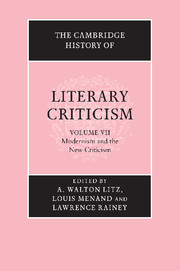
- The Cambridge History of Literary Criticism , pp. 1 - 14Publisher: Cambridge University PressPrint publication year: 2000
References
, The Culture of Professionalism: The Middle Class and the Development of Higher Education in America (New York, 1976).Google Scholar
, The Use of Poetryand the Use of Criticism: Studies in the Relation of Criticism to Poetryin England (London, 1933).Google Scholar
(ed.), Let's Murder the Moonshine: Selected Writings of F. T. Marinetti (1971; rpt. Los Angeles, 1993).Google Scholar
, ‘A Review of Gadamar's Truth and Method’, in and (eds.), Understanding and Social Inquiry (Notre Dame, 1977)Google Scholar
, After the Great Divide: Modernism, Mass Culture, Postmodernism (Bloomington, 1986).CrossRefGoogle Scholar
, ‘The Creation of the Avant-Garde: F. T. Marinetti and Ezra Pound’, Modernism/Modernity, 1 (September 1994)CrossRefGoogle Scholar
, ‘The Price of Modernism: Publishing The Waste Land’, in (ed.), T. S. Eliot: The Modernist in History (Cambridge, 1990)Google Scholar
, The Historyof Criticism and Literary Taste in Europe, from the Earliest Texts to the Present (3 vols., Edinburgh, 1900–1904).Google Scholar
Accessibility standard: Unknown
Why this information is here
This section outlines the accessibility features of this content - including support for screen readers, full keyboard navigation and high-contrast display options. This may not be relevant for you.Accessibility Information
Accessibility compliance for the PDF of this chapter is currently unknown
and may be updated in the future.
- 17
- Cited by