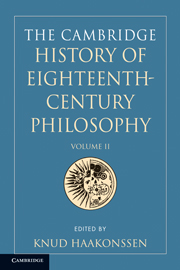
34 - Politics
from V - Moral Philosophy
Published online by Cambridge University Press: 28 March 2008
Edited by

Summary
The fundamental methodological controversy of the eighteenth century also affected the philosophical treatment of political problems, and two major currents, one rationalist and one empiricist, may be distinguished in the many-sided political philosophy of the period. Each of these traditions is of course considerably heterogeneous in itself and includes quite different thinkers who are, however, connected by characteristic family resemblances so that it is permissible to assign them to a single theoretical conception. Rationalist political philosophy is based either on a sort of natural law theory or on a conception of human rights and organises its justificatory arguments within the conceptual framework of contractarianism. Rousseau and Kant are the great protagonists of eighteenth-century contractual political philosophy, but it also includes the political philosophy of early and late German natural law theory, which has to be taken into account as an exceedingly interesting variant of modern contractarianism. Empiricist political philosophy, on the other hand, rejects both the justificatory constructs of the natural state and the normative presuppositions of natural law and human rights theories. Its basic arguments are founded on human interests and needs, on history, on prudence, and on the most profitable development of society. Elements of an empiricist political philosophy may be found in Montesquieu, the father of the modern theory of the separation of powers. The centre of empiricist political philosophy, however, is in Britain; its first great representative was Bernard Mandeville but Shaftesbury and Hutcheson, the inventor of the utilitarian formula of the greatest happiness of the greatest number, also belong to this tradition.
Information
- Type
- Chapter
- Information
- The Cambridge History of Eighteenth-Century Philosophy , pp. 1026 - 1068Publisher: Cambridge University PressPrint publication year: 2000
References
. Montesquieu, la politique et l’histoire.Paris, 1959.
. The Rise and Fall of Freedom of Contract.Oxford, 1979.
. Lectures on Jurisprudence, or The Philosophy of Positive Law, 5th edn., ed. , 2 vols. London, 1885.
. Die naturrechtliche Staatslehre Christian Wolffs.Berlin, 1977.
. The Ideological Origins of the American Revolution.Cambridge, 1967.
. Enlightenment, Revolution and Romanticism: The Genesis of Modern German Political Thought, 1790–1800.Cambridge, MA, 1992.
. A Fragment on Government [1776], in Works (eds. et al.), vol. 3.
. Briefe über Kants metaphysische Anfangsgründe der Rechtslehre.Leipzig, Gera, 1797.
. Untersuchungen aus dem Natur-, Staats- und Völkerrechte, mit einer Kritik der neuesten Konstitution der französischen Republik. n.p., 1796.
. Commentaries on the Laws of England, 4 vols. London, 1765–9; Chicago, IL, 1979.
, and , eds. Aufklärung als Politisierung – Politisierung der Aufklärung.Hamburg, 1987.
. Rousseaus Philosophie der Gesellschaft.Stuttgart, 1973.
. Die Rechts- und Staatslehre von Adam Smith und die Interessentheorie der Verfassung.Berlin, 1988.
. Reflections on the Revolution in France [1790], ed. . New York, NY, 1986; ed. , Indianapolis, IN, 1987.
. The Principles of Natural and Politic Law, trans. , 2 vols. London, 1747–8; 2nd edn., 1763.
. Pax Kantiana. Systematisch-historische Untersuchung des Entwurfs “Zum ewigen Frieden” (1795) von Immanuel Kant.Vienna, 1992.
. Edmund Burke and the Revolt against the Eighteenth Century: A Study of the Political and Social Thinking of Burke, Wordsworth, Coleridge, and Southey.London, 1960.
. Die Aporien der Rechtslehre Kants. Stuttgart, 1983.
. Moral philosophie und Naturrecht bei Samuel Pufendorf: Eine geistes- und wissenschafts-geschichtliche Untersuchung zur Geburt des Naturrechts aus der praktischen Philsophie. Munich, 1972.
. Jean-Jacques Rousseau et la science politique de son temps. Paris, 1988.
. The Lost Soul of American Politics: Virtue, Self-Interest, and the Foundations of Liberalism. Chicago, IL, 1986.
. Il contratto sociale nelle filosofia politica moderna. Milan, 1993.
. Rousseaus politische Philosophie: Zur Geschichte des demokratischen Freheitsbegriffs. Frankfurt am Main, 1978.
. Anti-Hobbes, oder Über die Gränzen der höchsten Gewalt und das Zwangsrecht der Bürger gegen den Oberherrn.Giessen, 1797.
. Tra egoismo e socialità: il giusnaturalismo de Samuel Pufendorf. Naples, 1992.
. Hume’s Philosophical Politics. Cambridge, 1975.
. Rousseau. Freiburg, 1977.
. Werke, 4 vols. Frankfurt, 1967–70.
. “Liberaler und demokratischer Republikanismus. Kants Metaphysik der Sitten und ihre radikal demokratische Kritik durch J. A. Bergk”, in Mitteleuropa im ausgehenden 18. und frühen 19. Jahrhundert, eds. and . Berlin, 1980.Google Scholar
. “Nachwort”, in Revolutionäre Vernunft. Texte zur jakobinischen und liberalen Revolutions re zeption in Deutschland, 1798–1810, ed. . Kronberg/Ts, 1974.Google Scholar
. “Politische Abhandlungen”, in , Betrachtungen über die Französische Revolution. Nach dem Englischen des Herrn Burke … mit einer Einleitung, Anmerkungen, politischen Abhandlungen und einem critischen Verzeichniss der in England über diese Revolution erschienenen Schriften, 2 vols., Berlin, 1793, vol. 2.Google Scholar
. Kants Entwurf “Zum Ewigen Frieden”, Eine Theorie der Politik. Darmstadt, 1995.
. Johannes Althusius und die Entwicklung der naturrechtlichen Staatstheorien. Breslau, 1902.
. Rousseau’s Social Contract: The Design of the Argument. Chicago, IL, 1983.
. Anthropologie et politique: les principes du système de Rousseau. Paris, 1974.
. Kant e le problème du droit. Paris, 1971.
. L’Interminable querelle du contrat social. Ottawa, 1983.
. “From Natural Law to the Rights of Man: A European Perspective on American Debates”, in A Culture of Rights. The Bill of Rights in Philosophy, Politics, and Law–1791 and 1991, eds. and . Cambridge and New York, NY, 1991.Google Scholar
. The Science of a Legislator: The Natural Jurisprudence of David Hume and Adam Smith. Cambridge, 1981.
., , and . The Federalist, or The New Constitution.New York, 1965.
. Hume’s Theory of Justice. Oxford, 1981.
. Bentham. London, 1983.
, ed. Immanuel Kant: Zum Ewigen Frieden. Berlin, 1995.
. Naturrecht des einzelnen Menschen, der Gesellschaften und der V ölker, 3rd edn. Giessen, 1785.
. Essays, Moral, Political, and Literary, ed. . Indianapolis, IN, 1987.
. Die Natur und das Wesen der Staaten als Grundwissenschaft der Staatskunst, der Policey und aller Regierungswissenschaft, desgleichen als die Quelle aller Gesetze.Berlin/Stettin/Leipzig, 1760.
. Philosophy and the State in France: The Renaissance to the Enlightenment. Princeton, NJ, 1980.
. “La dottrina del duplice contratto nel diritto naturale Tedesco”. Filosofia politica, 8 (1994):.Google Scholar
. “Der Kontraktualismus im deutschen Naturrecht”, in Das Europäische Natur-recht im ausgehenden 18. Jahrhundert, eds. and . Hamburg, 1994.Google Scholar
. “Die Logik des kontraktualistischen Arguments”, in Der Begriff der Politik, ed. . Stuttgart, 1990.Google Scholar
. Die politische Philosophie des Gesellschaftsvertrags. Darmstadt, 1994.
. Niccolò Machiavelli. Munich, 1988.
. Thomas Hobbes. Hamburg, 1992.
. Wohlgeordnete Freiheit: Immanuel Kants Rechts-und Staatsphilosophie. Frankfurt am Main, 1993.
. Freyheit und Eigenthum.Berlin, 1790.
. Politische Freiheit und Freiheitsrechte im deutschen Naturrecht des 18. Jahrhunderts. Paderborn, 1976.
. Republicanism and Bourgeois Radicalism: Political Ideology in Late Eighteenth-Century England and America. Ithaca, NY, 1990.
. The Politics of Discretion: Pufendorf and the Acceptance of Natural Law. Chicago, IL, 1965.
. Mässigung und Politik: Studien zur politischen Sprache und Theorie Montesquieus. Munich, 1975.
. Reform nach Prinzipien: Untersuchungen zur politischen Theorie Immanuel Kants. Stuttgart, 1986.
. Pufendorf et la loi naturelle. Paris, 1982.
. Monita quaedam ad Samuelis Pufendorfii Principia (1789), in Opera omnia, vol. 4.
. Social Contract. Houndmills, 1986.
. Herrschaftsordnung und bürgerliche Freiheit: Grenzen der Staatsgewalt in der älteren deutschen Staatslehre. Vienna, 1979.
. Burke’s Reflections on the Revolution in France. London, 1985.
. Jeremy Bentham’s Idea of Liberty in Relation to His Utilitarianism. Toronto, 1977.
. “On Nature and Society: Rousseau versus the Enlightenment”. History of Political Thought 5 (1984):.Google Scholar
. “Über die ersten Gründe des Naturrechts” [1795], in Gesammelte Werke, ed. , 7 vols. Hildesheim, 1965–76, vol. 6.Google Scholar
. The Political Philosophy of Rousseau. Princeton, NJ, 1968.
. The Natural Goodness of Man. On the System of Rousseau’s Thought. Chicago, IL, 1990.
. Philosophy and Ideology in Hume’s Political Thought. Oxford, 1981.
. Rousseau: Dreamer of Democracy. New Haven, CT, 1984.
. Oeuvres complètes, ed. , 2 vols. Paris, 1949–51.
. The Spirit of the Laws, trans. and eds. , and . Cambridge, 1989.
. Kant’s System of Rights. New York, NY, 1990.
. “Hume, Human Nature, and the Foundations of Morality”, in The Cambridge Companion to Hume, ed. , 1993.Google Scholar
. Samuel Pufendorf discepolo di Hobbes: per una reinterpretazione del giusnaturalismo moderno. Bologna, 1990.
. Montesquieu’s Philosophy of Liberalism: A Commentary on the Spirit of the Laws. Chicago, IL, 1973.
. The Spirit of Modern Republicanism: The Moral Vision of the American Founders and the Philosophy of Locke. Chicago, IL, 1988.
. The Machiavellian Moment. Princeton, NJ, 1975.
. De jure naturae et gentium libri octo [1672] (facsim. of 1688 edn.), trans. and eds. and , 2 vols. Oxford, 1934.
. De officio hominis et civis.Lund, 1673.
. The Law of Nature and Nations, 5th edn., trans. . London, 1749.
and , in Works (1976).
. Kant’s Political Philosophy. Totowa, NJ, 1983.
. Of the Social Contract or Principles of Political Right, in The Social Contract and Other Later Political Writings, trans. and ed. . Cambridge, 1997.
. The Discourses and Other Early Political Writings, trans. and ed. . Cambridge, 1997.
. “August Ludwig Schlözer als politischer Theoretiker”, in Vertragsdenken und Utopie: Studien zur politischen Theorie und zur Sozialphilosophie der frühen Neuzeit, Frankfurt am Main, 1989.Google Scholar
. La nascità della scienze dello stato: August Ludwig Schlözer (1735–1809) e le discipline politiche del settecento tedesco. Milan, 1994.
. “Versuch über den Begriff des Republikanismus”, [1796] in Kritische Friedrich Schlegel-Ausgabe, ed. , Paderborn, 1958–, vol. 7.Google Scholar
. Allgemeines StatsRecht und StatsVerfassungsLere.Göttingen, 1793.
. Naturrecht und Liebesethik: Zur Geschichte der praktischen Philosophie im Hinblick auf Christian Thomasius. Hildesheim, 1971.
. The Rights of Reason: A Study of Kant’s Philosophy and Politics. Toronto, 1980.
. Men and Citizens: A Study of Rousseau’s Social Theory. Cambridge, 1969.
. Qu’est ce que le Tiers Etat?Paris, 1789.
. What is the Third Estate?, trans. ., ed. . London, 1963.
. The Foundations of American Citizenship: Liberalism, the Constitution, and Civic Virtue. New York, NY, 1992.
. Lectures on Jurisprudence, eds. , and , in Works (1978).
. Edmund Burke and the Natural Law. Ann Arbor, MI, 1958.
. Jean-Jacques Rousseau: The Politics of the Ordinary. Thousand Oaks, CA and London, 1994.
. Vorträge über Recht und Staat, eds. and . Cologne, 1960.
. Fundamenta juris naturae et gentium.Halle, 1705.
. La penseé politique de Kant: métaphysique de l’ordre et dialectique du progrés. Paris, 1954.
. Die socialitas als oberstes Prinzip der Naturrechtslehre Samuel Pufendorfs. Heidelberg, 1930.
. Naturrecht und materiale Gerechtigkeit. Göttingen, 1962.
. Order and Artifice in Hume’s Political Philosophy. Princeton, NJ, 1985.
. Philosophy, The Federalist, and the Constitution. New York, NY, 1987.
. The Philosophy of the American Revolution. New York, NY, 1978.
, ed. Kant’s Political Philosophy. Cardiff, 1992.
. Kant’s Political Philosophy. New York, NY, 1983.
. Adam Smith’s Politics: An Essay in Historiographic Revision. Cambridge, 1978.
. Grundsätze des Natur- und Völckerrechts [1754], ed. , in Werke, Abt. I, vol. 19.
. Vernünfftige Gedancken von dem gesellschaffligen Leben der Menschen und insonderheit dem gemeinen Wesen (Frankfurt and Leipzig, 1736)
. Staatsrecht und Naturrecht in der Lehre vom Widerstandsrecht des Volkes gegen rechtswidrige Ausübung der Staatsgewalt: Zugleich ein Beitrag zur Entwicklungsgeschichte des modernen Staatsgedankens. Breslau, 1916.
. The Creation of the American Republic. Chapel Hill, NC, 1969.
Accessibility standard: Unknown
Why this information is here
This section outlines the accessibility features of this content - including support for screen readers, full keyboard navigation and high-contrast display options. This may not be relevant for you.Accessibility Information
Accessibility compliance for the PDF of this chapter is currently unknown
and may be updated in the future.
- 1
- Cited by