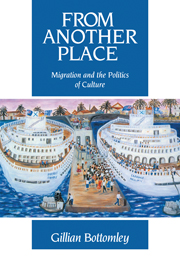
Book contents
- Frontmatter
- Contents
- Preface and acknowledgements
- Part I Migration studies and the problem of culture
- Part II Practising cultures
- Part III Constructing identities: gender, class, and ethnos
- Chapter 7 The cultural construction of gender in modern Greece
- Chapter 8 Generating identities: age, social bodies and habitus
- Chapter 9 Intersections: gender, ethnicity, class and culture in Australia
- Bibliography
- Index
Chapter 7 - The cultural construction of gender in modern Greece
Published online by Cambridge University Press: 05 November 2011
Book contents
- Frontmatter
- Contents
- Preface and acknowledgements
- Part I Migration studies and the problem of culture
- Part II Practising cultures
- Part III Constructing identities: gender, class, and ethnos
- Chapter 7 The cultural construction of gender in modern Greece
- Chapter 8 Generating identities: age, social bodies and habitus
- Chapter 9 Intersections: gender, ethnicity, class and culture in Australia
- Bibliography
- Index
Summary
When we examine aspects of experience as intimate as those of gender and sexuality, the concept of hegemony helps alert us to the fact that the dynamics of power in the social relations of individuals who are acting and interacting as sexual beings can be extremely subtle and complex.
Cowan, 1990, p.14This chapter will take up several of the themes delineated in earlier chapters. One of these is the continuing project of interrelating social, economic and political circumstances and cultural practices. A second is the process of social power, especially the definition of what is ‘imaginable’. A third is the development of some understanding of the cultural construction of gender in both meanings and values and in practices through which these values are expressed and embodied. Several other themes are also woven into this analysis – for example, the interplay between the subjective and objective and the possibly distorting effects of particular perspectives and analytic frameworks. To this end, I propose to observe the observers, to ask how gender relations have been represented in recent studies of modern Greece. As Paul Rabinow put it, representations are also social facts and deserve scrutiny (1986). Feminist writers have made major contributions to questioning of this kind, from Juliet Mitchell's Woman's Estate (1971) to the complex critiques of phallocentric discourses that have attacked the linguistic and philosophical foundations of self-evident authority (see Pateman and Gross, 1986).
Information
- Type
- Chapter
- Information
- From Another PlaceMigration and the Politics of Culture, pp. 105 - 120Publisher: Cambridge University PressPrint publication year: 1992
Accessibility standard: Unknown
Why this information is here
This section outlines the accessibility features of this content - including support for screen readers, full keyboard navigation and high-contrast display options. This may not be relevant for you.Accessibility Information
Accessibility compliance for the PDF of this chapter is currently unknown
and may be updated in the future.