Book contents
- Frontmatter
- Contents
- Figures
- Tables
- Acknowledgments
- Preface
- Abbreviations
- Map
- 1 Introduction
- 2 Strategic Culture
- 3 Foreign Policy, Use of Force, and Border Settlements
- 4 Military Modernization
- 5 Military Doctrine
- 6 Military Force Modernization and Power Projection
- 7 Economic Strategic Behavior
- 8 India, China, and Democratic Peace Theory
- 9 Meeting the Dual Challenge
- Appendix Defense Spending, Selected Additional Data
- Bibliography
- Index
- References
9 - Meeting the Dual Challenge
A U.S. Strategy for China and India
Published online by Cambridge University Press: 05 June 2012
Book contents
- Frontmatter
- Contents
- Figures
- Tables
- Acknowledgments
- Preface
- Abbreviations
- Map
- 1 Introduction
- 2 Strategic Culture
- 3 Foreign Policy, Use of Force, and Border Settlements
- 4 Military Modernization
- 5 Military Doctrine
- 6 Military Force Modernization and Power Projection
- 7 Economic Strategic Behavior
- 8 India, China, and Democratic Peace Theory
- 9 Meeting the Dual Challenge
- Appendix Defense Spending, Selected Additional Data
- Bibliography
- Index
- References
Summary
The growth of Chinese power has inspired alarm in the United States. India, too, is gaining relative power and influence. Yet most assessments of rising Chinese and Indian power and American interests suffer from three limitations. First, they often assume smooth, uninterrupted growth for both China and India despite the many internal challenges these emerging powers face. They also often fail to account for America’s proven track record of revitalization, adaptation, innovation, and growth, especially when faced with new challenges. Second, most recent studies focus on one or the other country in isolation or, less helpfully, as an amalgamated “Chindia.” Examining the rising power of each nation in relation to its own recent past puts the scale and pace of domestic change in sharp relief. It says little, however, about what matters most for international politics: capability and behavior relative to other states. Third, many studies draw conclusions about the potential threats and opportunities China and India may present without careful examination of the empirical track record of their actual strategic behavior. A lack of empirical comparison raises the risk that either country will appear to be an outlier in its international behavior, which in turn could lead the United States to exaggerate its response to that power.
This book has examined Chinese and Indian international strategic behavior, revisiting commonly held assumptions in comparative context. Past behavior does not guarantee that either country will continue along recent policy trajectories. However, international strategic behavior is “sticky” – with powerful bases in the structure of international politics, the long-term challenges faced by the state, the state’s own core interests, and the bureaucratic inertia imposed by domestic political and military traditions and preferences. Broad patterns of strategic behavior can change, but only in response to major (and usually observable) developments.
Information
- Type
- Chapter
- Information
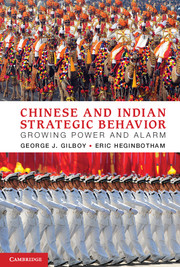
- Chinese and Indian Strategic BehaviorGrowing Power and Alarm, pp. 264 - 300Publisher: Cambridge University PressPrint publication year: 2012
References
Assymetric Warfare in South Asia: The Causes and Consequences of the Kargil ConflictNew YorkCambridge University Press 2009CrossRefGoogle Scholar
Iran’s Military Forces and Warfighting Capabilities: The Threat in the Northern GulfNew YorkPraeger 2007Google Scholar
2003
India’s Energy Security: Prospects for Cooperation with Extended NeighborhoodNew DelhiRupa & Co 2005Google Scholar
Perspectives on Sino-American Strategic Nuclear IssuesNew YorkPalgrave Macmillan 2008CrossRefGoogle Scholar
Pacific Currents: The Responses of U.S. Allies and Security Partners in East Asia to China’s RiseSanta MonicaRAND Corporation 2008CrossRefGoogle Scholar
A Question of Balance: Political Context and Military Aspects of the China-Taiwan DisputeSanta MonicaRAND Corporation 2009Google Scholar
Air Sea Battle: A Point-of-Departure Operational ConceptWashington, DCCenter for Strategic and Budgetary Assessments 2010Google Scholar
2003
War Plan Orange: The U.S. Strategy to Defeat Japan, 1897–1945AnnapolisNaval Institute Press 1991Google Scholar
Accessibility standard: Unknown
Why this information is here
This section outlines the accessibility features of this content - including support for screen readers, full keyboard navigation and high-contrast display options. This may not be relevant for you.Accessibility Information
Accessibility compliance for the PDF of this chapter is currently unknown
and may be updated in the future.