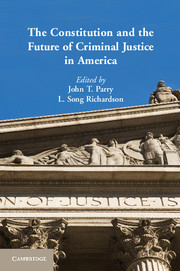
Book contents
- Frontmatter
- Contents
- Contributors
- Acknowledgments
- Introduction
- Part I Foundations – The Scope of Criminal Law and Access to Counsel
- Part II Race and Criminal Procedure
- Part III Policing and Privacy
- Part IV Technology and the Surveillance Society
- Part V Confessions and miranda
- Part VI Conviction, Sentencing, and Incarceration
- Part VII Emergencies and Borders – Immigration, Terrorism, National Security, and Transnational Crime
- Index
- References
Introduction
Published online by Cambridge University Press: 05 June 2014

Book contents
- Frontmatter
- Contents
- Contributors
- Acknowledgments
- Introduction
- Part I Foundations – The Scope of Criminal Law and Access to Counsel
- Part II Race and Criminal Procedure
- Part III Policing and Privacy
- Part IV Technology and the Surveillance Society
- Part V Confessions and miranda
- Part VI Conviction, Sentencing, and Incarceration
- Part VII Emergencies and Borders – Immigration, Terrorism, National Security, and Transnational Crime
- Index
- References
Summary
What is the future of criminal justice in the United States? There is ample room for pessimism, especially with the constitutional aspects of criminal law. No one doubts that the Warren Court era of the early 1950s through the 1960s was a high point for the constitutional rights of criminal defendants. Nor is there serious dispute that, on balance, the Supreme Court since then has adopted a more restrained attitude toward the constitutional rights of criminal defendants.
Changes in constitutional criminal law reflect more than judicial appointments and judicial attitudes, however. They also derive from political decisions and popular attitudes. Since the mid-1960s, national and local politicians have tended to support the idea of a “war on crime” that puts a premium on toughness toward lawbreaking and offenders (or suspected offenders) at the expense of individual rights. By and large, the voting public has supported these efforts.
The political decisions associated with the war on crime have had severalconcrete and negative results. More and more conduct has been criminalized,often through multiple statutes that define overlapping crimes (sometimesoverlapping state and federal crimes) for the same basic conduct.Incarceration rates have expanded, especially among young black men; maximumand supermax security prisons have proliferated; mandatory minimumsensure lengthy prison sentences for nearly all felonies in many jurisdictions;and the consequences of criminal convictions are dire. Police and prosecutorscontinue to enjoy wide discretion to control the outcomes of criminalcases, and the development of new surveillance technologies expands theirability to gather evidence in ways that erode traditional notions of personalprivacy. Politicians and commentators urge people to live in fear of violentcrime and to be suspicious of people who act in unusual ways or who justseem to be out of place. Undocumented immigrants automatically become criminals through the act of crossing a national border. These developmentsare important in their own right; they are also causes and effects of judicialdecisions to rethink the scope of constitutional rights and other constitutionaland structural limitations on criminal law and punishment.
Information
- Type
- Chapter
- Information
- Publisher: Cambridge University PressPrint publication year: 2013
References
Accessibility standard: Unknown
Why this information is here
This section outlines the accessibility features of this content - including support for screen readers, full keyboard navigation and high-contrast display options. This may not be relevant for you.Accessibility Information
Accessibility compliance for the PDF of this chapter is currently unknown
and may be updated in the future.