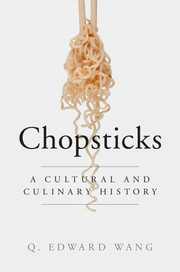
Book contents
- Frontmatter
- Dedication
- Contents
- Acknowledgments
- List of Plates
- Timeline
- Map of East Asia
- 1 Introduction
- 2 Why chopsticks? Their origin and original function
- 3 Dish, rice or noodle? The changing use of chopsticks
- 4 Forming a chopsticks cultural sphere: Vietnam, Japan, Korea and beyond
- 5 Using chopsticks: customs, manners and etiquette
- 6 A pair inseparable: chopsticks as gift, metaphor and symbol
- 7 “Bridging” food cultures in the world
- Conclusion
- Glossary
- Bibliography
- Index
- Plate section
- References
1 - Introduction
Published online by Cambridge University Press: 05 February 2015

Book contents
- Frontmatter
- Dedication
- Contents
- Acknowledgments
- List of Plates
- Timeline
- Map of East Asia
- 1 Introduction
- 2 Why chopsticks? Their origin and original function
- 3 Dish, rice or noodle? The changing use of chopsticks
- 4 Forming a chopsticks cultural sphere: Vietnam, Japan, Korea and beyond
- 5 Using chopsticks: customs, manners and etiquette
- 6 A pair inseparable: chopsticks as gift, metaphor and symbol
- 7 “Bridging” food cultures in the world
- Conclusion
- Glossary
- Bibliography
- Index
- Plate section
- References
Summary
Over one and a half billion people eat food with chopsticks daily. This is the first book in English that traces the history of the utensil from ancient times to the present day. The aim of this book is threefold. The first is to offer a comprehensive and reliable account of how and why chopsticks became adopted by their users and continued, as a dining habit, through the centuries in Asia and beyond. The second is to discuss the culinary impact of chopsticks use on Asian cookeries and cuisines and vice versa: how the change of foodways in the region influenced people’s choice of eating tools to aid their food consumption. And the third is to analyze the cultural meanings of chopsticks and chopsticks use in the respective cultures of their users. Chopsticks are distinctive in that though mainly an eating implement, they also have many other uses. A rich and deep cultural text is embedded in the history of chopsticks, awaiting our exploration.
Over many centuries, chopsticks have helped distinguish their users in Asia from those in the rest of the world. So much so that some Japanese scholars have identified a distinct “chopsticks cultural sphere” vis-à-vis the other two spheres on the globe: those who feed with fingers, which was a dining tradition for the people in the Middle East, South Asia and some parts of Southeast Asia, and those who eat with forks and knives, or the people who live in today’s Europe, North and South America, Australia, etc. Other scholars, such as Lynn White, have also noticed this tripartite division among the finger-feeders, the fork-feeders and the chopsticks-feeders in the world. Centering on China, where the utensil originated, the chopsticks cultural sphere encompasses the Korean Peninsula, the Japanese archipelago, certain regions of Southeast Asia, the Mongolian Steppe and the Tibetan Plateau. Thanks to the increasing global popularity of Asian foods in recent decades, this sphere is expanding – people outside the zone have increasingly adopted chopsticks while eating Asian foods. Indeed, in Chinese and other Asian restaurants throughout the world, many non-Asian customers attempt the use of chopsticks, with some showing admirable dexterity. In Thailand and Nepal, where the traditional dining method is to use one’s right hand, it is now increasingly common to see people use chopsticks to convey foods.
Information
- Type
- Chapter
- Information
- ChopsticksA Cultural and Culinary History, pp. 1 - 15Publisher: Cambridge University PressPrint publication year: 2015
References
, Hashi no Bunkashi: Sekai no Hashi Nihon no Hashi (A cultural history of chopsticks: world chopsticks and Japanese chopsticks) (Tokyo:Ochanomizu Shobō, 1990), 36–40Google Scholar
New York Times (Late Edition – East Coast), July 17, 1983, A-22
, The Chopsticks Diet: Japanese-Inspired Recipes for Easy Weight-Loss (Lanham:Kyle Books, 2009), 7Google Scholar
, & , “Effects of Prior Use of Chopsticks on Two Different Types of Dexterity Tests: Moving Beans Test and Purdue Pegboard,” Perceptual & Motor Skills, 108:2 (April 2009), 392–398CrossRefGoogle ScholarPubMed
& , “Mode of Grasp, Materials, and Grooved Chopsticks Tip on Gripping Performance and Evaluation,” Perceptual & Motor Skills, 102:1 (February 2006), 93–103CrossRefGoogle ScholarPubMed
, , & , “Use of Chopsticks in Chinese Children,” Child: Care, Health & Development, 28:2 (March 2002), 157–161Google ScholarPubMed
, , , , , , , & , “Chopsticks Arthropathy: The Beijing Osteoarthritis Study,” Arthritis & Rheumatism, 50:5 (May 2004), 1495–1500CrossRefGoogle ScholarPubMed
, Hashi no genryū o saguru: Chūkoku kodai ni okeru hashi shiyō shūzoku seiritsu (Investigation into the origin of chopsticks: the establishment of the habit of chopsticks use in ancient China) (Tokyo:Kyūko Shoin, 2001), 1–23Google Scholar
et al., Zhongguo zhu wenhuashi (A history of chopsticks culture in China) (Beijing:Zhonghua shuju, 2006), 70ffGoogle Scholar
, Culture of the Fork, trans. (New York: Columbia University Press, 2001), 14–17CrossRefGoogle Scholar
, From Hand to Mouth, Or How We Invented Knives, Forks, Spoons, and Chopsticks and the Table Manners to Go with Them (New York: Thomas Y. Crowell, 1987), 45–46Google Scholar
, “Chopsticks and Pasta in Medieval Turkic Cuisine,” Rocznik orientalisticzny, 49 (1994–1995), 71–80Google Scholar
, ed., The Legacy of China (Oxford: Oxford University Press, 1971), 342
Confucian Analects, The Great Learning and The Doctrine of the Mean, trans. (New York: Dover Publications, Inc., 1971), 232.Google Scholar
, “Yuan and Ming,” Food in Chinese Culture: Anthropological and Historical Perspectives, ed. (New Haven: Yale University Press, 1977), 201Google Scholar
Accessibility standard: Unknown
Why this information is here
This section outlines the accessibility features of this content - including support for screen readers, full keyboard navigation and high-contrast display options. This may not be relevant for you.Accessibility Information
Accessibility compliance for the PDF of this chapter is currently unknown
and may be updated in the future.