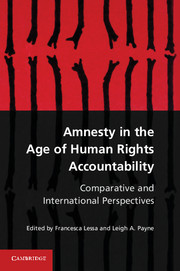
Book contents
- Frontmatter
- Contents
- Contributors
- Foreword
- Acknowledgments
- Introduction
- Part I Theoretical Framework
- Part II Comparative Case Studies
- 3 Amnesties’ Challenge to the Global Accountability Norm?
- 4 From Amnesty to Accountability
- 5 Barriers to Justice
- 6 Resistance to Change
- 7 De Facto and De Jure Amnesty Laws
- 8 Creeks of Justice
- 9 Accountability through Conditional Amnesty
- 10 De Facto Amnesty?
- 11 A Limited Amnesty?
- 12 The Spanish Amnesty Law of 1977 in Comparative Perspective
- Conclusion Amnesty in the Age of Accountability
- Bibliography
- Index
- References
6 - Resistance to Change
Brazil’s Persistent Amnesty and its Alternatives for Truth and Justice
Published online by Cambridge University Press: 05 June 2012

Book contents
- Frontmatter
- Contents
- Contributors
- Foreword
- Acknowledgments
- Introduction
- Part I Theoretical Framework
- Part II Comparative Case Studies
- 3 Amnesties’ Challenge to the Global Accountability Norm?
- 4 From Amnesty to Accountability
- 5 Barriers to Justice
- 6 Resistance to Change
- 7 De Facto and De Jure Amnesty Laws
- 8 Creeks of Justice
- 9 Accountability through Conditional Amnesty
- 10 De Facto Amnesty?
- 11 A Limited Amnesty?
- 12 The Spanish Amnesty Law of 1977 in Comparative Perspective
- Conclusion Amnesty in the Age of Accountability
- Bibliography
- Index
- References
Summary
This chapter aims to analyze transitional justice in Brazil, particularly thedevelopments in the fields of reparation and memory and the reasons behindthe persistence of the 1979 amnesty law for perpetrators of grave humanrights violations. In order to do so, the chapter is divided into threeparts. It begins by analyzing the development of four main dimensions oftransitional justice in Brazil, namely reparations, truth and memoryprocesses, institutional reform, and the regularization of justice andreestablishment of equality before the law. It argues that the policy ofreparations to victims is the lynchpin of the Brazilian transitional justiceagenda, a mechanism that has fostered progress in the recovery of truth andmemory, and more recently, in the pursuit of justice. Second, the chapteranalyzes the political and judicial reasons behind the effectiveness of the1979 amnesty law. Finally, it concludes by examining the ongoing pursuit oftruth in Brazil as well as justice alternatives for addressing human rightsviolations.
The main argument is that Brazil has had an ambiguous amnesty process. Thereparations policies adopted under the current democratic regimes emergedfrom a concept of “amnesty as freedom and reparations”substantially different from the concept of “amnesty as oblivion andimpunity” imposed by the regime in 1979. In this sense, thereparations process has the potential to craft a democratic concept ofamnesty. The reparatory policies contained in the 1988 constitution anddeveloped during the governments of Fernando Henrique Cardoso and LuisInácio Lula da Silva were carried out in a way that challenged theidea of a bilateral amnesty. The reparatory process connects amnesty andreparation, focusing on the politically persecuted and excluding theperpetrators. In this sense, progress with the policy of reparationslegitimized amnesty for the victims and delegitimized amnesty forperpetrators. This allowed for the development of other transitional justicedimensions that would otherwise be blocked by the idea of “amnesty asimpunity and oblivion.” Therefore the reparations process opened up anational dialogue through which greater accountability might be possible inthe future. This process involved an internal challenge to the culture ofimpunity in Brazil.
Information
- Type
- Chapter
- Information
- Amnesty in the Age of Human Rights AccountabilityComparative and International Perspectives, pp. 152 - 181Publisher: Cambridge University PressPrint publication year: 2012
References
2010
Sociedade como projeto – Projetos na sociedade. Sobre o papel dos movimentos sociaisCivitas – Revista de Ciências Sociais 2 2002 19Google Scholar
Accessibility standard: Unknown
Why this information is here
This section outlines the accessibility features of this content - including support for screen readers, full keyboard navigation and high-contrast display options. This may not be relevant for you.Accessibility Information
Accessibility compliance for the PDF of this chapter is currently unknown
and may be updated in the future.
- 6
- Cited by