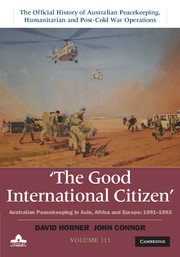
Book contents
Preface
Published online by Cambridge University Press: 12 May 2022

Summary
This volume of the Official History of Australian Peacekeeping, Humanitarian and Post–Cold War Operations continues the story of Australian peacekeeping and describes six Australian overseas missions that began in the year after the First Gulf War ended in March 1991. These missions were: the large peacekeeping mission in Cambodia (1991–99), in which Australian Lieutenant General John Sanderson was the force commander in 1992–93; the smaller mission in Western Sahara (1991–94); the limited but lengthy commitment to the former Yugoslavia (1992–2004); the short humanitarian deployment in northern Iraq (1991); the Maritime Interception Force operations applying sanctions against Iraq (1991–99); and Australia's contribution to the inspection of Iraq's weapons of mass destruction facilities under the auspices of the United Nations Special Commission on Iraq (1991–99). Dr John Connor wrote chapters 3 to 9, covering the main peacekeeping mission in Cambodia, while Professor David Horner wrote the remainder of the volume.
The previous volume in this series, Australia and the ‘New World Order’ (published in 2011) was concerned with Australia's role in the operations that resulted from the end of the Cold War. The missions were: Australia's contributions to the United Nations Iran–Iraq Military Observer Group in Iran (1988–90); to the United Nations Transition Assistance Group in Namibia (1989–90); to the United Nations Mine Clearance Training Team in Pakistan and Afghanistan (1989–93); to the Maritime Interception Force applying sanctions against Iraq in 1990; and to the First Gulf War in January–March 1991. The missions included observer activities, the conduct of elections and mine clearance training, but also moved beyond peacekeeping to peace enforcement, such as the application of sanctions and even war. The account of these missions effectively sets the scene for the stories of those described in our present volume.
Information
- Type
- Chapter
- Information
- The Good International CitizenAustralian Peacekeeping in Asia, Africa and Europe 1991–1993, pp. xi - xviPublisher: Cambridge University PressPrint publication year: 2014
Accessibility standard: Unknown
Why this information is here
This section outlines the accessibility features of this content - including support for screen readers, full keyboard navigation and high-contrast display options. This may not be relevant for you.Accessibility Information
Accessibility compliance for the PDF of this chapter is currently unknown
and may be updated in the future.