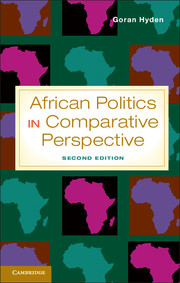
Book contents
- Frontmatter
- Contents
- Acknowledgments
- 1 The Study of Politics and Africa
- 2 The Supremacy of Politics
- 3 The Problematic State
- 4 The Economy of Affection
- 5 Big Man Rule
- 6 The Policy Paradox
- 7 The Agrarian Question
- 8 The Gender Issue
- 9 The Ethnic Factor
- 10 The External Dimension
- 11 What We Know and How
- 12 Quo Vadis Africa?
- References
- Index
10 - The External Dimension
Published online by Cambridge University Press: 05 November 2012

Book contents
- Frontmatter
- Contents
- Acknowledgments
- 1 The Study of Politics and Africa
- 2 The Supremacy of Politics
- 3 The Problematic State
- 4 The Economy of Affection
- 5 Big Man Rule
- 6 The Policy Paradox
- 7 The Agrarian Question
- 8 The Gender Issue
- 9 The Ethnic Factor
- 10 The External Dimension
- 11 What We Know and How
- 12 Quo Vadis Africa?
- References
- Index
Summary
There are many reasons why Africa's engagement with the rest of the world – the external dimension – is so important for understanding both politics and development on the continent. Its contemporary states were once territories created by the colonial powers to extract resources for their own use. Although these foreign powers made contributions to the social and economic development of these countries, at independence they were still far from modernized, lacked the human resources to manage their development, and had no real experience of governing themselves.
The European powers had not anticipated that their colonies would gain independence so quickly. Many officials in the mother countries also argued against independence on the ground that the colonies were not yet ready to “go it alone.” This position was brushed aside not only by African nationalists but also by governments in other regions of the world. In fact, just prior to the first wave of African independence in 1960, the United Nations had adopted a resolution (No. 1514), which stated that there are no specific preconditions before a country can be granted independence and recognized as a sovereign state.
With independence granted by the international community when the African colonies were still economically and politically weak, the fifty years since this landmark event have been characterized by continued dependence on wealthier and more powerful countries. The economic dimension of this dependency relation dominated the academic and policy debate in the first two decades after independence, whereas the political dimension, manifest in a dependence on the international donor community, has come to the fore since the 1990s.
Information
- Type
- Chapter
- Information
- African Politics in Comparative Perspective , pp. 209 - 230Publisher: Cambridge University PressPrint publication year: 2012
Accessibility standard: Unknown
Why this information is here
This section outlines the accessibility features of this content - including support for screen readers, full keyboard navigation and high-contrast display options. This may not be relevant for you.Accessibility Information
Accessibility compliance for the PDF of this chapter is currently unknown
and may be updated in the future.