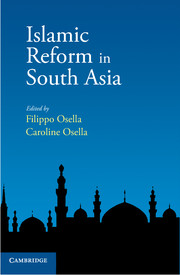
Book contents
- Frontmatter
- Contents
- List of Contributors
- Introduction
- Part I Reformist Journeys
- Part II Debating Reform
- Part III Everyday Politics of Reform
- 11 Reading the Qur'an in Bangladesh: The Politics of ‘Belief’ Among Islamist Women
- 12 Cracks in the ‘Mightiest Fortress’: Jamaat-e-Islami's Changing Discourse on Women
- 13 Islamic Feminism in India: Indian Muslim Women Activists and the Reform of Muslim Personal Law
- 14 Disputing Contraception: Muslim Reform, Secular Change and Fertility
- Part IV Reform, State and Market
- Index
12 - Cracks in the ‘Mightiest Fortress’: Jamaat-e-Islami's Changing Discourse on Women
from Part III - Everyday Politics of Reform
Published online by Cambridge University Press: 05 January 2014
By

Book contents
- Frontmatter
- Contents
- List of Contributors
- Introduction
- Part I Reformist Journeys
- Part II Debating Reform
- Part III Everyday Politics of Reform
- 11 Reading the Qur'an in Bangladesh: The Politics of ‘Belief’ Among Islamist Women
- 12 Cracks in the ‘Mightiest Fortress’: Jamaat-e-Islami's Changing Discourse on Women
- 13 Islamic Feminism in India: Indian Muslim Women Activists and the Reform of Muslim Personal Law
- 14 Disputing Contraception: Muslim Reform, Secular Change and Fertility
- Part IV Reform, State and Market
- Index
Summary
The Argument
Despite critiques, much of the scholarship on Islamism and the ‘woman question’ continues to be driven by a modernization paradigm. A classic example is the assumption that not only Islamist movements but Islam itself stand against women's equality. Articulated variously under the flags of Islamic ‘religion’, ‘culture’ or ‘tradition’, it is held that Islam is the signature cause of women's plight. From an atheistic framework, Winter (2001b) argues that Islam and Islamist movements (she conflates them) have irredeemably chained women. She asks: is Islam not ‘a primary cultural means of ensuring men's political domination of women'? (Winter 2001a: 33). Furthermore, she dismisses the idea that Islamist movements (she describes them as right-wing) have become moderate. Thus, she rejects any progressive reading of Islam claiming that the Qur'an (like other holy texts) is inherently ‘oppressive to women’ (ibid.: 12; see also Sahgal and Yuval-Davis 1992). Critical of ‘Islamic feminists’ project of evolving non-patriarchal readings of sources of Islamic authority (see, e.g., Badran 2002; Mirza 2005; and Moghadam 2002), Moghissi (1999) too contends that gender equality is ‘diametrically opposed to the basic principles of Islam’ and that ‘ … no amount of twisting… can reconcile the Qur'anic injunctions… with… gender equality' (ibid.: 140; also, see Karmi 1996: 79). Likewise, Mojab (2005: 325) avers that Islamic feminism ‘is a compromise with patriarchy’.
Information
- Type
- Chapter
- Information
- Islamic Reform in South Asia , pp. 317 - 345Publisher: Cambridge University PressPrint publication year: 2013
Accessibility standard: Unknown
Why this information is here
This section outlines the accessibility features of this content - including support for screen readers, full keyboard navigation and high-contrast display options. This may not be relevant for you.Accessibility Information
Accessibility compliance for the PDF of this chapter is currently unknown
and may be updated in the future.
- 3
- Cited by