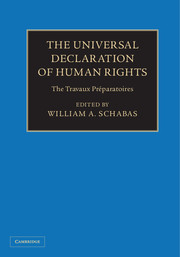
Book contents
Introductory essay: the drafting and significance of the Universal Declaration of Human Rights
Published online by Cambridge University Press: 05 May 2013
Edited by

Summary
The Universal Declaration of Human Rights was adopted by the United Nations General Assembly on 10 December 1948 following a complex drafting process that took nearly two years. Consisting of a preamble and thirty concise articles, totalling less than 1,800 words, the Declaration describes itself as “a common standard of achievement for all peoples and all nations”. It was designed to be part of a package comprising three components: a declaration or manifesto, a treaty or covenant, and provisions for implementation. The other parts followed the Declaration later, taking nearly two decades for adoption and another ten years for entry into force. The great impact of the Universal Declaration may not have been immediate. Its significance has grown over the years and continues to grow. The Declaration has been invoked in scores of international treaties, in national constitutions and legislation, and in judicial decisions at both the national and the international levels. In 2007, the United Nations Human Rights Council decided that all Member States would present periodic reports on their human rights compliance. Central to the legal framework of this new and novel procedure, known as Universal Periodic Review, are the standards set out in the Universal Declaration of Human Rights.
Information
- Type
- Chapter
- Information
- The Universal Declaration of Human RightsThe Travaux Préparatoires, pp. lxxi - cxxviPublisher: Cambridge University PressPrint publication year: 2013
References
, “The Influence of the Universal Declaration of Human Rights on International and National Law”, (1959) 53 Proceedings of the American Society of International Law217Google Scholar
, “The Status of the Universal Declaration of Human Rights in National and International Law”, (1995) 25 Georgia Journal of International and Comparative Law287Google Scholar
, “The Philosophy of the Universal Declaration”, (1984) 6 Human Rights Quarterly309CrossRefGoogle Scholar
, The Evolution of International Human Rights, Visions Seen, Philadelphia: University of Pennsylvania Press, 2003, pp. 98–100Google Scholar
, “The Road to San Francisco: The Revival of the Human Rights Idea in the Twentieth Century”, (1992) 14 Human Rights Quarterly447CrossRefGoogle Scholar
, “La déclaration universelle et la mise en oeuvre des droits de l’homme”, (1951) 79 Recueil de Cours de l’Académie de Droit International 241, at p. 272Google Scholar
, “World War Two and the Universal Declaration”, (1991) 15 Human Rights Quarterly357CrossRefGoogle Scholar
, “The International Court of Justice and the Human Rights Clauses of the Charter”, (1972) 68 American Journal of International Law337CrossRefGoogle Scholar
, “The Drafting of the Human Rights Provisions of the UN Charter”, (1997) 44 Netherlands International Law Review1CrossRefGoogle Scholar
, “Forgotten Crucible: The Latin American Influence on the Universal Human Rights Idea”, (2003) 16 Harvard Human Rights Journal27Google Scholar
, “A Magna Carta for Mankind: Writing the Universal Declaration of Human Rights”, in and , eds., The Universal Declaration of Human Rights, A History of its Creation and Implementation, 1948–1998, Paris: UNESCO Publishing, 1998, pp. 19–78Google Scholar
, “The Promise of Human Rights”, (April 1948) 40 Foreign Affairs
Canadian legal academic John Peters Humphrey (1905–95) served as Director of the United Nations Division of Human Rights from 1946 to 1968. On several occasions, Humphrey wrote about the drafting of the Universal Declaration of Human Rights and its legal significance, most notably in his memoir: Human Rights and the United Nations: A Great Adventure, Dobbs Ferry, NY: Transnational Publishers, 1984. For substantial excerpts from the memoirs, see: “Memoirs of John P. Humphrey, the First Director of the United Nations Division of Human Rights”, (1983) 5 Human Rights Quarterly 387
, ed., On the Edge of Greatness: The Diaries of John Humphrey, First Director of the United Nations Division of Human Rights, Vol. I, Montreal and Kingston: McGill-Queen’s University Press, 1994 (covering 1948)
, “The Universal Declaration of Human Rights: Its History, Impact and Juridical Character”, in , ed., Human Rights, Thirty Years After the Universal Declaration: Commemorative Volume on the Occasion of the Thirtieth Anniversary of the Universal Declaration of Human Rights, The Hague: Martinus Nijhoff, 1979, pp. 21–37
“International Bill of Rights: Scope and Implementation”, (1975–6) 17 William and Mary Law Review527
“The UN Charter and the Universal Declaration of Human Rights”, in , ed., The International Protection of Human Rights, London: Thames & Hudson, 1967, pp. 30–58Google Scholar
“La nature juridique de la Déclaration universelle des droits de l’homme”, (1981) 12 Revue Générale de Droit397
, Human Rights & the United Nations: A Great Adventure, Dobbs Ferry, NY: Transnational Publishers, 1984, p. 14Google Scholar
, ed., The Challenge of Human Rights, Charles Malik and the Universal Declaration, Oxford: Centre for Lebanese Studies, 2000
, “Universalizing Human Rights: The Role of Small States in the Construction of the Universal Declaration of Human Rights”, (2001) 23 Human Rights Quarterly44CrossRefGoogle Scholar
, Human Rights and the End of Empire, Oxford: Oxford University Press, 2001, pp. 350–2Google Scholar
, Human Rights & the United Nations: A Great Adventure, Dobbs Ferry, NY: Transnational Publishers, 1984, p. 23Google Scholar
, Human Rights & the United Nations: A Great Adventure, Dobbs Ferry, NY: Transnational Publishers, 1984, p. 31Google Scholar
, “The Preamble of the United Nations Declaration of Human Rights”, (2000) 28 Denver Journal of International Law and Policy129Google Scholar
, “The Preamble of the Universal Declaration of Human Rights”, in and , eds., The Universal Declaration of Human Rights, The Hague, Boston, London: Martinus Nijhoff, 1999, pp. 27–39Google Scholar
, “The Relationship between International Humanitarian Law and Human Rights Law: A Brief History of the 1948 Universal Declaration of Human Rights and the 1949 Geneva Conventions”, (1998) 324 International Review of the Red Cross409CrossRefGoogle Scholar
, Human Rights & the United Nations: A Great Adventure, Dobbs Ferry, NY: Transnational Publishers, 1984, p. 32Google Scholar
, Human Rights & the United Nations: A Great Adventure, Dobbs Ferry, NY: Transnational Publishers, 1984, p. 32Google Scholar
“Memorandum of Conversation with Eleanor Roosevelt”, 3 June 1947, of State Department official in , ed., The Eleanor Roosevelt Papers, Vol. I: The Human Rights Years, 1945–1948, Charlottesville, VA and London: University of Virginia Press, 2007, pp. 556–9
, “France: The Origins, with the Prospect of Increasing Effect”, in and , eds., 60 Years of the Universal Declaration of Human Rights in Europe, Antwerp, Oxford, Portland: Intersentia, 2009, pp. 19–26Google Scholar
, A World Made New, Eleanor Roosevelt and the Universal Declaration of Human Rights, New York: Random House, 2001, p. 65Google Scholar
, The Universal Declaration of Human Rights, Origins, Drafting, and Intent, Philadelphia: Penn, 2000, p. 168Google Scholar
, “The United Nations Sub-Commission on Prevention of Discrimination and Protection of Minorities”, (1968) 62 American Journal of International Law869CrossRefGoogle Scholar
in Nahimana et al. v. Prosecutor (ICTR-99–52-A), Partly Dissenting Opinion of Judge Meron, 28 November 2007
, “Denmark: A Document of Ideological Importance”, in and , eds., 60 Years of the Universal Declaration of Human Rights in Europe, Antwerp, Oxford, Portland: Intersentia, 2009, pp. 43–57Google Scholar
, The Universal Declaration of Human Rights, Origins, Drafting, and Intent, Philadelphia: Penn, 2000, p. 117Google Scholar
, “A Feminist Analysis of the Universal Declaration of Human Rights”, in , ed., Beyond Domination: New Perspectives on Women and Philosophy, Totowa, NJ: Rowman and Allanheld, 1983, pp. 250–71Google Scholar
, “Women’s Rights in the Universal Declaration”, (1991) 13 Human Rights Quarterly229CrossRefGoogle Scholar
, “The Mid-Life Crisis of the Universal Declaration of Human Rights”, (1998) 55 Washington and Lee Law Review781Google Scholar
, Human Rights & the United Nations: A Great Adventure, Dobbs Ferry, NY: Transnational Publishers, 1984, p. 36Google Scholar
, Human Rights & the United Nations: A Great Adventure, Dobbs Ferry, NY: Transnational Publishers, 1984, p. 36Google Scholar
, “Cultural Genocide, the Universal Declaration, and Minority Rights”, (1999) 21 Human Rights Quarterly1009CrossRefGoogle Scholar
, “Les droits des minorités: Une déclaration inachevée”, in Déclaration universelle des droits de l’homme 1948–98: Avenir d’un idéal commun, Paris: La Documentation française, 1999, pp. 223–42Google Scholar
, “A Problem from Hell”, America and the Age of Genocide, New York: Basic Books, 2002, pp. 74–6Google Scholar
, No Enchanted Palace: The End of Empire and the Ideological Origins of the United Nations, Princeton and Oxford: Princeton University Press, 2009, p. 131Google Scholar
, Human Rights & the United Nations: A Great Adventure, Dobbs Ferry, NY: Transnational Publishers, 1984, p. 71Google Scholar
, Human Rights & the United Nations: A Great Adventure, Dobbs Ferry, NY: Transnational Publishers, 1984, p. 71Google Scholar
, “Canada and the Adoption of the Universal Declaration of Human Rights”, (1998) 43 McGill Law Journal403Google Scholar
, “Eleanor Roosevelt, John Humphrey and Canadian Opposition to the Universal Declaration of Human Rights: Looking Back on the 50th Anniversary of the UNDHR”, (1998) 52 International Journal325Google Scholar
and , “Publicity for the Universal Declaration of Human Rights: General Assembly Resolution 217D(III)”, in and , eds., The Universal Declaration of Human Rights, The Hague, Boston, London: Martinus Nijhoff, 1999, pp. 725–41, 30–22Google Scholar
, Human Rights & the United Nations: A Great Adventure, Dobbs Ferry, NY: Transnational Publishers, 1984, pp. 72–3Google Scholar
, Human Rights & the United Nations: A Great Adventure, Dobbs Ferry, NY: Transnational Publishers, 1984, p. 73Google Scholar
, “Universal Human Rights: The Contribution of Muslim States”, (2004) 26 Human Rights Quarterly 799, at pp. 814–17CrossRefGoogle Scholar
, Human Rights & the United Nations: A Great Adventure, Dobbs Ferry, NY: Transnational Publishers, 1984, p. 64Google Scholar
, “The Influence of the Universal Declaration of Human Rights on International and National Law”, (1959) 53 Proceedings of the American Society of International Law 217, at p. 218Google Scholar
, “The Universal Declaration of Human Rights”, (1948) 25 British Yearbook of International Law 354, at p. 369Google Scholar
, “The United Nations Declaration of Human Rights”, (1949) 43 American Journal of International Law 316, at p. 321: “it is not law”CrossRefGoogle Scholar
, Human Rights & the United Nations: A Great Adventure, Dobbs Ferry, NY: Transnational Publishers, 1984, p. 74Google Scholar
, “The Legal Significance of Re-Citation of General Assembly Resolutions”, (1969) 63 American Journal of International Law 444, at p. 463CrossRefGoogle Scholar
, “The Universal Declaration of Human Rights”, (1948) 25 British Yearbook of International Law 354, at p. 356Google Scholar
, “The Changing Fortunes of the Universal Declaration of Human Rights: Genesis and Symbolic Dimensions of the Turn to Rights in International Law”, (2008) 19 European Journal of International Law903CrossRefGoogle Scholar
, “The Universal Declaration of Human Rights”, (1948) 25 British Yearbook of International Law 354, at pp. 362–3Google Scholar
Application of the International Convention on the Elimination of All Forms of Racial Discrimination (Georgia v. Russian Federation), Preliminary Objections, 1 April 2011
, “Expulsion to Face Torture? Non-refoulement in International Law”, (2008) 20 International Journal of Refugee Law 373, at p. 380CrossRefGoogle Scholar
, “An Instance of Enforcing the Universal Declaration of Human Rights: Action by the Security Council”, (1973) 22 International and Comparative Law Quarterly 161, at p. 162CrossRefGoogle Scholar
, “The Universal Declaration of Human Rights”, (1948) 25 British Yearbook of International Law 354, at p. 365Google Scholar
South West Africa (Second Phase), Judgment, [1966] ICJ Reports 6, p. 293 (Dissenting Opinion of Judge Tanaka)
, Human Rights & the United Nations: A Great Adventure, Dobbs Ferry, NY: Transnational Publishers, 1984, p. 65Google Scholar
, “The Status of the Universal Declaration of Human Rights in National and International Law”, (1995) 25 Georgia Journal of International and Comparative Law 287, at p. 340Google Scholar
United States Diplomatic and Consular Staff in Tehran, Judgment, [1980] ICJ Reports 3, para. 91
, “The Universal Declaration of Human Rights”, (1948) 25 British Yearbook of International Law 354, at p. 367Google Scholar
, Human Rights and Humanitarian Norms as Customary Law, Oxford: Clarendon Press, 1989, p. 88Google Scholar
, “How Universal is the Universal Declaration?”, (1998) 47University of New Brunswick Law Journal19, at p. 21Google Scholar
, The Last Utopia, Human Rights in History, Cambridge, MA and London: Belknap Press, 2010, p. 66Google Scholar
, “The Influence of the Universal Declaration of Human Rights on International and National Law”, (1959) 53 Proceedings of the American Society of International Law 217, at p. 218Google Scholar
According to the Human Rights Committee, interpreting provisions of the International Covenant on Civil and Political Rights that share a common ancestry with the Universal Declaration of Human Rights, the term “sex” as it appears in enumerations of grounds of prohibited discrimination is to include “sexual orientation”: Toonen v. Australia UN Doc. CCPR/C/50/D/488/1992 (1994), para. 8.7
, “Sexual Orientation, Discrimination, and the Universal Declaration of Human Rights”, (2010–11) 11 Chicago Journal of International Law789Google Scholar
, A World Made New, Eleanor Roosevelt and the Universal Declaration of Human Rights, New York: Random House, 2001, p. 31Google Scholar
, Human Rights & the United Nations: A Great Adventure, Dobbs Ferry, NY: Transnational Publishers, 1984, p. 59Google Scholar
, “Redressing Impunity for Human Rights Violations: The Universal Declaration and the Search for Accountability”, (1998) 26 Denver Journal of International Law and Policy591Google Scholar
, The Last Utopia, Human Rights in History, Cambridge, MA and London: Belknap Press, 2010Google Scholar
, “The Origins of the Universal Declaration of Human Rights”, in and , eds., The Universal Declaration of Human Rights, The Hague, Boston, London: Martinus Nijhoff, 1999, pp. 3–22, at pp. 20–1Google Scholar
, “The Mid-Life Crisis of the Universal Declaration of Human Rights”, (1998) 55 Washington and Lee Law Review 781, at p. 796Google Scholar
, The Last Utopia, Human Rights in History, Cambridge, MA and London: Belknap Press, 2010Google Scholar
Accessibility standard: Unknown
Why this information is here
This section outlines the accessibility features of this content - including support for screen readers, full keyboard navigation and high-contrast display options. This may not be relevant for you.Accessibility Information
Accessibility compliance for the PDF of this chapter is currently unknown
and may be updated in the future.
- 1
- Cited by