Book contents
- Frontmatter
- Contents
- Author’s Biography
- Acknowledgments
- 1 Introduction
- 2 Historical Context
- 3 Theoretical Underpinnings
- 4 Nuremberg
- 5 The Truman Proclamation on the Continental Shelf
- 6 Outer Space Law
- 7 The Yugoslavia Tribunal’s Tadic Decision
- 8 The 1999 NATO Intervention
- 9 The Response to 9/11
- 10 Conclusion
- Index
- References
7 - The Yugoslavia Tribunal’s Tadic Decision
Published online by Cambridge University Press: 05 June 2013

Book contents
- Frontmatter
- Contents
- Author’s Biography
- Acknowledgments
- 1 Introduction
- 2 Historical Context
- 3 Theoretical Underpinnings
- 4 Nuremberg
- 5 The Truman Proclamation on the Continental Shelf
- 6 Outer Space Law
- 7 The Yugoslavia Tribunal’s Tadic Decision
- 8 The 1999 NATO Intervention
- 9 The Response to 9/11
- 10 Conclusion
- Index
- References
Summary
On the eve of the establishment of the International Criminal Tribunal for the Former Yugoslavia in 1993, the International Committee of the Red Cross “underlined the fact that according to international humanitarian law as it stands today, the notion of war crimes is limited to situations of international armed conflict.” Yet, in its first decision, on October 2, 1995, the Appeals Chamber of the Yugoslavia Tribunal held that the same principles of liability that apply to international armed conflict apply to internal armed conflicts. Despite dubious provenance, this sweeping decision has been affirmed by the Rwanda Tribunal and Special Court for Sierra Leone; it has been codified in the military manuals of several governments; it has been enshrined in the 1998 Statute of the International Criminal Court; and it is now recognized as customary international law despite the dearth of state practice or prolonged period of development. This chapter examines how the occurrence of genocide in Europe for the first time since the Second World War and the creation of the first international criminal tribunal since Nuremberg sowed the seeds for rapid recognition of this expanded area of international criminal liability.
Events Leading to the Tadic Decision
Although many states and commentators hoped there would be a permanent war crimes tribunal created in the aftermath of the Nuremberg trial, it would be nearly sixty years before events on the ground and international political currents would align to enable the international community to establish another international war crimes tribunal. Just a few months after the breakup of the Soviet Union, genocide took place in Europe for the first time since Nazi Germany. The location was Bosnia-Herzegovina, which had recently declared its independence from what was left of the former Yugoslavia (Serbia and Montenegro).
Information
- Type
- Chapter
- Information
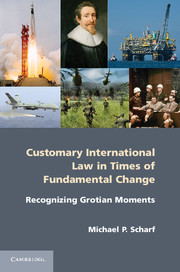
- Customary International Law in Times of Fundamental ChangeRecognizing Grotian Moments, pp. 139 - 156Publisher: Cambridge University PressPrint publication year: 2013
References
, Musical Chairs: The Dissolution of States and Membership in the United Nations, 28 Cornell International Law Journal29, 46–7 (1995)Google Scholar
, When Courts Make Law: How the International Criminal Tribunals Recast the Laws of War, 49 Vanderbilt Law Review1, 23 (2006)Google Scholar
, Trial and Error: An Assessment of the First Judgment of the Yugoslavia War Crimes Tribunal, 30 New York University Journal of International Law and Politics167, 167 (1998)Google Scholar
, The Humanitarian Law of the Yugoslavia War Crimes Tribunal: Jurisdiction in Prosecutor v. Tadic, 36 Virginia Journal of International Law687, 709 (1996)Google Scholar
, The Humanitarian Law of the Yugoslavia War Crimes Tribunal: Jurisdiction in Prosecutor v. Tadic, 36 Virginia Journal of International Law687, 709 (1996)Google Scholar
, The Humanitarian Law of the Yugoslavia War Crimes Tribunal: Jurisdiction in Prosecutor v. Tadic, 36 Virginia Journal of International Law687, 713 (1996)Google Scholar
, International Humanitarian Law and the Tadic Case, 7 European Journal of International Law265, 278 (1996)CrossRefGoogle Scholar
, When Courts Make Law: How the International Criminal Tribunals Recast the Laws of War, 49 Vanderbilt Law Review1, 2 (2006)Google Scholar
, When Courts Make Law: How the International Criminal Tribunals Recast the Laws of War, 49 Vanderbilt Law Review1, 45 (2006)Google Scholar
, When Courts Make Law: How the International Criminal Tribunals Recast the Laws of War, 49 Vanderbilt Law Review1, 23 (2006)Google Scholar
, When Courts Make Law: How the International Criminal Tribunals Recast the Laws of War, 49 Vanderbilt Law Review1, 5 (2006)Google Scholar
, The Continuing Role of Custom in the Formation of International Humanitarian Law, 90 American Journal of International Law238, 247 (1996)CrossRefGoogle Scholar
, When Courts Make Law: How the International Criminal Tribunals Recast the Laws of War, 49 Vanderbilt Law Review1, 45 (2006)Google Scholar
, When Courts Make Law: How the International Criminal Tribunals Recast the Laws of War, 49 Vanderbilt Law Review1, 5 (2006)Google Scholar
, When Courts Make Law: How the International Criminal Tribunals Recast the Laws of War, 49 Vanderbilt Law Review1, 44 (2006)Google Scholar
, When Courts Make Law: How the International Criminal Tribunals Recast the Laws of War, 49 Vanderbilt Law Review1, 49 (2006)Google Scholar
, International Humanitarian Law and the Tadic Case, 7 European Journal of International Law265, 279 (1996)CrossRefGoogle Scholar
, The ICC’s Jurisdiction over War Crimes in Internal Armed Conflicts: An Insurmountable Obstacle for China’s Accession? 28 Pennsylvania State International Law Review703, 715 (2010)Google Scholar
Accessibility standard: Unknown
Why this information is here
This section outlines the accessibility features of this content - including support for screen readers, full keyboard navigation and high-contrast display options. This may not be relevant for you.Accessibility Information
Accessibility compliance for the PDF of this chapter is currently unknown
and may be updated in the future.