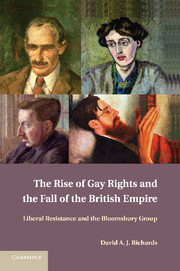
 The Rise of Gay Rights and the Fall of the British Empire
 Liberal Resistance and the Bloomsbury Group
5 - Gay Rights in Former British Colonies: Legacy of Empire?
Published online by Cambridge University Press: 05 June 2014

Summary
Despite the arguments to the contrary of liberal apologists such as John Stuart Mill, the British Empire appears to have been little concerned with introducing liberal democracy into its colonies. Indeed, the attempt to justify British imperialism and related practices on such grounds may not unreasonably be urged as grounds for questioning liberalism as a defensible political theory. There is a connection, and an important one, between the rise of gay rights in Britain and the serious questioning in Britain of its imperialism, but the connection, as we have shown, led to a criticism of practices of British patriarchy at home and abroad (enforcing the patriarchal Love Laws) as inconsistent with the deeper values of liberal democracy, as the British resistance group discovered through its experiments in living that the sexual love of equals, resisting the divisions imposed by the Love Laws, enabled them through such love to resist the ways patriarchy destroyed love and rationalized unjust violence at home and abroad (including the violence of World War I). So the rise of gay rights and British imperialism were very much at odds, as we can see clearly in Leonard Woolf, who moves from being a successful agent of British imperialism in Ceylon to, under the impact of his remarkable marriage to Virginia Woolf and friendship with Lytton Strachey, a stance of resistance, reflected both in the novel he wrote based on his experiences in Ceylon and his books criticizing imperialism. And what gay men like E. M. Forster and Roger Casement discovered in having sex with natives (breaking the Love Laws of both race and gender) was a liberation of ethical intelligence in seeking to expose to the wider world how racism rationalized not just unjust imperial hierarchies but genocide.
Information
- Type
- Chapter
- Information
- The Rise of Gay Rights and the Fall of the British EmpireLiberal Resistance and the Bloomsbury Group, pp. 208 - 230Publisher: Cambridge University PressPrint publication year: 2013
References
, “Resentment Toward the West Bolsters Uganda's New Anti-Gay Bill,” New York Times, Wednesday, February 29, 2012, p. A4
, “Out in Africa: A gay rights struggle with deadly stakes,” The New Yorker, December 24&31, 2012, pp. 64--70.
, “Out in Africa: A gay rights struggle with dead stakes,” The New Yorker, December 24&31, 2012, pp. 64--70, at p. 70.
, “The Values of a Just Society” in Towards a Just Society: The Trudeau Years, edited by and (Markham: Viking Books, 1990), 357 at 363.Google Scholar
, Rights of Passage: Struggles for Lesbian and Gay Legal Equality (Toronto: University of Toronto Press, 1994).Google Scholar
, The Soft Vengeance of a Freedom Fighter, new ed. (Berkeley: University of California Press, 2000)Google Scholar
, The Constitution of South Africa: A Contextual Analysis (Oxford: Hart Publishing, 2010), at p. 85Google Scholar
, “Constituting Sexuality: The Struggle for Sexual Orientation in the South African Bill of Rights,” 23 J.L. & Soc'y 455 (1966), at p. 458Google Scholar
, “Sexual Orientation and the Constitution: A Test Case for Human Rights,” 110 S. African L.J. 450, 451 (1993)Google Scholar
and , Defiant Desire: Gay and Lesbian Lives in South Africa (New York: Routledge, 1995)Google Scholar
, The Man Who Drove with Mandela (1998).
, Southern Africa: Old Treacheries and New Deceits (New Haven, CT: Yale University Press, 2011), at pp. 51–2.Google Scholar
, Robert Mugabe: A Life of Power and Violence (Ann Arbor: University of Michigan Press, 2003), at pp. 22–3CrossRefGoogle Scholar
. “Mugabe Ally Escalates Push to Control Church: Anglican Leaders Harassed and Threatened,” The New York Times, Monday, May 30, 2011, A6.
and , Why Nations Fail: The Origins of Power, Prosperity, and Poverty (New York: Crown Business, 2012)Google Scholar
, The Spirit of Democracy: The Struggle fo Build Free Societies throughout the World (New York: Times Books, 2008).Google Scholar
and , The Deepening Darkness: Patriarchy, Resistance, and Democracy's Future (Cambridge: Cambridge University Press, 2009), pp. 232–8.Google Scholar
, “In Uganda, Push to Curb Gays Draws U.S. Guest,” The New York Times, Monday, May 3, 2010, A9
, “Resentment toward the West Bolsters Uganda's New Anti-Gay Bill,” The New York Times, Wednesday, February 29, 2012, A4
, “Out in Africa: A gay rights struggle with deadly stakes,” The New Yorker, December 24&31, 2012, pp. 64--70.
, “Some-Sex Couple Stir Fears in Malawi of a ‘Gay Agenda’ Promoted by the West,” The New York Times, Sunday, February 14, 2010, p. 6.
, “Legal discrimination against homosexuals – a blind spot of the Commonwealth of Nations?,” E.H.L.R. 2009, 1, 21–36.
, From the Ruins of Empire: The Intellectuals Who Remade Asia (New York: Farrar, Straus & Giroux, 2012), at p. 239.Google Scholar
and , Ubuntu and the Law: African Ideals and Postapartheid Jurisprudence (New York: Fordham University Press, 2012)Google Scholar
, South Africa's Brave New World: The Beloved Country since the End of Apartheid (New York: Overlook Press, 2009)Google Scholar
, Hind Swaraj and Other Writings, edited by (Cambridge: Cambridge University Press, 2000)Google Scholar
, From the Ruins of Empire: The Intellectuals Who Remade Asia (New York: Farrar, Straus & Giroux, 2012)Google Scholar
, Civilization: Its Cause and Cure and Other Essays (London: Swan Sonnenschein, 1906), pp. 2–50Google Scholar
, Postcolonialism: An Historical Introduction (Oxford: Blackwell Publishing, 2001), pp. 326–7Google Scholar
, Disarming Manhood: Roots of Ethical Resistance (Athens, OH: Swallow Press, 2005), pp. 92–130Google Scholar
, The Indian Constitution: Cornerstone of a Nation (Oxford: Oxford University Press, 2011Google Scholar
, Working a Democratic Constitution: A History of the Indian Experience (Oxford: Oxford University Press, 1999)Google Scholar
and , The Deepening Darkness: Patriarchy, Resistance, and Democracy's Future (Cambridge: Cambridge University Press, 2009), pp. 249–53Google Scholar
, “How to Do Comparative Constitutional Law in India: Naz Foundation, Same Sex Rights, and Dialogical Interpretation,” in Comparative Constitutionalism in South Asia, edited by , , & (New Delhi: Oxford University Press, 2011)Google Scholar
, The Intimate Enemy: Loss and Recovery of Self under Colonialism (Oxford: Oxford University Press, 1983)Google Scholar
, “De-radicalising the Rights Claims of Sexual Subalterns though ‘Tolerance,” in Queer Theory: Law, Culture, Empire, edited by and , (New York: Routledge, 2010), pp. 37–52Google Scholar
, India: A Million Mutinies Now (New York: Vintage, 2011; originally published, 1990), p. 517.Google Scholar
Accessibility standard: Unknown
Why this information is here
This section outlines the accessibility features of this content - including support for screen readers, full keyboard navigation and high-contrast display options. This may not be relevant for you.Accessibility Information
Accessibility compliance for the PDF of this chapter is currently unknown
and may be updated in the future.