Preface
Published online by Cambridge University Press: 05 June 2016

Summary
Organization of this book is somewhat different from a normal textbook involving machines and equipment, in the field of mechanical engineering. Generally, stress is given to the theories and principles involved and the processes are explained to a great detail. There is no doubt that these are essential for an engineer. But it is equally important for an engineer to know the basic design, working principles and operations of the various machines and equipment which are used in the practical field for conversion of the raw materials into desired products. Baring the subject of ‘Machine Tools’, in most other fields of manufacturing processes, available textbooks seem to be rather miserly in thorough discussions on the description, design, working principles of various machines and systems involved and practices followed in actual operation.
An attempt has been made to bridge this gap by introducing laboratory exercises and workshops along with industry visits, in the engineering curricula. More often than not these prove to be inadequate. It is next to impossible that an equipment or machine like a turbine, an extrusion press or a rolling mill can be installed in an academic institution. By observing the operation of a machine or system during a visit to an industrial plant, definitely a lot can be learned about the manufacturing process, but seldom can it give an idea about the working principles of the various mechanisms, their design details or about the intricacies of operational practices.
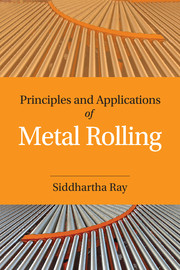
While teaching ‘Manufacturing Technology’ to MTech students at the National Institute of Technical Teachers’ Training and Research (NITTTR), Kolkata, I observed this shortcoming in my students and cherished the desire to bridge the gap as soon as possible. With 30 years’ experience in the industry in design, development and commissioning to operation plant and machinery (out of which more than half the period was in the field of Rolling Mills), I decided to write this book titled Principles and Applications of Metal Rolling.
Information
- Type
- Chapter
- Information
- Principles and Applications of Metal Rolling , pp. xxi - xxiiPublisher: Cambridge University PressPrint publication year: 2016
Accessibility standard: Unknown
Why this information is here
This section outlines the accessibility features of this content - including support for screen readers, full keyboard navigation and high-contrast display options. This may not be relevant for you.Accessibility Information
Accessibility compliance for the PDF of this chapter is currently unknown
and may be updated in the future.