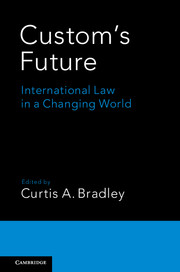
Book contents
- Frontmatter
- Dedication
- Contents
- Notes on Contributors
- Introduction: Custom's Future
- 1 Custom's Past
- 2 Customary International Law Adjudication as Common Law Adjudication
- 3 Customary International Law as a Dynamic Process
- 4 Custom, Jus Cogens, and Human Rights
- 5 Customary International Law: How Do Courts Do It?
- 6 Custom's Method and Process: Lessons from Humanitarian Law
- 7 The Growing Obsolescence of Customary International Law
- 8 The Strange Vitality of Custom in the International Protection of Contracts, Property, and Commerce
- 9 The Decline of Customary International Law as a Source of International Criminal Law
- 10 Customary International Law and Public Goods
- 11 Reinvigorating Customary International Law
- 12 The Evolution of Codification: A Principal-Agent Theory of the International Law Commission's Influence
- 13 Custom and Informal International Lawmaking
- 14 Custom's Bright Future: The Continuing Importance of Customary International Law
- Bibliography
- Index
5 - Customary International Law: How Do Courts Do It?
Published online by Cambridge University Press: 05 February 2016
Edited by

Book contents
- Frontmatter
- Dedication
- Contents
- Notes on Contributors
- Introduction: Custom's Future
- 1 Custom's Past
- 2 Customary International Law Adjudication as Common Law Adjudication
- 3 Customary International Law as a Dynamic Process
- 4 Custom, Jus Cogens, and Human Rights
- 5 Customary International Law: How Do Courts Do It?
- 6 Custom's Method and Process: Lessons from Humanitarian Law
- 7 The Growing Obsolescence of Customary International Law
- 8 The Strange Vitality of Custom in the International Protection of Contracts, Property, and Commerce
- 9 The Decline of Customary International Law as a Source of International Criminal Law
- 10 Customary International Law and Public Goods
- 11 Reinvigorating Customary International Law
- 12 The Evolution of Codification: A Principal-Agent Theory of the International Law Commission's Influence
- 13 Custom and Informal International Lawmaking
- 14 Custom's Bright Future: The Continuing Importance of Customary International Law
- Bibliography
- Index
Summary
INTRODUCTION: THE ODIOUS DEBT DEBATE
Around 2003, there was a surge in interest among international debt scholars in the question of what evidence courts look to in determining customary international law (CIL). The new post-Saddam Iraqi government had inherited an economy saddled with roughly $140 billion in Saddam-era debt. Since portions of that debt had almost certainly been incurred to fund things such as weapons to put down insurrections and palaces for the dictator, it is unsurprising that the post-Saddam Iraqi government bridled at the prospect of having to pay it. A key legal question, therefore, was whether international law excused a new government from paying some or all of the debts of a prior regime that had been, to use the technical term, “odious.” Or, did the international law governing governmental succession to debts contain an exception for odious debts?
There are two primary sources of international law, treaties and customary law. On the treaty front, the drafters of one international treaty, the 1983 Vienna Convention on the Succession of States, had discussed the inclusion of an odious debts exception to the general rules of state and governmental succession. But the idea failed to garner support beyond a handful of states. The next question, therefore, was whether an odious debt exception existed as a matter of custom. The treatises on international debt and state succession were clear on the rule: governments had to pay the debts of their predecessor governments regardless of matters such as political differences. Many of the treatises, however, were from a half-century or more prior and the norms of international law had changed dramatically during that post–World War II period. Scholars, therefore, took on the question of whether it could be argued that, over time, a customary exception of odious debts had evolved.
Even a rudimentary sense of history told these scholars that there had been occasions when governments had refused to pay debts of prior regimes. In the early 1900s, the communist governments in Russia and China had famously refused to pay the debts of the prior monarchies. In the United States in the 1800s, a number of post-Reconstruction southern governments had explicitly repudiated the debts of their predecessors on the grounds that those prior regimes had been illegitimate.
Information
- Type
- Chapter
- Information
- Custom's FutureInternational Law in a Changing World, pp. 117 - 147Publisher: Cambridge University PressPrint publication year: 2016
Accessibility standard: Unknown
Why this information is here
This section outlines the accessibility features of this content - including support for screen readers, full keyboard navigation and high-contrast display options. This may not be relevant for you.Accessibility Information
Accessibility compliance for the PDF of this chapter is currently unknown
and may be updated in the future.
- 3
- Cited by