Book contents
- Frontmatter
- Dedication
- Contents
- List of figures
- Acknowledgements
- A note on abbreviations
- Introduction
- PART I The art of memory
- PART II Rhetoric and poetics
- Introduction to Part II
- II.1 Anon., Table of Cebes (1531)
- II.2 Thomas Wilson, The Art of Rhetoric (1553)
- II.3 George Puttenham, The Art of English Poesy (1589)
- II.4 Henry Peacham, The Garden of Eloquence (1593)
- II.5 Philip Sidney, The Defence of Poesy (1595)
- II.6 Francis Meres, Palladis tamia (1598)
- II.7 Samuel Daniel, Musophilus (1599)
- II.8 Miles Sandys, Prudence (1634)
- II.9 Ben Jonson, Timber, or, Discoveries (1641)
- II.10 Alexander Ross, Mystagogus poeticus (1648)
- PART III Education and science
- PART IV History and philosophy
- PART V Religion and devotion
- PART VI Literature
- Index
- References
II.3 - George Puttenham, The Art of English Poesy (1589)
from PART II - Rhetoric and poetics
Published online by Cambridge University Press: 05 August 2016

Book contents
- Frontmatter
- Dedication
- Contents
- List of figures
- Acknowledgements
- A note on abbreviations
- Introduction
- PART I The art of memory
- PART II Rhetoric and poetics
- Introduction to Part II
- II.1 Anon., Table of Cebes (1531)
- II.2 Thomas Wilson, The Art of Rhetoric (1553)
- II.3 George Puttenham, The Art of English Poesy (1589)
- II.4 Henry Peacham, The Garden of Eloquence (1593)
- II.5 Philip Sidney, The Defence of Poesy (1595)
- II.6 Francis Meres, Palladis tamia (1598)
- II.7 Samuel Daniel, Musophilus (1599)
- II.8 Miles Sandys, Prudence (1634)
- II.9 Ben Jonson, Timber, or, Discoveries (1641)
- II.10 Alexander Ross, Mystagogus poeticus (1648)
- PART III Education and science
- PART IV History and philosophy
- PART V Religion and devotion
- PART VI Literature
- Index
- References
Summary
About the author
George Puttenham (1529–90/91) is generally thought to have written this text. Recent scholarship has revealed his embroilment in litigation over his brother's property, his wife's estate, treason, spousal abuse, murder and even sexual slavery, these legal wranglings suggesting shadier purposes to which his rhetorical studies were put.
About the text
The Art of English Poesy, the most comprehensive statement on English poetics in the Elizabethan era, advises fledgling courtiers on proper courtly speech and conduct and simultaneously advances the nationalist project of vernacularising classical poetry, prosody and rhetoric. No author's name appears on the title page, but internal and external evidence leave little doubt that Puttenham authored the text. Perhaps the treatise was published anonymously because assigning Puttenham's name risked public slander from his litigious enemies, injuring his reputation further and undermining his bid for patronage – he dedicates his text to William Cecil, the high treasurer, and addresses many passages to Elizabeth I, his ideal reader. His poetics stands out for its emphasis on poetry as a craft rather than a divine mystery and its serious consideration of aesthetic pleasure. The text consists of three books: the first examines the origins of poetry, while defending it from detractions; the second deals with proportion and metre; and the third assembles a catalogue of figures of speech, concluding with the importance of decorum and dissembling for fashioning the courtier's comportment, speech and writing.
The arts of memory
The excerpt comes from the first book, over half of which Puttenham spends rehearsing the various classical poetic genres. In this chapter, Puttenham justifies the benefits of historical poesy by appealing to the centrality of memory in policy, knowledge and ethics. After privileging the knowledge of things from the past over the knowing of things in the present (fleeting sensory impressions) and the future (mere conjecture), the passage takes an extraordinary turn. Memory slides into the imaginative – the exemplum and historical poesy blending with the fabulous. Like Sidney, Puttenham acknowledges a major difference between what has occurred and what is worth remembering. He asserts that writers have effectually harnessed literature's capacity to be memorable for the reader's ethical edification and pleasure and not for any verisimilitude to the past, since the events of history often include morally reprehensible actions and completely irrelevant situations.
Information
- Type
- Chapter
- Information
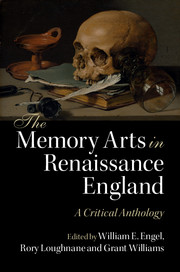
- The Memory Arts in Renaissance EnglandA Critical Anthology, pp. 116 - 120Publisher: Cambridge University PressPrint publication year: 2016
References
The Art of English Poesy by George Puttenham: A Critical Edition, ed. and (Ithaca, CT: Cornell University Press, 2007), introduction.
, ‘George Puttenham's Lewd and Illicit Career’, Texas Studies in Literature and Language, 50.2 (2008), 143–76.Google Scholar
, The English Renaissance Stage: Geometry, Poetics, and the Practical Spatial Arts 1580–1630 (Oxford University Press, 2010), pp. 118–26.
Accessibility standard: Unknown
Why this information is here
This section outlines the accessibility features of this content - including support for screen readers, full keyboard navigation and high-contrast display options. This may not be relevant for you.Accessibility Information
Accessibility compliance for the PDF of this chapter is currently unknown
and may be updated in the future.