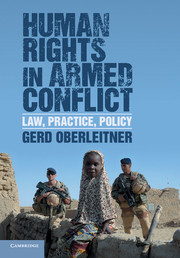
Book contents
- Frontmatter
- Contents
- Acknowledgments
- Table of cases
- Table of Legal Instruments
- List of Abbreviations
- Introduction
- Part I Human rights in armed conflict: history of an idea
- Part II Human rights and humanitarian law: theory
- Part III Human rights and humanitarian law: challenges and commonalities
- Part IV The dynamics of war and law
- Part V Enforcement: practice and potential
- Conclusion
- Bibliography
- Index
- References
Introduction
Published online by Cambridge University Press: 05 March 2015

Book contents
- Frontmatter
- Contents
- Acknowledgments
- Table of cases
- Table of Legal Instruments
- List of Abbreviations
- Introduction
- Part I Human rights in armed conflict: history of an idea
- Part II Human rights and humanitarian law: theory
- Part III Human rights and humanitarian law: challenges and commonalities
- Part IV The dynamics of war and law
- Part V Enforcement: practice and potential
- Conclusion
- Bibliography
- Index
- References
Summary
The continued application of international human rights law in situations of armed conflict is the “new orthodoxy” of our times. It is widely (although not universally) accepted that, as a matter of principle, international human rights law has a role to play in situations of armed conflict, particularly in internal armed conflicts and situations of occupation, as well as in peace support operations. Beyond the general proposition that human rights law remains applicable in armed conflicts there is, however, limited understanding of the legal, practical and political consequences of applying human rights. The crucial problem is no longer if human rights apply in armed conflicts but how they apply. This is the question upon which this book is built; a question which has been lingering in the corridors of the United Nations, in courtrooms, military command centres and university lecture halls since the emergence of the international human rights regime after 1945, and is now very much present in legal writing and state practice. But notwithstanding rhetorical claims of the importance of human rights, the idea of resorting to human rights in situations of armed conflict still has the potential to divide scholars, governmental representatives, the military, judges, civil society organizations and the public.
Some may perceive the very topic of human rights in armed conflict as cynical, given that war is the antithesis and negation of everything for which human rights stand: human dignity and physical integrity, prosperity, justice, equality, peace and security – all gone when war is waged. In their view, the Universal Declaration of Human Rights of 1948 (UDHR) was meant to secure peace and prevent the recurrence of the kind of atrocities which had inspired its adoption, but should not be abused to regulate matters of warfare. Human rights, they may argue, should keep well away from this area, given that a highly specialized legal regime – the law of armed conflict or international humanitarian law – already regulates matters of armed conflict. Given that war has been assigned its own law with a formidable history of codification, there is no place for human rights on the battlefield, and there should not be, such critics may claim.
Information
- Type
- Chapter
- Information
- Human Rights in Armed ConflictLaw, Practice, Policy, pp. 1 - 8Publisher: Cambridge University PressPrint publication year: 2015
References
, “Introduction: International Humanitarian and International Human Rights Law – Pas de Deux” in (ed.), International Humanitarian and International Human Rights Law (Oxford: Oxford University Press, 2011), p. 5CrossRefGoogle Scholar
, “Challenges in Applying Human Rights Law to Armed Conflict” (2005) 87(860) International Review of the Red Cross738CrossRefGoogle Scholar
, International Human Rights and Humanitarian Law (Cambridge: Cambridge University Press, 2002)CrossRefGoogle Scholar
, Human Rights in Times of Conflict and Terrorism (Oxford: Oxford University Press, 2011)CrossRefGoogle Scholar
and , Customary International Humanitarian Law, vol. I, Rules and vol. II, Practice (Cambridge: Cambridge University Press, 2005)CrossRefGoogle Scholar
, The Impact of Human Rights Law on Armed Forces (Cambridge: Cambridge University Press, 2006), pp. 1–162Google Scholar
, International Humanitarian Law: Theory, Practice, Context (The Hague: Hague Academy of International Law, 2011)CrossRefGoogle Scholar
Legality of the Threat or Use of Nuclear Weapons, International Court of Justice, Advisory Opinion of 8 July 1996 [1996] ICJ Reports 226 (“Nuclear Weapons case”), para. 75
and , Documents on the Law of War (3rd edn., Oxford: Oxford University Press, 2000), p. 31Google Scholar
Accessibility standard: Unknown
Why this information is here
This section outlines the accessibility features of this content - including support for screen readers, full keyboard navigation and high-contrast display options. This may not be relevant for you.Accessibility Information
Accessibility compliance for the PDF of this chapter is currently unknown
and may be updated in the future.