Book contents
- Frontmatter
- Foreword
- Contents
- Figures
- Plates
- Contributors
- Acknowledgements
- Abbreviations
- Gallipoli battlefield place names
- Introduction
- 1 Boundary and divide: The antiquity of the Dardanelles
- 2 The Gallipoli campaign: History and legend
- 3 Recording the battlefield: First steps
- 4 Capturing the battlefield: Mapping and air photography at Gallipoli
- 5 Battlefield archaeology: Gallipoli
- 6 Forming the ANZAC battlefield
- 7 Forming the Ottoman battlefield
- 8 Artefacts from the battlefield
- 9 Remembering Gallipoli
- 10 Remembering Gallipoli from a Turkish perspective
- Conclusion
- Appendix Anzac Gallipoli Archaeological Database
- References
- Index
Foreword
Published online by Cambridge University Press: 05 December 2015
By

Book contents
- Frontmatter
- Foreword
- Contents
- Figures
- Plates
- Contributors
- Acknowledgements
- Abbreviations
- Gallipoli battlefield place names
- Introduction
- 1 Boundary and divide: The antiquity of the Dardanelles
- 2 The Gallipoli campaign: History and legend
- 3 Recording the battlefield: First steps
- 4 Capturing the battlefield: Mapping and air photography at Gallipoli
- 5 Battlefield archaeology: Gallipoli
- 6 Forming the ANZAC battlefield
- 7 Forming the Ottoman battlefield
- 8 Artefacts from the battlefield
- 9 Remembering Gallipoli
- 10 Remembering Gallipoli from a Turkish perspective
- Conclusion
- Appendix Anzac Gallipoli Archaeological Database
- References
- Index
Summary
After perhaps all great wars – certainly after all modern ones – soldiers and relatives and, later, interested visitors have flowed to the battlefields; and one's mind could see Anzac, the most striking battlefield of that war, being the goal of pilgrimages from Britain and the Anzac countries … Here was a battlefield in which, though the trenches could not be preserved – as was being done in some parts of France – the graves themselves would mark the front line and even the farthest lines reached in the struggle, so heroic on both sides.
Bean, Gallipoli Mission, pp. 327–8.With much foresight, in his book Gallipoli Mission, Australian official historian Charles Bean predicted the intense level of interest the Anzac area would attract after the war. Gallipoli has indeed become a site of pilgrimage, particularly in recent years. A century removed from the campaign, all who served have now passed, but relatives, descendants and other interested visitors retain a strong sense of connection with this battlefield. As Bean suggested, the cemeteries are markers to all visitors, showing the extent of the front line. They are also a visual reminder of the loss of so many. The epitaphs, too, tell us something of the deep grief for families at home, a grief that is no longer raw but is still remembered. Those who visit are inevitably drawn to the cemeteries, but the Anzac battlefield, arguably the best preserved First World War battleground, holds many more stories in the traces that remain in the dense landscape of the ridgelines and scarps.
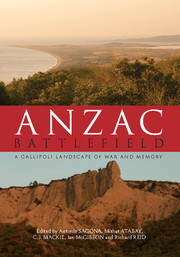
Anzac Battlefield is the outcome of the first tri-national, interdisciplinary survey (not excavation) of the Anzac area using modern archaeological techniques. It is an effort to document what remains on the surface at Anzac a century on. Drawing on five years (2010–14) of meticulous research, the past and present combine in this book to give us a picture of Gallipoli in its ancient context, as a battlefield in 1915, through its development into a commemorative site, and as a site of significance today. The book provides new insights into Gallipoli through an examination of the battlefield itself as both a constructed and a symbolic space.
Information
- Type
- Chapter
- Information
- Anzac BattlefieldA Gallipoli Landscape of War and Memory, pp. v - viiiPublisher: Cambridge University PressPrint publication year: 2016
Accessibility standard: Unknown
Why this information is here
This section outlines the accessibility features of this content - including support for screen readers, full keyboard navigation and high-contrast display options. This may not be relevant for you.Accessibility Information
Accessibility compliance for the PDF of this chapter is currently unknown
and may be updated in the future.