Book contents
- Frontmatter
- Contents
- Figures
- Contributors
- Acknowledgments
- Introduction: Debating the Consensuses
- PART I Deconstructing the Beijing Consensus
- PART II Examining the Beijing Consensus in Context
- PART III Revisiting the Beijing Consensus
- 9 Authoritarian Justice in China: Is There a “Chinese Model”?
- 10 China's Striking Anticorruption Adventure: A Political Journey Toward the Rule of Law?
- 11 Chinese Corporate Capitalism in Comparative Context
- Bibliography
- Index
11 - Chinese Corporate Capitalism in Comparative Context
from PART III - Revisiting the Beijing Consensus
Published online by Cambridge University Press: 28 April 2017
Edited by

Book contents
- Frontmatter
- Contents
- Figures
- Contributors
- Acknowledgments
- Introduction: Debating the Consensuses
- PART I Deconstructing the Beijing Consensus
- PART II Examining the Beijing Consensus in Context
- PART III Revisiting the Beijing Consensus
- 9 Authoritarian Justice in China: Is There a “Chinese Model”?
- 10 China's Striking Anticorruption Adventure: A Political Journey Toward the Rule of Law?
- 11 Chinese Corporate Capitalism in Comparative Context
- Bibliography
- Index
Summary
Capitalism will be much more robust if it's not a monopoly of the West, but flourishes in societies with different cultures, religions, histories, and political systems.
Introduction
The “Beijing Consensus” is a broad label applied to China's approach to economic governance, one in which the state plays a pervasive role and (at least in theory) markets serve the higher interests of national development. As such, the Beijing Consensus may be an alternative term for “state capitalism,” a concept that has attracted considerable attention due to China's spectacular economic growth. These labels suggest something unique about China's developmental path. However, the Chinese economy shares with all other developed and developing economies a key feature: corporate capitalism. That is, the central actors in the Chinese economy are legal entities enjoying separate and perpetual existence, governed ostensibly by a board of directors and appointed managers, with ownership interests represented by shares held by the providers of capital.
Using this fundamental commonality as a starting point, this chapter looks behind the “Beijing Consensus” or “state capitalism” by briefly examining Chinese corporate capitalism in comparative context, with particular reference to other countries that have influenced China's approach to economic organization: Japan, South Korea, and Singapore. It seeks to distill the common and distinctive features of China's approach to corporate capitalism, explain their existence in the context of the Chinese political economy, and examine the feasibility and normative appeal of replicating Chinese corporate capitalism in other developing countries. Simply put, the chapter asks what is unique about Chinese corporate capitalism and whether those unique elements can or should be transplanted elsewhere.
To briefly state the conclusions, the chapter argues that the organizational foundation of Chinese state capitalism is not particularly unique, because state capitalism is a species of corporate capitalism. The corporate form – with its inherent characteristics – lends a familiar structure even to a form of economic organization that looks novel (or sinister) to outside observers. Yet the chapter argues that Chinese corporate capitalism does have some distinctive features, namely “party centrality” and “institutional bridging” (concepts elaborated below), although they have rough functional parallels in the comparison countries. These distinctive features are mostly a matter of degree, yet they suggest shifting emphasis in the Chinese case from “state” capitalism to “party-state” capitalism.
Information
- Type
- Chapter
- Information
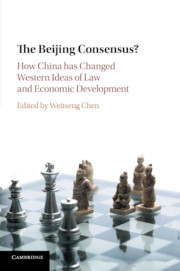
- The Beijing Consensus?How China Has Changed Western Ideas of Law and Economic Development, pp. 275 - 300Publisher: Cambridge University PressPrint publication year: 2017
Accessibility standard: Unknown
Why this information is here
This section outlines the accessibility features of this content - including support for screen readers, full keyboard navigation and high-contrast display options. This may not be relevant for you.Accessibility Information
Accessibility compliance for the PDF of this chapter is currently unknown
and may be updated in the future.
- 2
- Cited by