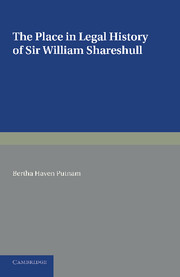
Book contents
- Frontmatter
- Contents
- GENERAL EDITOR'S PREFACE
- Preface
- Introduction
- Abbreviations
- CHAPTER I FAMILY AND ESTATES: History of the Shareshull family and of their landed estates, with special reference to the chief justice
- CHAPTER II PROFESSIONAL CAREER: Shareshull's elementary and legal education; his career as pleader and as judge; his appointments to common pleas, king's bench and exchequer, also to innumerable commissions, special and general
- CHAPTER III PUBLIC AFFAIRS: Shareshull's relations with the king on diplomatic missions and in parliament and council; his work on the private domains of the Black Prince
- CHAPTER IV LEGISLATION: Shareshull's part in framing ordinances and statutes, especially the legal and economic enactments of 1349-52
- CHAPTER V LAW ENFORCEMENT: Shareshull's policy of law enforcement, and of the imposition of huge financial penalties by means of commissions of oyer and terminer and of eyres, by the development of the justices of the peace and of the justices of labourers, and by a novel use of the king's bench
- CHAPTER VI STAFF AND EXPENSES: The enrolment and the preservation of proceedings before Shareshull; his group of trained clerks; arrangements for travelling and for transporting documents, for housing, food and clothing; annual stipends and daily fees
- CHAPTER VII SHARESHULL AND SHARDELOW: An account of the confusion between William Shareshull and his colleague John Shardelow; an attempt at disentangling them
- CHAPTER VIII LEGAL DOCTRINE:Shareshull's judicial pleadings and opinions: his legal thought in general, his learning, his doctrines of private law and of criminal law
- CHAPTER IX VINDICATION OF CHARACTER: Analysis of the charges against Shareshull and of the attitude of his contemporaries towards him; reasons for his retirement to a Franciscan convent
- CHAPTER X His PLACE IN HISTORY: An estimate of Shareshull's personality and of his significance for legal, economic and administrative history
- APPENDIXES
- NOTES
- List of statutes cited
- List of reports of cases cited
- Index
CHAPTER VIII - LEGAL DOCTRINE:Shareshull's judicial pleadings and opinions: his legal thought in general, his learning, his doctrines of private law and of criminal law
Published online by Cambridge University Press: 05 June 2016
Book contents
- Frontmatter
- Contents
- GENERAL EDITOR'S PREFACE
- Preface
- Introduction
- Abbreviations
- CHAPTER I FAMILY AND ESTATES: History of the Shareshull family and of their landed estates, with special reference to the chief justice
- CHAPTER II PROFESSIONAL CAREER: Shareshull's elementary and legal education; his career as pleader and as judge; his appointments to common pleas, king's bench and exchequer, also to innumerable commissions, special and general
- CHAPTER III PUBLIC AFFAIRS: Shareshull's relations with the king on diplomatic missions and in parliament and council; his work on the private domains of the Black Prince
- CHAPTER IV LEGISLATION: Shareshull's part in framing ordinances and statutes, especially the legal and economic enactments of 1349-52
- CHAPTER V LAW ENFORCEMENT: Shareshull's policy of law enforcement, and of the imposition of huge financial penalties by means of commissions of oyer and terminer and of eyres, by the development of the justices of the peace and of the justices of labourers, and by a novel use of the king's bench
- CHAPTER VI STAFF AND EXPENSES: The enrolment and the preservation of proceedings before Shareshull; his group of trained clerks; arrangements for travelling and for transporting documents, for housing, food and clothing; annual stipends and daily fees
- CHAPTER VII SHARESHULL AND SHARDELOW: An account of the confusion between William Shareshull and his colleague John Shardelow; an attempt at disentangling them
- CHAPTER VIII LEGAL DOCTRINE:Shareshull's judicial pleadings and opinions: his legal thought in general, his learning, his doctrines of private law and of criminal law
- CHAPTER IX VINDICATION OF CHARACTER: Analysis of the charges against Shareshull and of the attitude of his contemporaries towards him; reasons for his retirement to a Franciscan convent
- CHAPTER X His PLACE IN HISTORY: An estimate of Shareshull's personality and of his significance for legal, economic and administrative history
- APPENDIXES
- NOTES
- List of statutes cited
- List of reports of cases cited
- Index
Summary
HIS LEGAL THOUGHT IN GENERAL
As far as Shareshull's personal interests and opinions can be inferred from the narrative of his public life, it is clear that much of his legal thinking had been expressed in practical measures—such as the formulation of statutes, and of effective means for their enforcement through novel expedients for the punishment of offenders, through the development of existing types of justices or the creation of new ones. Even without listening to him in court, I feel sure, from the evidence on his relation to labour legislation and to the maintenance of the peace of the realm, that he wished to keep labourers in their place, that he favoured a strong central government, that he meant by all possible methods to discourage corruption of officials and to check violence, whether committed by members of the upper or of the lower classes. In its outward acts his religion conformed with that of his times and included the bestowal of gifts upon, and affording protection to, monastic houses, and probably attendance, in his rare moments of leisure, at Steeple Barton church, only a short walk across the fields from his home in Barton Odonis. But his conventional appeal to God in a letter to the abbot of Glastonbury is in striking contrast to his cynical remarks in court. He had the aim, fashionable among his contemporaries, of accumulating landed property through purchase and through suitable marriages for himself and his children, and even for his widowed mother. That a lawyer, versed in common law and therefore in the habit of looking to past precedents, should normally hold many conservative views, was as natural in the fourteenth as it is in the twentieth century, and Shareshull was no exception.
Although the age of Edward III was not an age of formal jurisprudence and was singularly lacking in the composition of legal and political treatises, it was a particularly interesting transition period in England, not only for economic and social conditions, but also for the development of political and judicial institutions and concepts that were to make possible the clear-cut definitions of later centuries, the sixteenth and especially the seventeenth—definitions that included the meaning of statute, the relation of parliament to common law, or the concept of sovereignty.
Information
- Type
- Chapter
- Information
- The Place in Legal History of Sir William ShareshullChief Justice of the King's Bench 1350–1361, pp. 103 - 134Publisher: Cambridge University PressPrint publication year: 2013
Accessibility standard: Unknown
Why this information is here
This section outlines the accessibility features of this content - including support for screen readers, full keyboard navigation and high-contrast display options. This may not be relevant for you.Accessibility Information
Accessibility compliance for the PDF of this chapter is currently unknown
and may be updated in the future.